
Kim Jong Un: The Rise, Ruthless Rule and Dark Secrets of North Korea’s Supreme Leader
From secret schooling in Switzerland to political purges, nuclear weapons and an armored luxury train—inside the mysterious life of the world’s most feared dictator

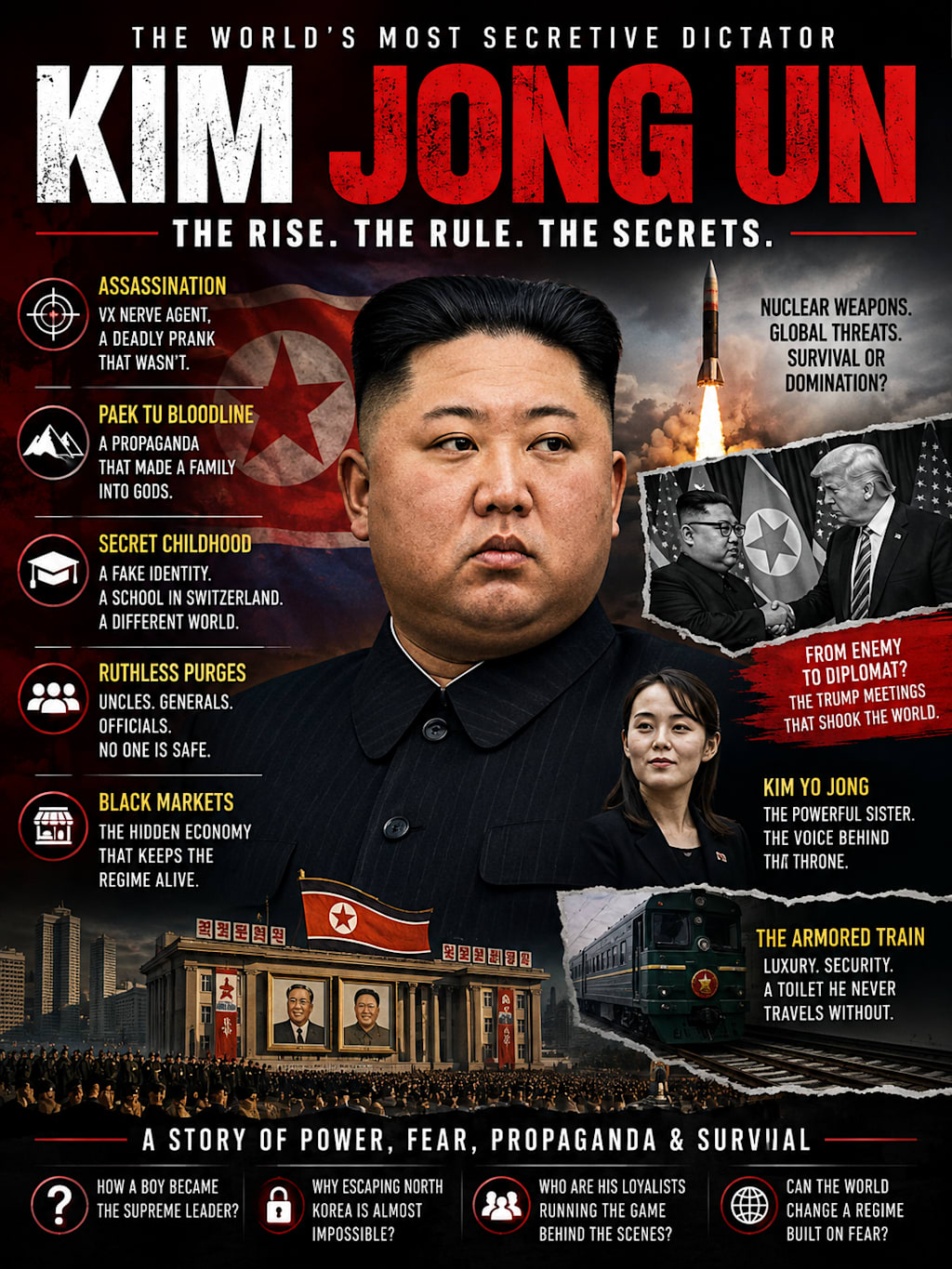
On February 13, 2017, a man entered Kuala Lumpur International Airport in Malaysia. Moments later, two women approached him and rubbed a substance across his face. The incident initially looked like a strange television prank, but within minutes, the man began struggling to breathe.
He desperately moved toward the airport’s medical centre before collapsing. He later died after being exposed to the deadly VX nerve agent.
The victim was Kim Jong Nam, the estranged half-brother of North Korean leader Kim Jong Un.
The two women involved reportedly believed that they were participating in a hidden-camera prank. Investigators later alleged that they had unknowingly become part of a carefully planned assassination. Although North Korea denied involvement, the killing became one of the most shocking incidents associated with Kim Jong Un’s secretive regime.
However, Kim Jong Nam’s death was only one chapter in the much larger story of North Korea’s ruling family.
The Beginning of the Kim Dynasty
Japan controlled Korea from 1910 until the end of World War II in 1945. After Japan’s defeat, Korea was divided along the 38th parallel.
The Soviet Union supported the communist government in the North, while the United States supported the government in the South. Kim Il Sung became the first leader of North Korea and established a political system centred around his personality and family.
North Korean propaganda presented Kim Il Sung as a heroic revolutionary who fought against Japanese occupation. His family was connected with Mount Paektu, a mountain considered sacred in Korean culture.
The idea later became known as the “Paektu bloodline.” It was used to portray the Kim family as uniquely qualified—almost divinely chosen—to govern North Korea.
When Kim Il Sung died in 1994, power passed to his son, Kim Jong Il. After Kim Jong Il’s death in December 2011, his youngest son, Kim Jong Un, became the third generation of the family to rule the country.
Kim Jong Un’s Secret Childhood
Kim Jong Un is believed to have been born in the early 1980s, although even basic information about his life remains difficult to confirm because of North Korea’s secrecy.
Unlike most North Korean children, Kim reportedly grew up surrounded by luxury. During the 1990s, he was sent to Switzerland for education under a false identity.
He attended school near Bern and was presented as the child of a North Korean diplomat. Former classmates described him as a quiet student who enjoyed basketball, video games and Western culture.
His years in Switzerland allowed him to experience a lifestyle completely different from the tightly controlled society created by his family. Nevertheless, when he returned home, he was trained in military affairs and politics.
Kim Jong Un was not initially the obvious successor. His older half-brother, Kim Jong Nam, was once considered a possible future leader. However, Kim Jong Nam lost favour after being caught attempting to enter Japan with a false passport, reportedly to visit Tokyo Disneyland.
Another brother, Kim Jong Chol, was reportedly considered unsuitable for political leadership. Kim Jong Un gradually emerged as his father’s preferred successor and was publicly introduced as the future leader in 2010.
Taking Power at a Young Age
Kim Jong Un was still in his late twenties when he took control of North Korea in 2011. His age created uncertainty among senior military officers and political officials who had served under his father.
To strengthen his position, Kim reorganised the country’s leadership and removed individuals who could potentially challenge him.
One of the most dramatic cases involved his uncle, Jang Song Thaek. Jang was considered one of North Korea’s most powerful officials and had played an important role in trade relations with China.
In 2013, he was publicly removed from a political meeting, accused of corruption and treason, and executed shortly afterward.
Numerous other officials reportedly disappeared, were imprisoned or were executed during Kim’s consolidation of power. Because independent access to North Korea is extremely limited, the exact number and circumstances of many alleged executions remain difficult to verify.
Still, the message was unmistakable: no military officer, government official or family member was powerful enough to challenge the supreme leader.
Life Inside North Korea
North Korea is one of the world’s most controlled societies. The government dominates television, radio, newspapers and public communication.
Citizens have limited access to foreign media and the global internet. Watching unauthorised foreign entertainment or criticising the government can lead to severe punishment.
Local surveillance networks reportedly monitor neighbourhoods and report suspicious behaviour. Travel between different regions of the country may also require official permission.
The personality cult surrounding the Kim family remains central to the system. Portraits of Kim Il Sung and Kim Jong Il are displayed in homes and public buildings, while schools teach carefully prepared versions of the family’s history.
Military service is compulsory for many citizens, and the armed forces continue to play a major role in North Korean society.
The Markets That Helped the Regime Survive
During the 1990s, North Korea experienced a devastating famine after the collapse of the Soviet Union, natural disasters and failures in the government-controlled food distribution system.
As official supplies disappeared, ordinary people began trading food and household products through informal markets known as “jangmadang.”
Instead of completely eliminating these markets, the government gradually tolerated parts of the system. Under Kim Jong Un, some private economic activity continued despite North Korea officially remaining a socialist state.
The markets helped citizens survive while also producing a new class of wealthy traders sometimes called “donju,” meaning “masters of money.”
These traders may finance construction projects, transportation businesses and unofficial commercial operations. In return, they depend heavily on relationships with party officials and government institutions.
The arrangement creates a strange economic balance: private profit exists, but only as long as it does not threaten the authority of the state.
Nuclear Weapons and Conflict With America
North Korea has spent decades developing nuclear weapons and long-range ballistic missiles.
The government argues that these weapons are necessary to protect the country from the United States and its allies. American forces remain stationed in South Korea, and military exercises between the United States and South Korea are regularly described by Pyongyang as preparations for an invasion.
In 2017, North Korea tested intercontinental ballistic missiles that appeared capable of reaching parts of the United States. The tests caused international concern and led to stronger economic sanctions.
Surprisingly, Kim Jong Un later changed his diplomatic strategy.
In June 2018, he met US President Donald Trump in Singapore. It was the first meeting between a sitting American president and a North Korean leader.
The summit provided Kim with international recognition and allowed him to present himself as a confident statesman rather than only a threatening dictator.
A second summit took place in Hanoi, Vietnam, in February 2019. However, the negotiations ended without an agreement because the two sides could not resolve their differences over nuclear disarmament and sanctions relief.
Trump and Kim met again at the Korean Demilitarized Zone in June 2019, but the discussions failed to produce a lasting breakthrough.
Kim Yo Jong: The Powerful Sister
One of the most influential people surrounding Kim Jong Un is his younger sister, Kim Yo Jong.
She has played a major role in propaganda, diplomacy and political communication. During the 2018 Winter Olympics in South Korea, she became the first member of North Korea’s ruling family to visit the South since the Korean War.
Her carefully managed public appearance helped present North Korea as open to diplomacy.
However, she has also issued aggressive statements against South Korea and the United States. Her growing influence has led many observers to consider her one of the most powerful figures in the country.
Kim Jong Un may represent the public face of leadership, but Kim Yo Jong has increasingly become the regime’s political voice and one of her brother’s most trusted advisers.
The Mystery of Kim’s Armored Train
Kim Jong Un frequently travels aboard a heavily protected train instead of using an aircraft.
Train travel has become a family tradition. His grandfather, Kim Il Sung, travelled extensively by train, while his father, Kim Jong Il, reportedly avoided flying whenever possible.
Kim’s train is believed to contain meeting rooms, bedrooms, communication systems and extensive security equipment. Its heavy armour makes it slower than a normal passenger train but offers greater protection against attacks.
Kim is also reported to travel with a personal toilet. Former officials have claimed that his security team prevents biological material from being left behind because it could reveal information about his health.
As with many stories surrounding North Korea’s leadership, some details remain impossible to independently confirm. Nevertheless, the reports demonstrate the extraordinary secrecy and security surrounding the supreme leader.
A Modern Image With an Authoritarian Reality
Kim Jong Un has tried to modernise his public image by building ski resorts, amusement parks, apartment towers and coastal tourism projects.
He frequently appears with his wife, Ri Sol Ju, and has presented his family as a modern ruling household. State media has shown him smiling with children, visiting construction sites and attending cultural events.
Yet behind this softer image remains an authoritarian system built on surveillance, censorship, political prisons and military power.
Kim Jong Un wants the world to see him as a modern leader capable of diplomacy. At the same time, he continues to protect the political system inherited from his father and grandfather.
Final Thoughts
For more than seven decades, the Kim family has maintained control over North Korea through propaganda, isolation, military strength and fear.
Kim Jong Un’s life contains extraordinary contradictions. He studied in democratic Switzerland but governs one of the world’s most restricted countries. He promotes luxury resorts while many citizens struggle economically. He meets world leaders while continuing to expand military capabilities.
His international appearances may suggest change, but North Korea remains deeply isolated.
The biggest question is not simply how Kim Jong Un gained power. It is how long the political system created by his family can survive in a world where information, technology and communication are becoming increasingly difficult to control.
Until North Korea opens its doors to independent observers, the full truth about Kim Jong Un, his family and his regime will remain hidden behind one of the most secretive borders on Earth.
About the Creator
parwinder singh
🎬 Movie & Entertainment Writer sharing reviews, ending explanations, story breakdowns, plot twists and hidden details from Bollywood, Hollywood, South Indian cinema, Korean dramas and OTT releases.
Enjoyed the story? Support the Creator.
Subscribe for free to receive all their stories in your feed.
Comments
There are no comments for this story
Be the first to respond and start the conversation.