
It's the Debate that Failed Last Night, Not Biden
Some Thoughts on Thursday's Presidential Debate

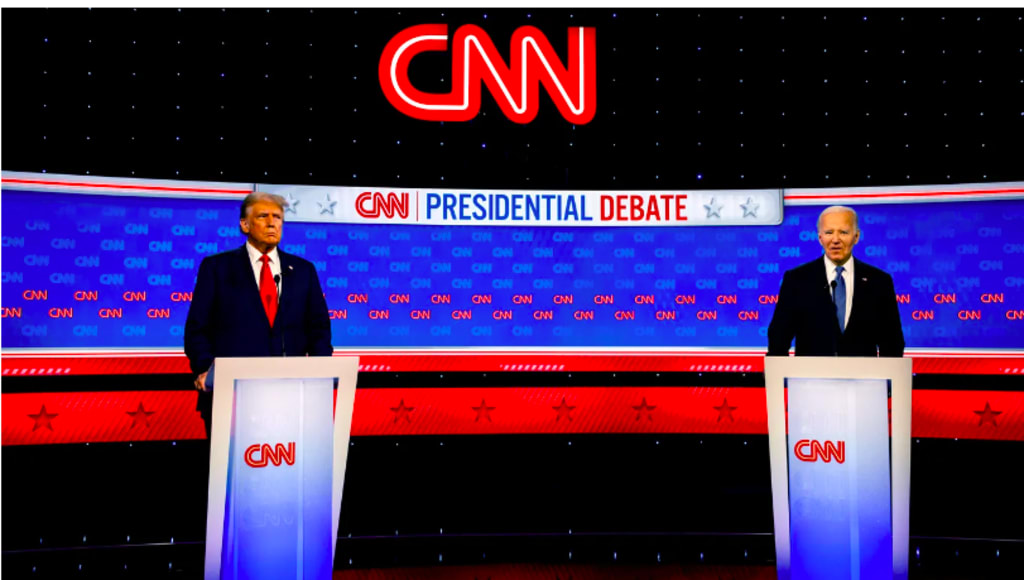
It's been two days since the Presidential debate on CNN. Biden tried to say decent, ethical things but delivered most of his words poorly; Trump spoke much more clearly but said vile things and lied just about every time he opened his mouth (lies which the CNN moderators failed to call out).
What are we to think about all of this?
I would say it's that debates shouldn't matter as much as they seem to. JFK looked better on TV than did Nixon, and a majority of people who saw the two on TV thought Kennedy won. A much smaller number of people heard the same debate on radio, and thought Nixon won. That event certainly demonstrated the importance of debates. But though JFK proved to be an excellent President, the fact that he won the debate was really no indication that JFK would do so well in office. The debates, in other words, were very valuable windows into the effects of media in politics, not indicators of the political character and acumen of the candidates.
It's plain logic that what a President does in office has nothing to do with the President's voice quality or appearance. FDR was in a wheelchair throughout his presidency. He connected to the American people in an age before television via his fireside chats on radios. Few people knew he was in a wheelchair. Most historians agree that he was our very best President, getting the United States out of the Great Depression, and guiding us and our allies to victory in the Second World War.
I've spent my professional life as a professor of media and an author talking about the importance of televised debates, how candidates look and sound on television. JFK won the debate with Nixon because because by 1960 more than 90-percent of Americans had television in their homes and JFK looked so good. Reagan prevailed over Mondale by making a savvy joke about not making the younger age of his opponent an issue. Obama faltered in his first debate with Romney but came back strong in their second nationally televised conversation. But maybe it's time to focus on what debates really are: a 90-minute performance on camera that has little to do with what the candidate did, is doing, or will do in office. The truth is that the skills needed to be an effective debater have nothing to do with the skills needed to be an effective President. Never did, never will. Maybe it's long since time that we recognized that.
Marshall McLuhan was the first to point out that JFK won the 1960 debates and then the election because he performed so well on television, in contrast to Nixon who was judged as winning the debates on their radio broadcasts that so few people listened to. McLuhan made this observation in Understanding Media (1964), whose breakthrough message was "the medium is the message". The view that Biden's poor performance in Thursday's debate means he's no longer fit to be President strikes me as an egregious case of mistaking the medium (the debate) for the message (Biden's been doing a superb job as President).
Or, to paraphrase Shelley, maybe it's the debate that failed on Thursday night, not Biden.
***
And Biden amply demonstrated his power to effectively communicate in a rip-roaring speech in North Carolina the day after the debate, on Friday, June 28th, afternoon. Again, a debate is a unique mode of communication, which not only has nothing to do with Presidential decision-making and other Chief Executive activity, but not much in common with speech-making, interviews, and other kinds of communication, either.
But also on Friday, June 28th, The New York Times' editorial board, lamenting Biden's weak performance in Thursday's Presidential debate, called on Joe Biden to leave the race. They didn't say a word about Biden's speech in North Carolina. What are we to make about such an unprecedented call from the editors of what used to be known as the newspaper of record? I would say this is just more evidence of the decline of a once-great newspaper. See my What's Wrong with The New York Times for an example this past Fall of what I'm talking about.
About the Creator
Paul Levinson
Novels The Silk Code, The Plot To Save Socrates, It's Real Life: An Alternate History of The Beatles; LPs Twice Upon A Rhyme & Welcome Up; nonfiction The Soft Edge & Digital McLuhan, translated into 15 languages. Prof, Fordham Univ.
Enjoyed the story? Support the Creator.
Subscribe for free to receive all their stories in your feed. You could also become a paid subscriber, letting them know you appreciate their work.
Comments
There are no comments for this story
Be the first to respond and start the conversation.