
Is Free Speech in the UK Under Pressure?
The Growing Debate Over Speech, Social Media and Policing
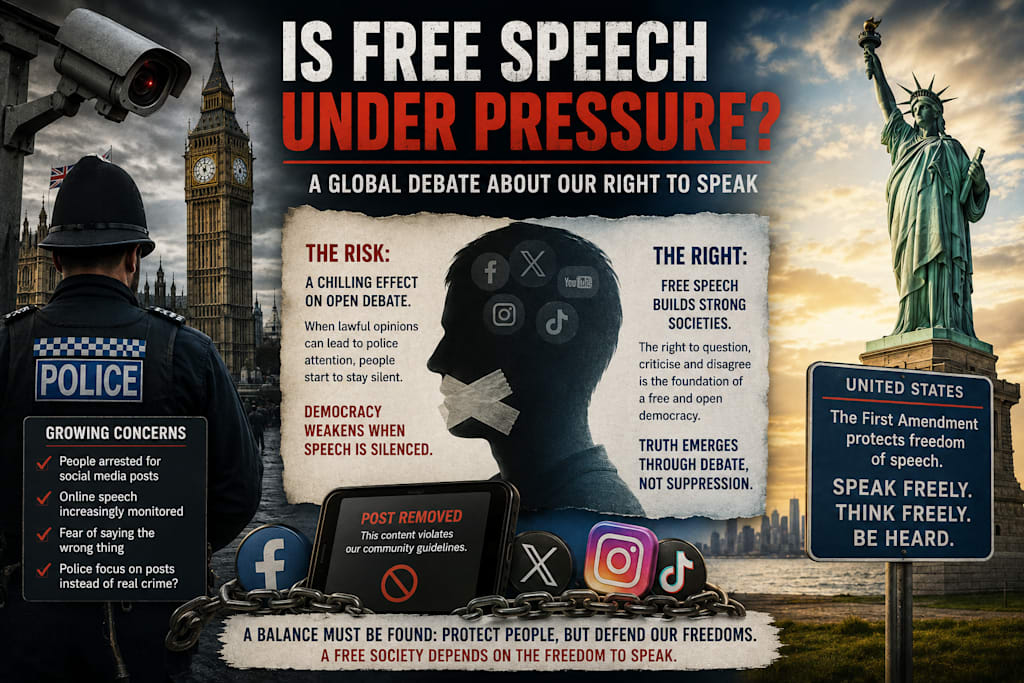
Free speech has always been one of the foundations of a democratic society. The ability to question governments, criticise public policy, challenge accepted ideas and express unpopular opinions allows societies to correct mistakes and hold those in power accountable. Without the freedom to speak openly, democracy itself becomes weaker.
In recent years, however, many people have become increasingly concerned about the balance between protecting individuals from harm and protecting freedom of expression. Social media platforms such as X, YouTube and Facebook have become the modern public square, where political debate, news and personal opinions are shared instantly with millions of people. They have also become places where governments, regulators and the police have taken a greater interest in what people say online.
Many people believe this has created a chilling effect. They worry that expressing controversial opinions, even where no violence is advocated, could lead to police attention, investigation or prosecution. Whether those fears are justified in every case is open to debate, but the perception itself has become an important political issue.
Supporters of stronger regulation argue that online platforms can spread harassment, intimidation, fraud, terrorism and incitement at unprecedented speed. They believe laws are needed to protect vulnerable people and maintain public order. Few would argue that genuine threats of violence, organised criminal activity or targeted harassment should be beyond the reach of the law.
The more difficult question is where the boundary should be drawn. Democracies have always accepted that some forms of speech are unlawful. Defamation, direct threats, incitement to violence and certain forms of harassment have long been restricted. The concern arises when people believe that lawful political opinions, criticism of government policy or robust public debate could also become subject to official scrutiny.
Critics argue that police resources are limited and should primarily be directed towards investigating burglary, robbery, violent crime, organised crime, shoplifting and fraud. When stories emerge of police investigating social media posts, some members of the public question whether those resources are being deployed in the most effective way. Others respond that online offences can have real-world consequences and should not simply be ignored. The challenge for any police force is deciding how to prioritise competing demands while maintaining public confidence.
The United States is often cited in these discussions because its constitutional protection of free speech under the First Amendment is among the strongest in the world. American law generally permits a wider range of speech than many European countries, although even in the United States there are recognised exceptions, including true threats, certain forms of incitement and defamation.
The United Kingdom has taken a different legal approach. Parliament has enacted laws dealing with areas such as malicious communications, harassment, public order and online safety. Supporters argue these measures help protect individuals and communities from genuine harm. Critics argue that some laws can be interpreted too broadly, potentially discouraging legitimate public debate.
Ultimately, this is not simply a legal question but a philosophical one. A free society depends upon the ability of people to disagree, sometimes strongly, without fearing disproportionate consequences for expressing lawful opinions. Equally, a civil society requires that freedom be exercised responsibly and without threatening or intimidating others.
The challenge facing every democracy is finding the right balance. Too little regulation risks allowing intimidation, abuse and criminal activity to flourish. Too much regulation risks discouraging honest debate and weakening one of the freedoms that distinguishes democratic societies from authoritarian ones.
George Orwell's 1984 is frequently invoked in modern political debate because it portrays a society in which the state exercises extensive control over information, language and individual behaviour. Some critics argue that certain developments in the United Kingdom, including increased surveillance, greater regulation of online speech and the growing role of technology in monitoring daily life, raise questions that echo themes explored in Orwell's novel. Others strongly disagree, pointing out that the UK remains a parliamentary democracy with an independent judiciary, free elections, a diverse media landscape, and legal protections that are fundamentally different from those of the totalitarian regime depicted in 1984. The comparison is therefore best understood as a warning about the importance of safeguarding civil liberties and maintaining public debate, rather than as a literal description of modern Britain.
Whatever one's political views, it is healthy for citizens to question where that balance lies. Open discussion about free speech should not itself become something that people fear. Democracies are strongest when ideas can be debated openly, governments can be criticised without fear, and the law protects both public safety and the fundamental right to express lawful opinions.
The debate over free speech is unlikely to disappear. As technology continues to evolve and more of public life takes place online, societies will continue to wrestle with the same question that has existed for centuries: how to preserve freedom while protecting people from genuine harm. The answer will shape not only the future of social media but the character of democracy itself.
About the Creator
Alan Spencer
Have been an author and writer for over 20 years. Have been a journalist, editor, proofreader, and a designer and presenter of training courses. Have written over 100 articles, two books, and around 20 training courses.
Enjoyed the story? Support the Creator.
Subscribe for free to receive all their stories in your feed. You could also become a paid subscriber, letting them know you appreciate their work.
Comments
There are no comments for this story
Be the first to respond and start the conversation.