
Both Sides Released Eight Points. The $30 Billion Is the Least Important Part.
The U.S. and Chinese readouts tell different stories. Put them side by side and you can see what the deal actually does, what it avoids, and where the next fight starts.
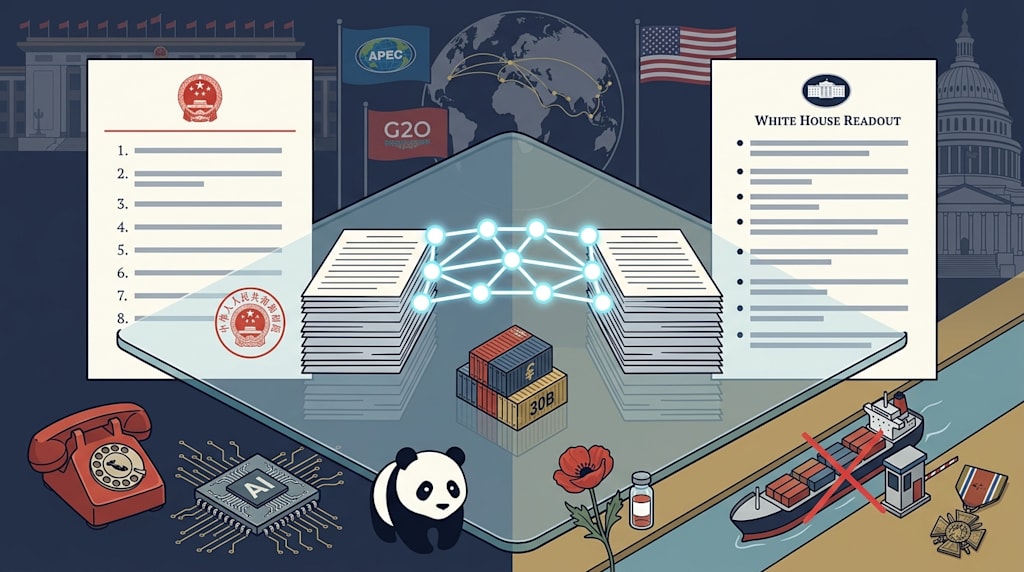
In September 2026, China and the United States released eight points from their leaders’ meeting. Most coverage focused on a $30 billion tariff cut. The more important shift is in how the two countries manage the relationship. They are moving from emergency responses to standing procedures.
The clearest way to see this is to read both official summaries together. China’s version gives the frame. The U.S. version adds demands and footnotes. Together they show the deal’s solid parts, its blank spots, and the next round of bargaining.
1. The framework matters more than the money
The first point calls for a “China-U.S. constructive strategic stability relationship based on respect, fairness, and reciprocity.” That phrase is not new. Putting it first, however, makes it the operating frame. For now, the relationship is not defined by decoupling or full confrontation. It is defined by stability.
Two pieces support that frame. First, both sides will support each other’s APEC and G20 hosting duties, and both leaders plan to attend the other’s meetings. Second, the two militaries will sign a memorandum on crisis communication and prevention as soon as possible. They will also keep searching for the remains of missing U.S. service members in China. Miscalculation is the biggest risk between great powers. A military hotline is a guardrail.
2. The tariff cut is reciprocal
The economic package is the most concrete part. The two sides agreed to a $30 billion reciprocal tariff reduction and extended the Kuala Lumpur consultations. The U.S. list includes agricultural goods, fish and seafood, logs and wood products, cosmetics, and medical devices. China’s list includes small appliances, toys, holiday decorations, and child safety seats.
The size is modest. The design matters more.
Both sides picked goods that are politically useful but not strategically sensitive. Each government can show a win at home without upsetting security hawks.
The cut is two-way. China’s readout stresses “reciprocal.” The U.S. list is also two-way. That means China held the line on equality.
The deal extends earlier consultation results. The Kuala Lumpur truce did not collapse. It is being stretched into a longer cycle.
The bigger change is the Trade Council and Investment Council. The U.S. readout says they will create a “structured channel” for investment opportunities and barriers. China says the two sides will “establish and advance” these mechanisms. In plain terms, economic talks now have a permanent table. When friction appears, the two sides do not have to call the leaders first. They can send officials to work the problem. That is what “constructive strategic stability” looks like in practice.
3. Counter-narcotics and AI are trust tests
Counter-narcotics is the area with the fewest disputes. The two sides broke several cases involving new psychoactive substances and precursor chemicals. They arrested dozens of suspects in both countries. The U.S. had used fentanyl to justify a 20% tariff on China. That tariff is still in place. China’s cooperation is both a signal and a concrete action. It shows that law enforcement cooperation can produce results.
AI is the slowest area. The two sides agreed to a China-U.S. AI dialogue on risks and benefits. The next meeting is in November. They also set up a channel for AI incidents.
The language differs. China calls it an “AI dialogue.” The U.S. calls it a “superintelligence dialogue.” That gap shows different priorities. Washington wants to talk about frontier competition. Beijing wants risk communication and a working channel. Either way, the two sides now have a pipe. In a field where the U.S. has gone all in, building a pipe before writing rules is progress.
4. Iran, World War II, and pandas
Only one point deals with an outside issue. Both sides agree that Iran should not develop nuclear weapons. They also agree that no country or institution should charge tolls on international waterways.
That sounds simple. It is also useful. Trump has complained that China supports Iran. By moving toward the U.S. position on Iran’s nuclear program and waterway tolls, China restates its own policy. It also sends a message: Iran’s endurance is not China’s doing. The waterway line is broad. If the U.S. later tries to charge tolls on other waterways, China can oppose that too.
Another point recalls that China and the U.S. were allies in World War II. That reference carries a claim about the postwar order. The UN Charter, international law, and the basic norms of international relations came out of that war. Taiwan’s independence push, the Philippines’ South China Sea moves, and Japan’s effort to loosen its constraints all challenge that order. The World War II reference is a warning.
Then there are the pandas. China loaned a pair to Zoo Atlanta. The U.S. welcomed them. It is a soft signal. It also shows the temperature between the two countries.
5. What the U.S. readout adds
Read the two summaries side by side and you find items in the U.S. version that China does not mention.
The U.S. says China should increase refined petroleum output to stabilize global supply. It says China will import at least 10 million metric tons of U.S. coal in 2027 and 2028. It also raises concerns about rare earths and critical minerals. Washington wants China to restore shipments to normal levels.
These three items show where the U.S. needs China. Trump once said in front of Takaichi Sanae that “China is our big customer.” These points reflect that view.
China’s silence means they are not consensus. They are U.S. demands. Whether they happen depends on the next round of talks. That is where the next fight will be.
The same pattern appears elsewhere. Trade, counter-narcotics, and AI are on the table. Minerals are not. Energy talks focus on traditional fuels. The U.S. still pressures China’s new energy sector. There is no overall plan for industrial coordination. Decoupling will continue in many industries. There is also no plan to manage U.S. long-arm jurisdiction over Chinese industries and regions.
6. Talk and fight
This deal is a step beyond Trump’s May visit to China. There is now a document with real intersections. But it is only a start. The blank spaces need more agreements. That means the two countries are in a new stage: talk and fight under the banner of constructive strategic stability.
Talk and fight means negotiating while countering. Since Trump’s visit, the U.S. has moved on many fronts. It launched Section 301 investigations. It sanctioned Chinese firms over Xinjiang. It expanded the Defense Department’s 1260H list. It used Treasury sanctions. It tightened chip and hardware controls. It chased transshipment. Different agencies have acted like they are racing to hit quotas.
The pattern is clear. The U.S. is probing across the board. It links economic tools to security laws. Trump himself pushes sanctions. It uses panic and financial pressure. It tries to pull other countries into the fight.
So constructive strategic stability does not mean peace. It is a way to manage differences, not erase them. Stability comes from struggle. It lasts through mechanisms.
7. China’s next move
China’s approach should be simple: keep its own course, fight while building, and pair countermeasures with rule-making.
First, set quantitative standards for countermeasures. Last year’s trade war targeted tariff rates. This year, China can measure the losses of sanctioned firms, especially industry leaders. Those numbers can guide cuts in purchases from the U.S., tighter exports of critical materials, and higher costs for U.S. production and consumers. The focus should move from tariff rates to sales channels. After solving technology bottlenecks, China must watch for sales bottlenecks.
Second, connect countermeasures to regional strategy. China’s overseas interests are global. Its hard power is still regional. It should strike the worst cases and speed up integration with nearby markets. Southeast Asia and Central Asia to the Middle East to Europe are two wings. If both wings develop, the country’s position changes.
Third, support friendly countries against U.S. long-arm jurisdiction. Many Southeast Asian countries run large surpluses with the U.S. They face tariffs, transshipment probes, and poison-pill clauses. China should consider offering protection as integration deepens. That was a gap in last year’s trade war. It is a useful direction now.
Finally, keep countermeasures tied to the larger goal of stability. Since May, the U.S. has restrained itself somewhat on geopolitics. It has shifted to economic friction. China’s response proves it is an equal partner. That helps stabilize the relationship. Seek unity through struggle, and unity survives.
Conclusion
The $30 billion is not the main story. The main story is the framework and the mechanisms. The Trade Council, Investment Council, AI dialogue, and military crisis line are now part of the relationship. They move the two countries from crisis response to management.
But mechanisms are only bones. The flesh is still contest. U.S. demands, blank spaces, and new sanctions show that the relationship remains in a talk-and-fight stage. China should not expect one-time stability. It should seek stability through struggle, build rules through countermeasures, and strengthen itself through opening.
Stability has to be won and maintained. The eight points are a beginning. The next phase will test implementation, bargaining, and China’s ability to set its own rhythm under the framework of constructive strategic stability.
About the Creator
Jin
Writer of reamstories
https://reamstories.com/jin
Enjoyed the story? Support the Creator.
Subscribe for free to receive all their stories in your feed. You could also become a paid subscriber, letting them know you appreciate their work.
Comments
There are no comments for this story
Be the first to respond and start the conversation.