
6,198 Dead and Counting: The Middle East War the World Forgot to Name
Preliminary death tolls from the U.S.-Israeli strikes on Iran and the ongoing conflict are emerging. Here’s a clear-eyed look at what the numbers reveal — and what they don’t.
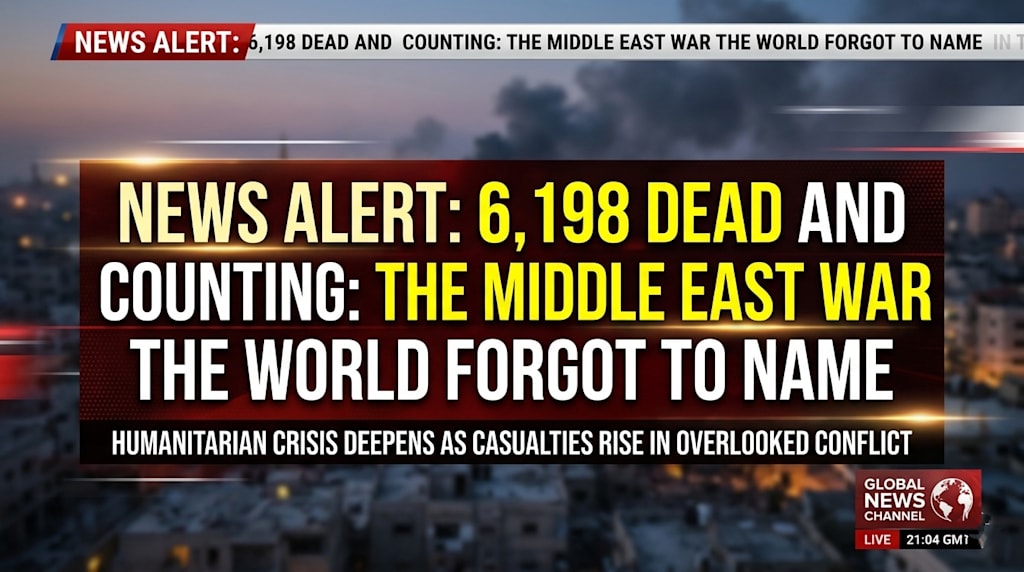
Wars are often defined not only by violence, but by language.
The names we give conflicts shape how societies understand them, justify them, remember them, and ultimately judge them. A named war becomes part of history. It acquires timelines, documentaries, academic debates, memorials, and political accountability. Governments explain why it began. Journalists track its progress daily. Citizens debate whether it should continue.
Unnamed wars are different.
They emerge gradually — one airstrike, one assassination, one retaliatory missile barrage at a time. They spread through proxy groups, cyberattacks, naval confrontations, sanctions, and covert operations. Without a formal declaration, they often drift into the background noise of modern media, appearing as disconnected headlines instead of components of a single escalating conflict.
That is precisely what is unfolding now between the United States, Israel, and Iran.
It does not yet have a universally accepted name.
But it already has thousands of dead.
The Scale of the Casualties
The preliminary death toll emerging from the region paints a picture of warfare on a scale the Middle East has not witnessed in years.
Inside Iran, approximately 3,468 people have reportedly been killed since the beginning of the conflict. In Lebanon, where Hezbollah entered the war in support of Tehran, an estimated 2,702 people have died. Across Gulf states targeted by Iranian missile and drone strikes, at least 28 fatalities have been confirmed.
And these are only the numbers currently visible.
In modern warfare, especially in heavily restricted conflict zones, early casualty figures almost always underestimate reality. Communication systems collapse. Hospitals become overwhelmed. Entire areas become inaccessible to independent verification teams. Civilian deaths frequently go unrecorded for weeks or months.
The true toll is almost certainly higher.
Behind every statistic is a name, a family, a funeral, and a future erased.
The Assassination That Changed the Region
The conflict escalated dramatically on February 28, 2026, when the United States and Israel launched what became known as Operation Epic Fury.
The coordinated strikes targeted Iranian military installations, nuclear infrastructure, missile facilities, and senior members of Iran’s leadership structure. Among those killed was Iran’s Supreme Leader, Ali Khamenei — an event that instantly transformed a long-running shadow conflict into open regional warfare.
The symbolic significance of Khamenei’s death cannot be overstated.
For decades, he represented continuity within the Islamic Republic. His assassination shattered longstanding assumptions about deterrence and red lines in the Middle East. Iran responded not as a state absorbing a military setback, but as a regime fighting for survival and prestige.
His son was rapidly elevated as successor, signaling Tehran’s determination to preserve political continuity even under direct attack.
Retaliation Across Multiple Fronts
Iran’s response came swiftly and on multiple fronts simultaneously.
Missiles struck Israeli cities and U.S. military bases located in the UAE, Qatar, and Bahrain. Hezbollah launched sustained rocket attacks from southern Lebanon into northern Israel, forcing mass evacuations and intensifying fears of a wider regional collapse.
Then came the move that shook the global economy: Iran effectively closed the Strait of Hormuz.
That single decision transformed the war from a regional security crisis into a worldwide economic emergency. Energy prices surged. Shipping routes froze. Insurance premiums exploded. Global markets began pricing in the possibility of a prolonged Middle Eastern conflict capable of disrupting the world’s energy supply chain.
Since a fragile ceasefire emerged in early April, the violence has continued in a lower-intensity but highly dangerous form.
This week alone, the United States confirmed strikes on Iranian-flagged oil tankers following attacks on American naval destroyers operating near Hormuz. Meanwhile, Israel launched a major strike on Beirut that reportedly killed the commander of Hezbollah’s elite Radwan force.
The ceasefire exists largely on paper.
The war continues in practice.
The Legal Fiction of “Not War”
Perhaps the strangest aspect of this conflict is its legal ambiguity.
Neither Washington nor Tehran has formally declared war.
Instead, the fighting exists inside a grey zone of modern conflict — conducted through executive orders, military operations, covert actions, proxy militias, and retaliatory strikes without the formal political architecture traditionally associated with war.
This ambiguity matters far more than most people realize.
In the United States, a formal declaration of war would require congressional authorization. It would trigger expanded legal obligations, greater public scrutiny, and clearer demands for military objectives and exit strategies. Internationally, formal war status would activate broader legal frameworks governing combat, occupation, and accountability.
By avoiding formal declarations, governments preserve flexibility.
But they also avoid responsibility.
The conflict proceeds through presidential speeches, social media announcements, intelligence briefings, and military press conferences while remaining politically undefined. The result is a war that behaves like a war, kills like a war, destabilizes economies like a war — yet officially exists in a category vague enough to avoid the full weight of democratic oversight.
History Will Eventually Name It
History rarely leaves major conflicts unnamed forever.
Eventually, historians, journalists, and political leaders will assign this conflict a title. It may become known as the Gulf Escalation, the Second Hormuz Crisis, the Iran-Israel War, or something else entirely.
But by the time history settles on a name, the human cost will likely be far greater than what we see today.
Because wars do not wait for official definitions.
People die whether governments formally acknowledge the conflict or not.
And until diplomacy overtakes escalation, more names will continue to be added to the toll before the world finally decides what to call it.
About the Creator
Enjoyed the story? Support the Creator.
Subscribe for free to receive all their stories in your feed.
Comments
There are no comments for this story
Be the first to respond and start the conversation.