
Three Carriers, One Deadline: Why the Middle East Window Is Already Closing
Three U.S. aircraft carriers are converging on the Arabian Sea. Their deployment clocks, the congressional calendar, and a stretched supply line are all counting down at once.
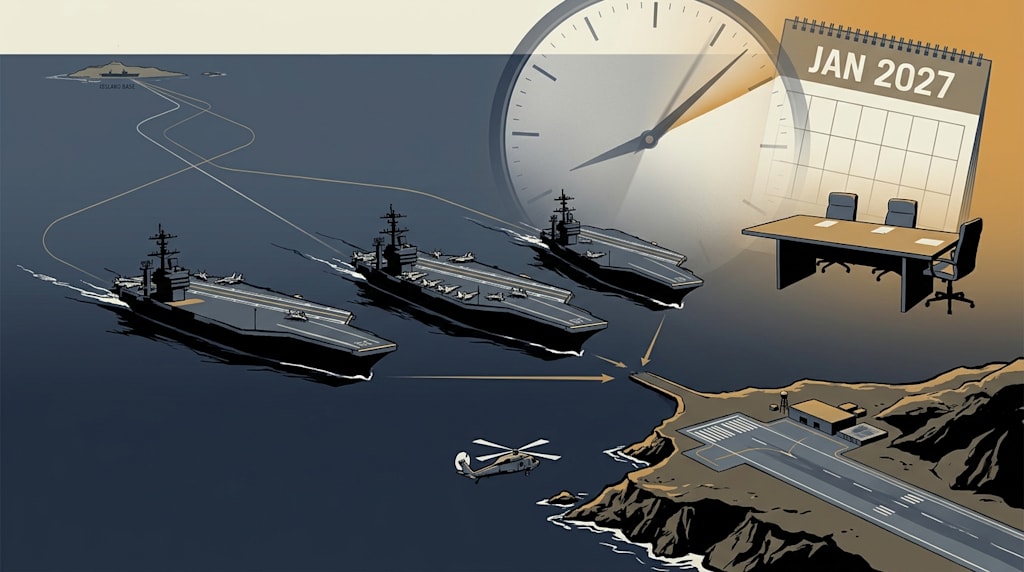
On November 9, 2026, the MH-60S “612” helicopter from the USS George H.W. Bush (CVN-77) once again shuttled to and from Muscat International Airport. The last time this route was observed was September 22.
That same week, the USS George Washington (CVN-73) was at 22.219°N, 62.291°E, heading 205°, speed 14 knots. The USS Theodore Roosevelt (CVN-71) left Singapore on the afternoon of the 8th, and two CMV-22Bs took off from Subang. The USS Makin Island (LHD-8) departed Yokosuka on the 7th.
Lay these coordinates and timestamps out on the same table. Three carriers are steaming toward the same narrow body of water. Their departure dates, deployment lengths, and return requirements are tightening the same deadline at different rates.
The Illusion of Three Carriers in One Frame
Three nuclear-powered carriers near the Arabian Sea is a fact in force numbers. It is said to be the largest maritime concentration in the region since 2003. Numbers can still mislead.
The Bush left Norfolk in March, sailed around Africa, and by early November had been deployed for more than 220 days. When it stopped in Phuket in early October, reports described it as ending a six-month Middle East deployment. At that point the deployment had reached 186 days, more than five months of which were in the CENTCOM area of responsibility. The Washington arrived in the Middle East on August 19 to relieve the Lincoln, which by then had already been at sea for 274 days. The Washington itself had been on station in the Middle East for nearly three months. Add its earlier Western Pacific deployment, and its total time at sea was also approaching the limit.
The Roosevelt is the only fresh reinforcement. Shipping data indicate it will reach the Arabian Sea no earlier than November 15.
So the timeline looks like this. The Roosevelt arrives on November 15. The Bush must depart by November 24 at the latest to make it back to port before Christmas. Once the handover is complete, the Washington loses the physical conditions for continued forward deployment. The effective period during which all three carriers are inside the theater is likely one week to ten days.
The overlap works as a handover window. It is not a long combat window.
The amphibious groups face a tighter clock. The Boxer entered deployment in mid-March and by late November will be approaching eight months. The Makin Island only left San Diego on September 28, departed Yokosuka on November 7, and is expected to arrive around the 23rd, precisely when the Boxer must begin its return. The day the new force arrives is the day the old force leaves. Almost no margin remains for overlapping deterrence.
The Tighter Clock
The physical constraints of ship rotations can be planned months in advance. The narrower limit comes from another clock.
The 2026 U.S. midterm elections have concluded. The Republicans lost. The Democrats will formally take control of the new Congress in January 2027. Around November 6, advisers inside the Trump administration told the president that the time window for launching a new large-scale military operation against Iran is shrinking. They recommended acting before the Democrats control Congress.
The reasoning is straightforward. Before the elections, the Democrats had already pushed resolutions limiting the president’s war powers. The Senate had voted 50-48 in favor of a resolution requiring an end to military operations against Iran and congressional authorization for any future use of force. Once the new Congress is seated, the political cost for the White House of launching a new military operation against Iran will rise sharply. Trump himself has acknowledged that the Iran war affected the Republicans’ performance.
Militarily, the carrier deployment limit sets a hard deadline in late November. Politically, the transfer of congressional control sets another institutional deadline in January 2027. The usable time between the two is narrower than the window set by either factor alone. The “decision within weeks” that advisers speak of falls inside this intersection.
There is also an opposing pressure. Sustaining three carriers, two amphibious ready groups, more than 50,000 troops, and over twenty ships in the Middle East at high intensity drains Navy readiness and munitions stocks. Concentration creates options. The cost of sustaining that concentration also compresses the time in which those options remain available.
The Decay Curve of Available Strike Capacity
Between the number of carriers on paper and the strike sorties they can actually generate sits a decay curve set by logistics.
The U.S. Fifth Fleet headquarters in Bahrain was severely damaged early in the conflict. U.S. ports in the Gulf are no longer considered safe enough for repairs and resupply. Diego Garcia has become the only base in the region where U.S. warships can be repaired with relative safety, but it is 2,500 miles from the Gulf. The transit itself consumes repair cycles and ship availability. The carrier resupply line has been stretched to the central Indian Ocean. It costs money and time, and time is the scarcest resource in a closing window.
The fading out of escort forces belongs in the same picture. The lack of trackable movements for DDG-69, DDG-76, and DDG-115 for some time should not be read simply as withdrawal. Prolonged maritime blockade depletes vertical launch system cells, propulsion systems, and crew endurance. Those ships need rear-area rest. The deterrent power of a carrier strike group never sits in the carrier alone. It sits in the carrier air wing plus the air and missile defense capability of the escort ships. When escort forces begin to rotate, available strike capacity falls faster than the deployment-day curve.
Time Itself at the Negotiating Table
On November 9, Trump met with the Qatari Prime Minister and Foreign Minister at the White House. Vice President Vance met him separately first. Iran’s conditions, passed through Qatari mediators, are consistent at the core: lift the maritime blockade, unfreeze funds, end military operations, and recognize a new arrangement for navigation through the Strait of Hormuz.
Experts at the China Institute of International Studies assess that the most likely outcome of this meeting is still a consensus to restart working-level technical meetings, not a final agreement framework. Secretary of State Rubio was more blunt the same day. Diplomatic means to end the Iran conflict have not been effective.
This creates a mutual lock. The military concentration gives diplomacy a credible bargaining chip: if talks fail, we escalate. The physical limits of that concentration also set the chip’s expiration date. If diplomacy does not produce a deliverable outcome before the carriers must withdraw, the White House will face a narrower choice. It can strike within a shrinking window, or it can accept lower military pressure after the window closes and keep talking. The first means launching a high-risk operation while ship fatigue, stretched logistics, and the political clock all approach their limits. The second means the deterrence capital built by the three-carrier concentration will dissipate through rotation, and Iran has every incentive to drag out negotiations past that point.
The Iranian Foreign Minister has said that mediators have not visited Iran recently. Tehran is waiting for Washington to make the first offer. It is also treating America’s domestic political predicament and military rotation pressure as its own bargaining chips. Time has become a party at the table.
The Arithmetic
Return to the situation map of November 9. The Bush is still maintaining the blockade line near the mouth of the Gulf of Oman. Whether the “612” helicopter is carrying VVIP coordination or critical supplies to and from Muscat cannot be confirmed from public information. Whatever sits in that helicopter’s cargo hold, the military machine it serves is operating inside a narrow interval set by deployment days, the congressional transition date, the rate of logistical decay, and diplomatic deadlock.
The same-frame appearance of three carriers is, photographically, a moment worth capturing. Strategically, it is a fleeting transitional state. Watch what happens when one carrier turns for home. The usable options left at that point matter more than another photo of three flattops together. Tehran will be reading the same signal.
No single decision closes the window. The arithmetic of time does.
On the Bush’s deck, the rotors of that “612” are still turning. Ground crew are inspecting its driveshaft. Pilots are checking fuel for the next round trip. They do not care when Congress changes hands. They only care whether the deployment clock has run out. If it has, they leave.
About the Creator
Jin
Writer of reamstories
https://reamstories.com/jin
Enjoyed the story? Support the Creator.
Subscribe for free to receive all their stories in your feed. You could also become a paid subscriber, letting them know you appreciate their work.
Comments
There are no comments for this story
Be the first to respond and start the conversation.