

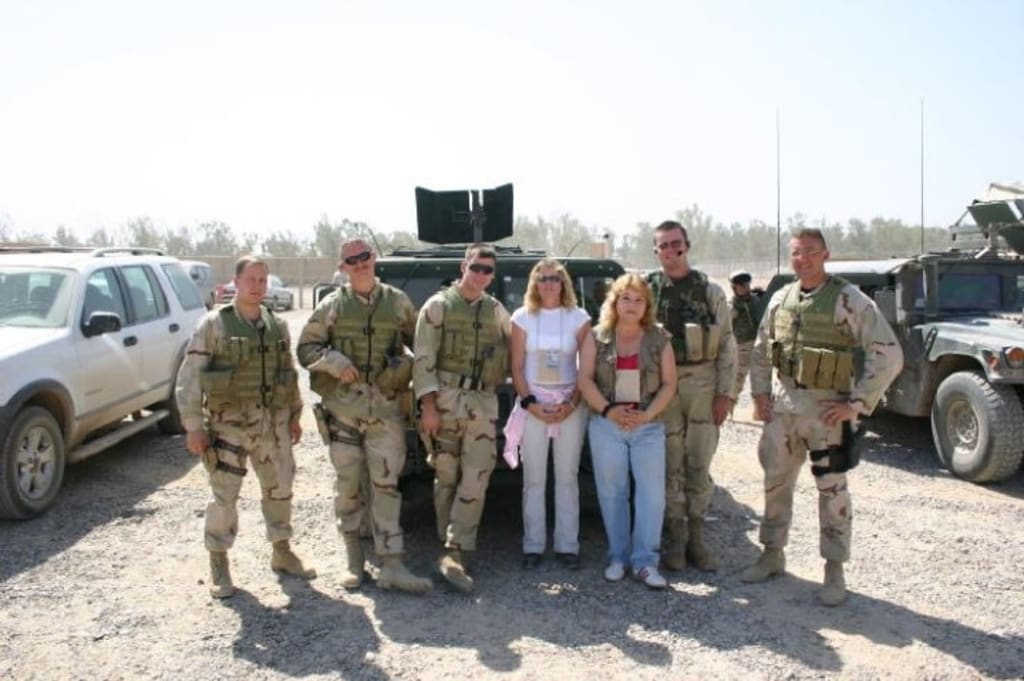
This is a 100% true story. I had quite a number of experiences throughout my career as a journalist. The experience of being an embedded wartime reporter in 2007, however, was both, the highlight and the nightmare of that career. I was asked, by the Kansas National Guard, not to use any names of our service members in this recounting. Therefore, the only person named within is the Kuwaiti General I had the dubious fortune of meeting when I was trying to return to the U.S.
Harrowing experiences weren’t anything new to me. I’d faced my share and then some during my twenty-year tenure as an investigative reporter. The time I spent embedded with the Kansas National Guard in Iraq, however, was easily the most nerve-wracking of my journalistic career.
I’m fairly certain I acted like a kid on Christmas morning when the military invited me to report from Baghdad. It didn’t matter I’d be smack in the middle of the epicenter of unrest. Saddam Hussein had just been captured and executed and Iraqi citizens were sharply divided. While a faction was happy at the hope of freedom from tyranny, many more vehemently distrusted the motives of Coalition Forces. They were convinced the soldiers were infidels infiltrating their country, with the purpose of stealing the only way of life they’d ever known.
There was an extensive list of things to slog my way through before I could fly the friendly skies to an unfriendly land. First, I had to track down my birth certificate so I could apply for my passport and visa (I’d never been outside the United States before then).
Next on the list of must-do’s, were shots. Thoroughly detesting needles, I balked at being required to have something close to a dozen different inoculations. Couldn’t they combine them all instead of using me as a veritable pincushion? The health department nurse rolled her eyes and asked me if I would prefer to be gifted with a host of diseases. Once she finished explaining the possibilities, all of which sounded more unpleasant than having a sliver of metal repeatedly jammed into my body, I asked if she wanted my arm or backside first.
Thank goodness my right arm wasn’t as affected by the shots as the rest of me since there were also numerous documents to sign. It rather pleased me, thinking how after a few rounds of paper-pushing, I would’ve made a doctor proud of my illegible hen scratches. Almost an E, then not much more than a wavy line for the rest of my name, topped with a little curly-q type of O at the end. Over and over, I released the United States, the U.S. military, and my employer from any liability should I be injured or killed in transit or in-country. That drawn-out session brought a whole new meaning to signing my life away.
I also had to attend several briefings, where I was warned about the potential for danger during my two-week stay. Working for our statewide news network at the time, my program director asked if that were the only danger I would face. Was I sure I’d been forgiven? I’d only recently wrapped up a year-long probe into ghost soldiers within the KNG. That investigation uncovered the fact a significant number of guard members listed as active, hadn’t reported for drills in long periods of time. In a few cases, even deceased members remained on the rosters.
The findings were significant since it meant our state of readiness in the case of an emergency, wasn’t nearly what the numbers indicated. On the other hand, if the actual tally had been reflected in KNG reports, it would have impacted such things as the number of military bases allocated to Kansas. Needless to say, I hadn’t made any friends with high-ranking officials during that investigation, least of all the Adjutant General, who’d conveniently ‘retired’ during its course.
Taking that into consideration, the program director’s question was a valid one. I’d joked that if I came back in one piece, we’d know I’d been forgiven. I honestly hadn’t been worried, though, at least not much. I’d had the support, and even the gratitude, of the majority of lower-ranking members, as well as a few colonels who hoped for a new era of accountability.
Finally, I’d met all requirements and it was time to go. I eagerly, albeit nervously, boarded the commercial flight for what would be, altogether, a fifteen-hour trip, energized along the way by espressos during an eight-hour layover at Schiphol Airport in Amsterdam.
Espresso in Amsterdam? Talk about strong! That old cliché, strong enough to put hair on your chest? It’s very nearly true.
Landing in Kuwait City, I was forced to reluctantly relinquish my passport and visa. The colonel in charge insisted he needed them to process me through customs. At that command, my already-frazzled nerves had to resemble a strand of yarn, mauled beyond recognition by an overambitious household cat. Along with the warning to never look an Iraqi male in the eyes (lest I be mistaken for a prostitute), to not offer my right hand to shake hands with an Iraqi national (it was considered an insult), and to never eat or drink anything that couldn’t be peeled, opened or boiled, I’d most especially been cautioned against letting those items off my person … at any time … no matter what.
In relatively short order, I had my passport back. My blood pressure eased a notch once I’d resecured the little blue booklet in my fanny pack. It quickly surged again, shooting a painful jolt through my chest when I realized that was all he’d given back. There was no visa. I objected strenuously to leaving Kuwait City without that piece of paper. As though he were explaining it to a petulant child, the colonel offered the reassurance it was protocol; I would be granted a new visa to re-enter Kuwait upon my departure from Iraq.
My objection was duly noted when I told him forcefully I’d been forewarned, but it made no difference. Unless I wanted to be stranded in Kuwait City, I had no choice. The military transport was getting ready for takeoff, with or without me. I chose with, sending up a silent prayer my instincts hadn’t been wrong; that the Guard wasn’t trying to have me silenced.
The next two weeks were amazing in both wonderful and horrifying ways.
Wonderful, was being included in a Blackhawk helicopter mission to pick up the Prime Minister of Romania in Babylon for a very important, hush-hush meeting. While we waited on the diplomats to conduct their business, I learned to play Hacky Sack with the soldiers, a common competition whenever they were on standby with wheels down. Before long, I had to admit I wasn’t especially coordinated for such a game.
Taking care to remain in the soldiers’ line of sight, I, instead, leisurely strolled around Old Babylon, marveling at the partially crumbling remains. I’d never felt so insignificant as I did that day, walking on the same ground and inhaling the same air Christ had, more than two-thousand years before. On a far lesser note but still a real coup for a country music fan, I slept one night in the same bed Toby Keith had occupied while in Baghdad entertaining troops.
Horrifying, was a school busload of children blown to smithereens from an improvised explosive device. A decade and a half later, I still have nightmares about that senseless tragedy. Horrifying, was when insurgents bombed the female living billets. Less horrifying, but still terrifying; careening at break-neck speeds through Green Zone streets in a Humvee. Still more terrifying, a soldier hanging half out the Humvee’s open window, ready to fire in the case of imminent danger.
More on those stories, though, in another entry in The Reporter’s Notebook. This account has to do with that one slip of paper I was told to leave behind in Kuwait City.
The return trip home didn’t start out well. At 9:15 a.m., I was left at the airport in Baghdad with a guardsman who’d been ordered to make sure I stayed safe. He did his duty. I made it on board the cargo plane meant to carry me back to Kuwait City. That plane ended up shaming the outside temperature. I have no idea what the temperature was onboard with zero air flow, but the thermometer outside registered 115 degrees.
For over two hours, I, along with roughly two-dozen soldiers heading home, some on leave, some for good, sat on the blistering heat of the tarmac, encapsulated in that plane-shaped metal box. Engine trouble. I wasn’t sure whether I hoped the plane would eventually be able to take off, or if I were afraid it would. I remember thinking, even with it as hot as it was, I would choose being grounded any day over having engine trouble several-thousand feet in the air.
Eventually, we were told they couldn’t get wheels up. Plan B. Trying to find my assigned guardsman, I struggled with my humongous suitcase and another very large, very heavy bag filled with various electronic devices I’d needed to do my job. No luck. I asked another guardsman to try to contact the colonel. He tried but no answer. Yet again, my blood-pressure exploded like a firecracker when I was told there wouldn’t be another flight from Baghdad to Kuwait City until the next day. Not good. My connecting flight out of Kuwait to Houston, Texas was scheduled to depart shortly after midnight. Since I was required to check in an hour early, I only had eleven-hours to find a way back to Kuwait City.
The clock was ticking and I was becoming more nervous with every tick. I wondered if I’d have to change my travel arrangements and worried about how I would manage it from Baghdad. Nearly two hours passed before the second guardsman informed me another military transport flight would leave for a province near Kuwait City in an hour and 20 minutes. From there, I could take ground transportation to the airport. The good news, he told me, was that I should make it in time for my flight back to the U.S.
Should make it? Ground transportation? Would it have an engine or would that ground transportation have four legs? And who would be driving or guiding that said transportation? Those were a few of the questions I asked with shocked disbelief and overwhelming dread.
He laughed at me. In fairness, I probably did exhibit quite a combination of interesting and possibly even twisted expressions. It took him a few seconds to compose himself but once he regained control, he apologized and explained there were semi-regular buses between the two areas, driven by Iraqi nationals employed by the Coalition.
With further prompting, I learned Kuwait City was about a thirty minute drive from where we were landing. If there weren’t any issues, I should reach the airport there just in time to make my flight home.
If there weren’t any issues. The way the day was going, things didn’t bode well. I tried to remind myself how that leg of the trip, in itself, would be an adventure. It almost worked. In any case, what choice did I have?
Contrary to the way things had gone to that point, it turned out far better than I’d feared. The most frightening part was the sudden stall and drop of the plane. The young man next to me explained it was a safety maneuver; a slow landing would’ve made us more of a target in the air. Okay, I thought, no crash landing, then. That was good.
We did, in fact, land safely at the military base. To be honest, although there were a handful of FEMA-type trailers in the background, the base actually felt more like a way stop, consisting of little more than a bunch of cowboys dressed in fatigues, huddled outside around a non-existent campfire in the desert.
They seemed to be in good spirits, laughing, joking in a myriad of accents, tearing open MRE’s and stuffing the contents into their mouths. My own mouth watered at the smell of the Meals Ready To Eat and my neglected stomach responded. Instead of merely growling, the empty pit roared like a lion. Since I’d skipped breakfast, a full twenty-four-hours had slid into the past since I’d eaten. While embarrassed that a nearby soldier obviously heard the thunder, I gratefully accepted the offer when he asked if I’d care for one. Between greedy bites, which I inhaled more than chewed, I remembered not only to thank him for the food, but also for his service.
The wait for the bus wasn’t as long as I’d anticipated after overhearing a guy with a delightful Australian accent ask about its arrival time. The general consensus had been simply when it got there. I’d no more than checked my watch when there was a sudden rustle of bodies and belongings. Once the plume of smoke dissipated from its much-used exhaust system, I could see our dubious form of transportation had arrived.
Although faded and antiquated with an engine that grumbled every mile of the way, the bus successfully got those of us going that way, to the airport. The backup guardsman had been right. It was eleven p.m. in Kuwait. I was going to make my flight! I began breathing easier, right up to the point a customs official demanded to know why I didn’t have a visa.
I tried, without success, to explain the predicament I’d found myself in on arrival two weeks prior. The official’s face remained impassive. I wasn’t sure if it was because of the language barrier … perhaps he didn’t fully understand … or maybe he thought I was untruthful. I made a second attempt, forcing myself to slow down and appear calm. He waited for me to finish, then ordered me to wait there and not move. Stepping away from the customs booth, he disappeared into a side office. Three minutes, later, he was back. Yeah, I was starting to count down the minutes by then. Grabbing my arm with his giant paw, he pulled me along behind him to said office.
All but shoved into the door, my first thought was I’d begun celebrating too early. It was going to be trouble.
Actually, though, I might have laughed if I hadn’t been so petrified. The room I found myself in totally could’ve been staged for a scene in a Humphrey Bogart movie. Behind a massive desk that was mahogany in color, sat General Rasheed el Rasheed. A large, intimidating beast of a man with a bushy moustache nearly as intimidating as the man himself. My impression was that of a stereotypical third-world bad guy general. I felt the blood began chilling in my veins.
On his desk were three things. One was an elegant, ornate, gold pen-holder. The second item was a very handsome square, wooden box with inlaid mosaic tiles on the lid. The third, right in the middle, in front of the general, was my passport.
Across the desk, was just enough room for two straight-back chairs. Curiously, I wondered whether a person would fit in one without hitting their knees against the desk. I rather doubted if someone tall could manage it.
An interior room the size of a postage-stamp took up about a third of the space on the far side of the office. That inner-office area was separated from the general by a half wall, with glass the rest of the way to the ceiling. It reminded me of a fish tank. Standing watch inside were two men eerily reminiscent to General Rasheed el Rasheed. There was barely room for those big boys, no less the two … and I gulped at the sight … wickedly big automatic weapons hanging from their hips. Clips that seemed to go on forever were looped over their shoulders.
I reconsidered. Maybe it was more like Humphrey Bogart meets Rambo.
Fluidly, despite his size, the general rose a couple of inches from his chair in greeting. Sitting back down, he motioned to one of the empty chairs. Fortunately, as a shorter than average person, I was able, barely, to sneak my legs between the chair and the desk. I sat, wondering if my luggage would still be by the customs booth when I got out of there. If I got out of there.
“It appears we have a situation.” His voice was a deep baritone, a perfect fit for his body. While his words were spoken in a thick accent, his English was far more understandable than had been the customs official’s. “You don’t have your paperwork.”
Trying to smother a sigh, I explained, for the third time, what had transpired when I’d first arrived in Kuwait.
“Impossible. The military does not make this kind of mistake.” All his I’s were pronounced like E’s.
“Unfortunately, if it was a mistake, it was one made by the military. I tried to tell the colonel the prep team had been very precise about always having it on me. He guaranteed it would be no problem getting another visa when I came back through.”
“Ah, but that is wrong. You must have paperwork first. It is required to enter our country. Without it, you cannot enter Kuwait.”
I cleared my throat. “What should I do?” I knew my voice was small. It came out that way without any help from me. Usually, I instinctively knew how to address someone. Passively, aggressively, naively, sweetly. It wasn’t often I was wrong. In that case, though, I had no idea what was right or what could be a serious mistake. It didn’t help I couldn’t get a clue by meeting his eyes. I well-remembered that warning.
“We will consider over mystery tea.” With the long E sound and the rolled R, it came out more like mee-stuh-rre tea. The general snapped his fingers and spoke to one of his bodyguards in what I assumed was Arabic. The guard opened the box and pulled out a cigar and lighter, cut the end of the cigar, put it to the general’s lips and lit it. Then he left the room.
Hmm. Maybe a little of the Godfather thrown in? Then it hit me. Mystery tea? Do not eat or drink anything that hasn’t been peeled, opened or boiled. That had been the warning. Dear God if you get me out of this, I promise to ….
The general’s baritone cut into my bargaining. “No matter. It is better you stay in my country.”
WHAT? Umm, thanks, but like never. Of course I had the sense to keep those words from snaking out. Instead, I tried to explain I had four children at home I had to get back to. He blew out the smoke from his cigar. I fought the urge to cough. Surreptitiously, I tried to gauge his expression. Blatantly, he watched mine.
Moments later, his bodyguard, who also appeared to be his manservant, returned with two steaming cups of tea. Boiled? I could but hope.
“Drink.” he ordered.
I lifted the cup to my lips, pretending to take a sip, and managed to sneak a glance at my watch in the process. 11:45. I was already more than half an hour late for check-in. The sands in the hourglass were rapidly running out. A jack-hammer started inside my chest cavity and my hand began shaking almost uncontrollably. It took almost everything I had not to slosh the mystery tea.
“General,” I began, and checked my tone before I continued. I wanted to come across as sincere but not as though I were begging. “Thank you so much for your hospitality. I plan on relaying your kindness to the National Guard Bureau when I get back home. I am getting a little worried, though. The time. My flight leaves in about twenty-five minutes and I haven’t checked in at the gate. Is there any way you can help?”
“You don’t wish to stay in my country? It is very good country.”
“Thank you for the offer. It does seem to be a very good country. But, my children. I have to get back to them. Please understand.”
General Rasheed el Rasheed sighed. “First, must finish mystery tea.”
Another silent prayer passed through my lips before I allowed the tea to do the same. I then drained the cup in a single gulp. I rationalized if it was laced with something, I wasn’t getting out of there whether I drank it or not.
When I was finished, the general again snapped his fingers. He stood for a brief conversation with his other bodyguard before he spoke to me.
“Since you must leave, my guard will escort you to the gate, Miss Montaño.” After butchering my name – the least of my worries -- he gave a slight tilt of his head.
He was letting me go? It was perhaps the biggest surprise of the trip. Just one more silent prayer. Thank you, God.
“Thank you, General.” My voice came out breathy in my relief. Despite a fear of saying or doing anything to make him change his mind, I had to ask. “My luggage?”
The general said the bodyguard’s name but I didn’t understand and I wasn’t about to ask him to repeat it. “… will collect it on the way.”
We arrived at the gate just as the attendant started to close the door. “Wait, please!” My yell echoed along the nearly empty corridor. I definitely wasn’t above begging now. I already had my ticket in hand, running as if my life depended on it. The bodyguard barely had to increase his stride to keep up, despite lugging those heavy bags.
The attendant scowled, but radioed someone about my bags and cracked open the door enough I get through. “I’ll see to it they’re loaded.” She gestured me ahead and I took off like lightning, unable to get in that tube to board the plane fast enough. Luggage or not, I hadn’t been silenced and I was going home.
By the way, the bags made it.
About the Creator
Liz Montano
Former news reporter, now a multi-genre novelist who's indie-published out of impatience. I'm much happier now writing stories and endings that touch and make readers feel. I can be contacted at elizabethmontano.com or #newsbizlizzy on X.
Enjoyed the story? Support the Creator.
Subscribe for free to receive all their stories in your feed. You could also become a paid subscriber, letting them know you appreciate their work.
Comments
There are no comments for this story
Be the first to respond and start the conversation.