
The Havoc Coin Trap: Why Rat Hoarding Is Quietly Killing Delta Force
Rats keep looting. Aggressive players keep paying. The economy keeps breaking.
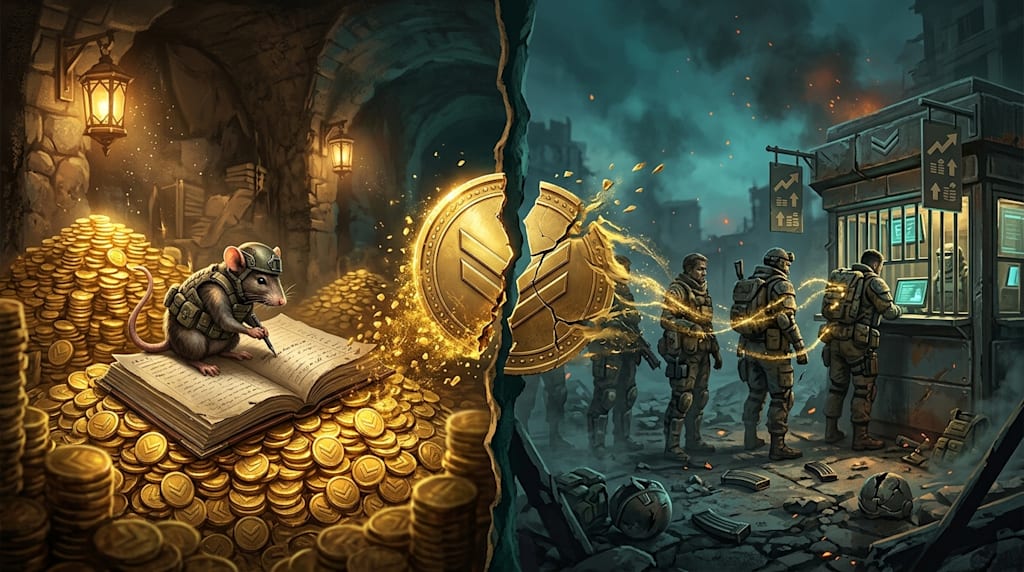
The Havoc Coin Paradox: When Rat Hoarding Becomes the Game’s Slow Poison
1. A Question That Keeps Coming Back
In the Delta Force community, one question keeps returning: rats love to loot, and they keep looting after they get rich. Aggressive players, once rich, feel safe bringing gear into raids. If both groups get what they want from Havoc Coins, what is the official team trying to recover?
The question makes sense for one player at a time. A game economy is not one player. It is a system shaped by millions of players who affect one another. When rat hoarding turns from a personal choice into the best group strategy, the chain reaction eats the game’s main source of fun.
The official effort to recycle Havoc Coins fights a structural problem in a no-wipe extraction shooter: currency only piles up, while sinks grow far slower than output.
2. How Havoc Coins Are Created Out of Nothing
To see why the official team must recycle Havoc Coins, first see how they are created.
In Delta Force’s Operations mode, Havoc Coins do not mainly come from player-to-player trades. They come from players trading with the system. A rat run means looting supplies and selling them to the system through the Auction House or Quartermaster for Havoc Coins. The system creates the coins. A piece of loot picked up from the map gets bought for hundreds of thousands or millions of Havoc Coins. That money enters the player’s pocket. The system does not take an equal amount back.
The rat style consumes almost no Havoc Coins. A standard budget run is naked plus a military knife and two smoke grenades. The Havoc Coin cost is near zero. Every successful extraction injects new currency into the economy. When many players choose this zero-cost, stable-return style, the total supply of Havoc Coins grows fast.
Havoc Coins also do not vanish when a player dies. In a normal economy, taxes or销毁 mechanisms can remove currency. In Delta Force, death moves goods and currency to other players or the system. The currency itself stays. Players have pointed out that Delta Force “basically has no secondary circulation,” and prices depend mainly on official control. The economic design is abnormal. When output stays above consumption and the money supply keeps rising, Havoc Coins lose value. That is not a risk. It is the result.
3. Who Pays for Rat Hoarding
The rats do not feel the first effects of Havoc Coin depreciation. Aggressive players do.
Rats barely care about prices. Their goal is looting, the number in their stash, not buying high-value gear on the Auction House. If prices rise, rats earn a little more when selling loot. If prices fall, they still run zero-cost raids and keep hoarding. The people hit by price swings are aggressive players who keep buying ammo, armor, and weapon attachments.
Prices have already passed what normal players can bear. Tier 4 ammo has risen by 90% to 110%. A single raid’s ammo cost can reach hundreds of thousands of Havoc Coins. Gold ammo has entered the 5,000+ era. An AWM bare rifle costs 750,000. An M7 bare rifle plus barrel starts at 500,000. A full Tier 5 or Tier 6 loadout with a modded weapon and Tier 4 AP ammo can cost hundreds of thousands or millions just to enter. Some players calculate a full aggressive run at 3.8 million.
Red item purchasing power keeps falling. Micro Reactors dropped from over 5 million to 3.6 million. Laptops fell from around 5 million to 1 or 2 million. Resuscitation Respirators plunged to just over 3 million. A small red item sells for only 100,000 to 200,000. Even after a successful extraction with high-value loot, an aggressive player’s return does not cover the gear cost. One player said: “Originally, with normal Tier 4 gear and Tier 4 ammo, normal search-fight-extract could still make a few million Havoc Coins a day. Now it has become losing a few million Havoc Coins a day.”
Aggressive players are not bad at the game. The economic system punishes the people who play the core loop. When bringing gear to fight loses money and zero-cost rat runs make money, the rational choice tilts toward rats. That is the outcome the official team least wants.
4. The End of the Rat Is Not the Aggressive Player
You might say rats keep looting when rich, and they do not get in anyone’s way. The rat population is more complex than players who enjoy hoarding.
On forums and trading platforms, it is an open secret that a large share of rat-earned Havoc Coins flows into gray markets. One player pointed out: “A green escort can easily burn through 100 million a day. The most commonly rented accounts are also Level 60 rats with 100 million cash, some AWM ammo, and Tier 6 gear.” So-called pork-rib rats only run budget kits. Once they pile up enough, they find club boosters to trade for pork ribs and rent the account out. When boosters have no orders, they list it on Xianyu and keep selling. Havoc Coins have a clear price on second-hand platforms. 10 million Havoc Coins can trade for dozens of yuan. A skilled rat runner can make three to four hundred yuan a day.
A large part of the Havoc Coins hoarded by rats flows back into the game through gray channels. It buys escort services, boosting, and supports a cross-border boosting chain. In places like Nepal and Madagascar, young people in game studios take commissions from Chinese players to loot resources and pile up Havoc Coins in Delta Force, saving players the boring work. The official crackdown on gray industries affects the economy’s health. That fight is far more complex than recycling Havoc Coins.
When the shared prison strategy appeared, a player-created mutual extraction model, the problem grew. Shared prison let ordinary players produce 10 million Havoc Coins per hour. Havoc Coins flooding into the account-rental market rose fast, pushing down the real-world value of Havoc Coins. The official team’s emergency limit on extraction point players came from fear that loot farming would collapse prices. The change caused large protests, and the game’s rating once fell to 2.7. That reaction shows a hard fact: players making rational choices for themselves can destroy the game’s economic base.
5. The Official Team’s Dilemma
With that background, the official team’s real dilemma is clear: Havoc Coins must be recycled, but crude recycling hurts players.
The current methods rely on map meat grinders, official restocking at the trading post, and Special Services upgrades. Their effects are limited and their costs are high. Raising gear prices speeds up Havoc Coin use, but it raises the entry barrier for aggressive players and pushes more people toward rats. Lowering high-value container drop rates cuts currency output, but it makes looting worse for everyone. Some players say the official approach is “crude consumption, treating the symptom but not the root cause, and players strongly resist it.”
Season 7 added consumables like the Haavk Endbrain Painkiller, Brain-Machine Fluid, and Proteus Jammer. These are attempts to create new Havoc Coin sinks without changing the basic game experience. The consumables cover the raid flow. Players buy what they need. That improves the experience and recycles Havoc Coins. The direction is right. Whether the scale can counter the massive currency oversupply is still unclear.
The deeper problem is that the official team did not reserve enough sinks for a no-wipe economy. Traditional extraction shooters like Escape from Tarkov and Arena Breakout reset the economy through hard or soft wipes. Delta Force chose no-wipe but did not build a rich out-of-raid consumption system. Turing Bricks and the collection room are the official answer. Players point out that Turing Brick loss and return are hard to see, and their appeal to rats is limited. Community ideas like a larger stash, skin exchange, and limited chromatic tasks all ask for the same thing: more ways players want to spend money, rather than price increases alone.
6. The End of Hoarding Is Desolation
Back to the first question: what is wrong with rats hoarding Havoc Coins?
For one rat, nothing is wrong. Piling up numbers in a zero-cost, stable-return style is a reasonable way to play. When that style becomes the common choice for many players, the inflation it creates raises gear costs for aggressive players. The core combat loop becomes economically unsustainable. It breeds a large gray market that moves game currency into the real world. It erodes the game’s main source of fun: judging risk against reward, and winning through confrontation.
The official recycling of Havoc Coins fights a structural problem. When zero-risk hoarding becomes the best answer, high-risk, high-reward play gets pushed to the edge. This is not the rat’s fault. It is not entirely the official team’s fault. It is a problem every no-wipe extraction shooter meets in long-term operation. Recycling and consumption alone will not fix it. The fix is to build a rich, attractive out-of-raid consumption system so Havoc Coins have somewhere to go, and players with different tastes find a reason to keep investing.
Otherwise, when the number in the stash grows so large that it no longer excites, rats will find they have hoarded a pile of meaningless symbols. The battlefield that once made their hearts race will be quiet enough to hear only wind.
About the Creator
Jin
Writer of reamstories
https://reamstories.com/jin
Enjoyed the story? Support the Creator.
Subscribe for free to receive all their stories in your feed. You could also become a paid subscriber, letting them know you appreciate their work.
Comments
There are no comments for this story
Be the first to respond and start the conversation.