
The Judicial Reformation
Black Robes, Pews, Choirs, and the Ten Commandments


Abstract
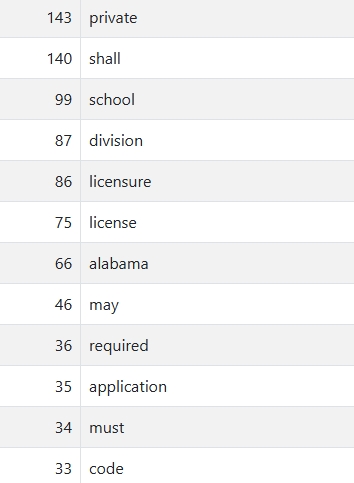
This study uses text mining to examine Alabama’s Private School License Guide with a focus on word frequency and sentiment. The analysis shows that the word “shall” appears far more often than any other directive term. Sentiment analysis indicates that the language comes across as aggressive, prosecutorial, and condescending. Drawing on research in legal linguistics and institutional theory, the findings suggest that repeated use of directive language reinforces authority and obligation. The study also connects these patterns to historical overlaps between legal and religious traditions, where prescriptive language has long been used to establish unquestioned authority (Berman, 1983; Tiersma, 1999). In addition, the document appears to place less emphasis on social entrepreneurship and community building compared to bureaucratic control and historically rooted social hierarchies. These results highlight how language choices shape how institutions communicate expectations and enforce compliance.
Introduction
Courtroom attire, particularly the robes worn by judges, has long carried symbolic weight that parallels religious authority. Scholars of legal history note that judicial robes developed from medieval clerical dress, reflecting the close institutional ties between church and state in early Western legal systems (Berman, 1983). Like clergy garments, these robes signal moral authority, separation from ordinary society, and a role as interpreter of higher rules. The visual similarity to preacher robes reinforces the perception that judges occupy a position not only of legal authority but of moral judgment. This symbolism is not incidental; it communicates hierarchy, legitimacy, and a sense of solemn obligation, much like religious leadership does within a church setting.
The physical layout of courtrooms further strengthens this resemblance. Many courtrooms are arranged with fixed seating that closely resembles church pews, positioning attendees in orderly rows facing a central authority figure. Research on legal spaces has shown that courtroom design is intentionally structured to promote order, obedience, and attentiveness (Resnik & Curtis, 2011). This arrangement mirrors religious environments where congregants sit in pews directed toward a pulpit. In both cases, the spatial design reinforces a one-directional flow of authority—from the front to the audience—while minimizing interaction or challenge. The effect is a setting that feels ceremonial and controlled, emphasizing compliance and reverence.
Beyond judges and seating, the broader courtroom environment can be interpreted through similar parallels. Judicial assistants, clerks, and supporting staff operate in coordinated roles that resemble a choir, contributing to the rhythm and function of proceedings while remaining secondary to the central authority. Attendants and observers, positioned collectively within the space, function much like a congregation, present to witness and affirm the process. The practice of oath-taking on a Bible further reinforces these connections, blending legal obligation with religious symbolism (Cover, 1983). In this context, The Code of Alabama can be seen as occupying a role similar to a sacred text within the legal system—treated as authoritative, foundational, and not to be questioned within the structure it governs. Together, these elements create an environment where legal authority is reinforced through visual, spatial, and ritual similarities to religious practice.
Language is one of the main tools institutions use to exercise authority. In legal and policy documents, word choice is rarely neutral; it signals expectations, obligations, and consequences. Scholars have shown that modal verbs like “shall” are especially important because they impose mandatory action rather than suggestion (Tiersma, 1999; Bhatia, 2010). In education policy, this kind of language shapes how schools understand their responsibilities and limits.
This study examines Alabama’s Private School License Guide using text mining to identify patterns in how authority is expressed. The results show that the word “shall” dominates the document. Alongside this, the overall language feels strict and prosecutorial rather than supportive or collaborative.
These findings can be better understood by looking at the historical connections between law and religion. Prescriptive language like “shall” appears prominently in religious texts such as the Ten Commandments, where it signals absolute authority (Levinson, 1983). Legal institutions have long reflected similar structures of authority, from courtroom rituals to the use of oaths (Berman, 1983; Cover, 1983). This overlap helps explain why legal documents often rely on language that sounds moralistic or commanding.
Finally, this study considers what is missing from the text. Compared to its strong emphasis on rules and compliance, there is little attention given to ideas like community development or social entrepreneurship, which research shows are important for addressing complex social problems (Dees, 1998; Mair & Martí, 2006).
Methods
This study uses a combination of quantitative and qualitative text analysis. The full text of Alabama’s Private School License Guide was converted into a format suitable for computational analysis. AI assisted in the writing of this report in terms of syntax and grammar.
Results
Discussion
The most obvious finding is the dominance of the word “shall.” In legal writing, “shall” is used to create obligation, leaving little room for interpretation. Scholars have noted that heavy reliance on this word can make texts feel rigid and overly forceful (Adams, 2013). In this case, its repeated use contributes to a tone that feels more like enforcement than guidance.
This kind of language reinforces a clear power difference between the state and private schools. Research in legal discourse shows that directive language often positions institutions as subjects who must comply rather than partners who can collaborate (Gibbons, 2003). The lack of softer language—such as “may” or “encouraged”—makes this effect even stronger.
The connection to religious language is also important. The use of “shall” in texts like the Ten Commandments reflects absolute authority and moral certainty. Legal systems in the Western tradition have historically borrowed from these structures, blending moral and legal authority (Berman, 1983). Courtroom practices, including oath-taking and Black robes, further reinforce this connection (Cover, 1983). These parallels help explain why the language in the guide can feel not just strict, but moralizing.
Another key point is what the document does not emphasize. There is little language related to innovation, community engagement, or social entrepreneurship. Research shows that these elements are critical for addressing social and educational challenges (Dees, 1998; Mair & Martí, 2006). Instead, the focus remains on compliance and administrative control.
This emphasis may also reinforce existing inequalities. Studies in education policy have shown that highly bureaucratic systems often favor organizations with more resources and administrative capacity (Apple, 2004). Smaller, community-based schools may find it harder to meet strict requirements, which can limit diversity and innovation in the education system.
References
Adams, K. A. (2013). A Manual of Style for Contract Drafting. Chicago: American Bar Association.
Apple, M. W. (2004). Ideology and Curriculum. New York: Routledge.
Berman, H. J. (1983). Law and Revolution: The Formation of the Western Legal Tradition. Harvard University Press.
Bhatia, V. K. (2010). Legal discourse: Opportunities and threats for corpus linguistics. International Journal of Corpus Linguistics, 15(2), 136–155.
Cover, R. M. (1983). The Supreme Court, 1982 Term—Foreword: Nomos and Narrative. Harvard Law Review, 97(1), 4–68.
Dees, J. G. (1998). The meaning of social entrepreneurship. Stanford University Working Paper.
Gibbons, J. (2003). Forensic Linguistics: An Introduction to Language in the Justice System. Blackwell.
Levinson, S. C. (1983). Pragmatics. Cambridge University Press.
Mair, J., & Martí, I. (2006). Social entrepreneurship research: A source of explanation, prediction, and delight. Journal of World Business, 41(1), 36–44.
Pang, B., & Lee, L. (2008). Opinion mining and sentiment analysis. Foundations and Trends in Information Retrieval, 2(1–2), 1–135.
Tiersma, P. M. (1999). Legal Language. University of Chicago Press.
About the Creator
T.J. Greer
Scholarly research, from data collection, to statistical analyses with SPSS; I enjoy every part of crafting relevant and engaging pieces.
Enjoyed the story? Support the Creator.
Subscribe for free to receive all their stories in your feed.
Comments
There are no comments for this story
Be the first to respond and start the conversation.