science
According to Chemistry, Alcohol Is a Solution; Proof explores the science of alcohol, from its production to its effect on your bloodstream, brain, body and behavior.
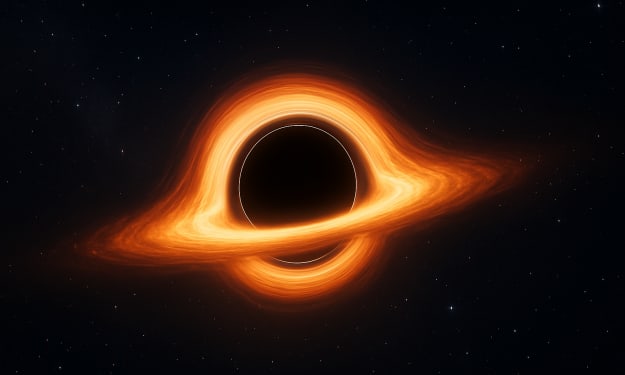
Black Holes: Vaults of Light and Dense Matter
Black Holes: Vaults of Light and Dense Matter Matter and Energy Are Pulled In If you’ve ever stared up at the night sky and wondered where the universe hides its deepest secrets, the answer might be simpler—and stranger—than you think: black holes. These mysterious objects are cosmic vaults, locking away light, matter, and energy in a place where the normal rules of physics seem to break down.
By Mohamed hgazyabout a year ago in Proof
The Matter That Makes Up the Universe
The Matter That Makes Up the Universe Have you ever looked up at the night sky and wondered what it’s all made of? Those twinkling stars, the vast black space between them, and even the invisible air around us—what are they, really? Most of us grow up learning about atoms in school: tiny particles made of protons, neutrons, and electrons. But the truth is, that’s only the beginning of the story. The real building blocks of the universe are even smaller, stranger, and far more fascinating. They belong to something scientists call the Standard Model of Particle Physics—a scientific map of the tiniest known pieces of reality.
By Mohamed hgazyabout a year ago in Proof
YouTube: Turning Views into Income?
Introduction In today’s digital world, YouTube is more than just a platform for watching funny videos or music. It has become a powerful tool for earning real money. Millions of people around the world are turning their passions—like gaming, cooking, tech reviews, or vlogging—into full-time incomes. This blog will help you understand how YouTube works as a money-making platform and how you can begin your own journey.
By aadam khanabout a year ago in Proof
Do COVID-19 Vaccines Increase Heart Attack Risk?
Since the global rollout of COVID-19 vaccines, billions of people have been vaccinated in an effort to curb the devastating effects of the pandemic. While the vaccines have significantly reduced hospitalizations and deaths, some concerns have emerged—particularly regarding the risk of heart-related issues such as heart attacks. Reports, social media posts, and even some news outlets have fueled speculation that COVID-19 vaccines might increase the risk of heart attacks or other cardiovascular problems. But what does the science really say?
By Taimoor Khanabout a year ago in Proof
"The Day I Met an Alien: A True Story of the Unbelievable"
I’m not the kind of person who sees ghosts in the mirror or believes in every UFO sighting on YouTube. I’ve lived in a small rural town in Colorado my entire life, where the strangest thing you might encounter is a raccoon knocking over a trash can. But something happened on the night of September 13th, 2023, that flipped my world upside down.
By Nizam khanabout a year ago in Proof
Are Yellowstone’s Animals Fleeing Because They Sense Danger — Or Is It Just Social Media Hype?
Over the past few days, social media has erupted with dramatic videos that seem to show massive animal migrations out of Yellowstone National Park—and people are asking: Do they know something we don’t?
By 🕵️♂️ True Crime Enthusiast | Storyteller of the Dark Side 🔍about a year ago in Proof
The Zone of Silence.
In our modern world, we are drowning in signals. Wi-Fi, GPS, radio waves, and cellular data form an invisible, inescapable web that connects us all. We are never truly lost, never truly out of touch. But what if there was a place where that web simply… broke? A place where the modern world falls silent, where technology dies, and something much older and stranger whispers in the quiet. Such a place exists. In the stark, beautiful emptiness of the Mapimí Biosphere Reserve in Durango, Mexico, lies a patch of desert known as La Zona del Silencio—the Zone of Silence.
By MUHAMMAD FARHANabout a year ago in Proof
Deadly Worlds in Universe
Imagine a planet where taking a single breath doesn't fill your lungs with air—but with acid. Initially, scientists believed Gliese 581c might be similar to Earth and capable of supporting life, based on its location in the so-called "habitable zone" around its star. However, that hope came only from observing it from afar. Upon deeper analysis, the truth was far more terrifying. Gliese 581c: The Illusion of a Second Earth In 2007, the scientific world was electrified by the discovery of a planet orbiting a red dwarf star just 20.4 light-years away from Earth in the constellation Libra. This planet, known as Gliese 581c, was among the first exoplanets identified as potentially Earth-like, sparking widespread speculation that it might host life. Some even hailed it as a possible "second Earth." However, as more data came in, the initial optimism faded. The closer we looked, the more Gliese 581c revealed itself to be not a paradise—but a nightmare. Far from being a haven for life, it turned out to be one of the most hostile environments scientists have studied. With scorching temperatures, a toxic atmosphere, and conditions more reminiscent of Venus than Earth, Gliese 581c represents the dark side of planetary discovery—a world where life would not only struggle to exist but would be instantly destroyed. --- The Discovery and Early Hype Gliese 581c orbits a red dwarf star named Gliese 581, which is smaller and cooler than our Sun. Using radial velocity measurements—techniques that detect wobbles in a star's motion caused by orbiting planets—astronomers identified Gliese 581c as one of several planets in the system. What made Gliese 581c particularly exciting was its position in the so-called "habitable zone", the region around a star where temperatures could, theoretically, allow liquid water to exist. Since water is essential for life as we know it, this placement immediately made Gliese 581c a prime candidate in the search for extraterrestrial life. Its mass is about five times that of Earth, placing it in the category of super-Earths—planets larger than Earth but smaller than gas giants like Neptune. Early reports even suggested it might have an atmosphere and a rocky surface. But as further studies and models were applied, scientists quickly realized that being in the habitable zone doesn't guarantee habitability. In fact, Gliese 581c might be one of the most inhospitable planets we’ve ever discovered. --- A Hellish Greenhouse Effect The primary reason Gliese 581c is so hostile is due to a runaway greenhouse effect, similar to what we see on Venus but likely even more extreme. In a greenhouse effect, certain gases in the atmosphere—like carbon dioxide—trap heat from the star, causing surface temperatures to rise dramatically. On Gliese 581c, this process is thought to be so intense that surface temperatures may exceed 500°C (932°F)—more than enough to melt lead. Any oceans that may have once existed would have long since evaporated, and the resulting water vapor would only further intensify the greenhouse effect, creating a vicious feedback loop. This leads to a horrifying paradox: while Gliese 581c orbits within the habitable zone, it’s far too hot for any form of Earth-like life. The planet's atmosphere likely contains high levels of carbon dioxide, sulfur dioxide, and perhaps even acidic vapors, making it not only oven-hot but also chemically toxic. --- Atmosphere of Death While we haven't directly sampled the atmosphere of Gliese 581c (which would require incredibly advanced spacecraft), models based on its mass, distance from its star, and star type suggest a thick, dense atmosphere composed mainly of greenhouse gases. If humans were somehow able to teleport to the surface, the experience would be instantly fatal. You wouldn’t be able to breathe; instead of air, you'd inhale acidic, corrosive gases. The pressure would be crushing, the heat unbearable, and the atmosphere would likely burn your lungs before you could even scream. Any exposed metal equipment would corrode, and electronic systems would quickly fail due to the heat. It’s the kind of environment where not even extremophiles—life forms that survive in Earth’s harshest conditions—could endure. --- Tidal Locking and Permanent Extremes Another challenge is the likelihood that Gliese 581c is tidally locked. This means one side of the planet always faces its star, while the other is in permanent darkness—similar to how the Moon always shows the same face to Earth. This would result in extreme climate zones: The day side would be a blazing wasteland, with continuous exposure to its star’s radiation. The night side would be a frozen, icy abyss. Only a narrow strip of land along the terminator line—the border between night and day—might have semi-stable temperatures. But even here, atmospheric chaos would dominate, with gale-force winds, violent storms, and pressure differences that make it nearly impossible for any form of stable climate to exist. --- Lessons from Gliese 581c Gliese 581c serves as a sobering reminder that appearances can be deceiving. Just because a planet is in the habitable zone doesn't mean it's actually habitable. Planetary conditions depend on a delicate balance of atmospheric composition, geological activity, magnetic shielding, and more. In the early days of exoplanet discovery, Gliese 581c ignited dreams of alien worlds teeming with life. But today, it stands as a symbol of false hope and harsh reality—a planet that looked promising from afar, but up close is nothing less than a living hell.
By Faizan Khanabout a year ago in Proof
Unlocking Excellence in Clinical Research: The Key to Leading Award-Winning Clinical Trials
Clinical trials represent the critical bridge between medical research and real-world patient care. They validate new treatments, establish safety protocols, and ultimately pave the way for improved health outcomes worldwide. Leading clinical trials that receive awards and accolades is not merely about scientific discovery—it involves exceptional leadership, meticulous planning, and a commitment to excellence. This article delves into the essential factors that define leadership success in clinical trials and presents a blueprint for achieving award-winning research outcomes.
By Yousuf A. Gaffar, M.Dabout a year ago in Proof
Air Pods Pro 3 Just Revealed in New Leak—Straight from Apple's Own Code
In a move that echoes past accidental reveals, Apple appears to have tipped its own hand once again. The long-rumored Air Pods Pro 3 is likely coming soon, according to a newly discovered leak in Apple's own software code. And while the Cupertino tech giant is known for its tight-lipped secrecy, this time the evidence comes straight from the horse’s mouth—buried deep in internal iOS and audioOS references.
By Today Articleabout a year ago in Proof