science
According to Chemistry, Alcohol Is a Solution; Proof explores the science of alcohol, from its production to its effect on your bloodstream, brain, body and behavior.
The Proof
When words are not enough, life leaves its own evidence The Question That HauntsFor years, Junaid carried a question in his heart that no one could answer. After his father passed away suddenly, many people spoke of him in different ways — some called him generous, others said he was too strict, and a few even whispered that he had hidden his true nature behind a quiet face. “How do we know who someone really was?” Junaid often wondered. “Is it what they say? Or what people remember? And what if the truth gets lost with time?”
By The Curious Writer3 months ago in Proof
According to a recent study, common bacteria and fungus can work together to create an infection that is far more severe.
Researchers have found that a common bacterium and a common fungus can cause significantly more damage to living tissue when combined than when either organism acts alone. The discovery recasts some mixed infections as planned attacks in which the partners involved—rather than merely the names on a lab report—determine the level of danger.
By Francis Dami6 months ago in Proof
The Experiment That Proved Love Is Real
THE IMPOSSIBLE MEASUREMENT 💕 For most of scientific history love has been considered unmeasurable and therefore unscientific, a subjective emotional experience that could be described by poets and analyzed by philosophers but that could not be quantified, replicated, or studied with the rigorous methodology that science requires, and scientists who attempted to study love were dismissed by their peers as pursuing a topic that was inherently beyond the reach of empirical investigation because you cannot put love in a test tube or measure it with a ruler or observe it under a microscope, and this dismissal reflected the broader scientific assumption that subjective experiences are not appropriate subjects for scientific study because they cannot be directly observed by anyone other than the person experiencing them 🔬
By The Curious Writer6 months ago in Proof
Why Gas Prices are So Expensive Right Now
If you’ve pulled up to a gas pump lately and winced at the total, you’re not alone. Rising gas prices have become a regular frustration for drivers, commuters, and families trying to manage their budgets. While it’s easy to blame “the economy” or assume companies are simply charging more, the reality is more complicated. Gas prices are shaped by a mix of global events, supply chains, government policy, and basic economics.
By AnthonyBTV7 months ago in Proof
The Return of the “Vampire Deer”
If you think vampires only belong in movies, buckle up, because nature just reminded us it can outdo Hollywood anytime. Earlier today, reports surfaced about a strange, almost mythical animal spotted in a remote forest in northeastern Afghanistan. For the first time in nearly six decades, researchers confirmed the presence of the Kashmir musk deer, a tiny, shy deer known for one wild feature: its vampire-like fangs.
By Areeba Umair10 months ago in Proof
The Max Headroom Incident: The Night a Masked Stranger Hijacked Live Television—and Vanished Forever
Television is designed to be predictable. The news airs on time, sports run in their scheduled slots, and commercials interrupt programming only when expected. But on a cold November night in 1987, the people of Chicago witnessed something so bizarre, so unexpected, that it would go down in history as one of the strangest unsolved broadcast hijackings ever recorded. It would be remembered simply as The Max Headroom Incident. The event lasted only a few chaotic minutes. Yet its impact shook the broadcasting industry, terrified viewers, and sparked decades of theories ranging from hacking, media sabotage, underground prank groups, and even psychological warfare experiments. Despite federal investigations, enhanced analysis, and hundreds of leads, no one has ever been arrested. Not a single suspect has ever been confirmed. This is the story of how a masked, anonymous intruder broke into live television—and disappeared without leaving a trace. A Normal Broadcast—Until It Wasn’t On November 22, 1987, Chicago's WGN-TV was airing the evening sports report. Viewers expected the usual commentary, highlights, and interviews. Instead, their screens suddenly flickered. The signal warped. For a fraction of a second, static overtook the entire broadcast. Then a strange figure appeared. He wore a plastic mask modeled after Max Headroom—the fictional AI character from 80s pop culture, known for his electronic stutter and glitchy digital appearance. But this wasn't the charming, quirky Max Headroom from TV. This one was unsettling. Still. Silent. Staring. His head bobbed in front of a metallic, corrugated background designed to look like the original show’s digital “studio.” There was no audio. No movement. No explanation. And just as quickly as it began, it ended. The real broadcast returned, and the WGN studio scrambled to apologize, calling it a “technical difficulty.” But this was only the beginning. The Second Hijack: Stranger, Darker, Disturbingly Human Two hours later, Chicago’s PBS station (WTTW) was airing an episode of Doctor Who. Fans were immersed in the sci-fi storyline when, without warning, the screen glitched again. The masked intruder returned—this time with audio. He spoke in a distorted, mocking tone. He rambled nonsense, hummed, screamed. He quoted random TV slogans. He laughed in a high-pitched, almost childlike way. The delivery was chaotic, unpredictable, and deeply unnerving. Wearing the same plastic Max Headroom mask, he moved with exaggerated, jerky motions, like a puppet glitching out of reality. His background wobbled as if it had been built cheaply—cardboard and metal sheets taped together. Everything about the setup looked improvised and underground. Then things escalated. He picked up a glove. He waved it around. He mocked a news anchor. And near the end of the broadcast, an off-screen accomplice appeared holding a fly swatter—suggesting there was more than one person involved. The audio was distorted. The image unstable. The behavior increasingly manic. And then—black screen. Broadcast restored. Viewers sat frozen in their living rooms, wondering what they had just witnessed. How Did He Even Do It? The Mystery That Haunts Experts To hijack a television signal in 1987 was no simple prank. This wasn’t a YouTube channel or livestream. These were licensed broadcast frequencies protected by the FCC. To break into them, one needed: • powerful radio transmitters • technical engineering knowledge • precise timing • directional broadcasting aimed directly at the tower • equipment that could overpower the live signal In other words: this person knew exactly what they were doing. The FBI and FCC both launched immediate investigations. Engineers combed through signal logs. They studied frequency interference patterns. They interviewed technicians from every local broadcast tower. But the intruder had been careful. He left no fingerprints, no equipment trails, no radio signatures. Nothing. The official case file still remains open, unsolved, and gathering dust.
By The Insight Ledger 11 months ago in Proof
For the First Time, We Can Slow Alzheimer's
The battle against Alzheimer’s disease has ushered in a transformative era. The introduction of new medications that modestly slow its progression, coupled with the identification of biomarkers that facilitate early detection, has reignited hope for addressing a condition that currently impacts 50 million individuals globally. After years of challenges and the inability to discover effective treatments for a form of dementia that undermines memory and personal autonomy, the scientific community is observing a promising diagnostic and pharmacological evolution. A panel of experts shared a series of articles in The Lancet on Monday, shedding light on these advancements and discussing the significant controversies surrounding the new treatments — the first to modify the disease's trajectory, yet criticized for their high costs, potential side effects, and limited efficacy.
By Said Rahiliabout a year ago in Proof
From Maser to Laser. AI-Generated.
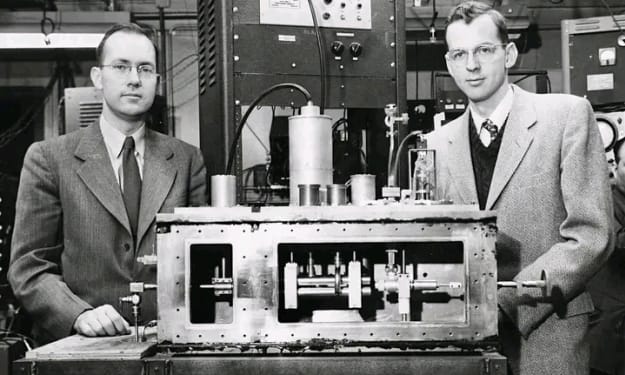
How a Quiet Invention in 1955 Changed Physics and Everyday Life On August 15, 1955, three scientists—Charles Townes, James Gordon, and H. J. Zeiger—published a paper that might have seemed obscure to the general public at the time. Its title was long and technical: “The Maser—New Type of Microwave Amplifier, Frequency Standard, and Spectrometer.” Yet hidden in those words was the seed of a technological revolution. Their invention, the maser, would become the direct forerunner of the laser, and eventually transform not only physics but also medicine, communication, and the way we interact with the world.
By Mohamed hgazyabout a year ago in Proof
Quarks: The Elementary Building Blocks of Matter. AI-Generated.
. Quarks: The Elementary Building Blocks of Matter the Subatomic World When I was a child, I used to look up at the night sky and wonder what stars were truly made of. Were they fire, like candles in the heavens, or something deeper—something hidden beneath the surface of what our eyes can see? That simple question stayed with me, and over the years I discovered that scientists had been chasing the same curiosity for centuries. The quest to know what lies beneath matter itself has led us to one of the most fascinating discoveries in modern physics: quarks.
By Mohamed hgazyabout a year ago in Proof
Chasing the Mirror Particle
Chasing the Mirror Particle: My Journey into the World of the Positron" When I first stumbled upon the word “positron”, I imagined something out of a science fiction novel—a particle from another universe, glowing in neon pink, zipping through space. It turns out, reality wasn’t too far from that picture. The positron is, in many ways, a particle from a “mirror world.” It looks exactly like an electron, behaves like an electron, but carries the opposite electric charge. And yes—it’s real, it’s here, and it plays a huge role in both the universe and in our technology.
By Mohamed hgazyabout a year ago in Proof
What Are Space Rockets
What Are Space Rockets and Engineering of Space Rockets When I was a kid, I thought rockets were just giant fireworks—loud, spectacular, and colorful. The truth, as I learned later, is far more fascinating. Space rockets are among the most complex machines humans have ever built. They combine physics, engineering, chemistry, and a fair share of human daring to break free from Earth’s gravitational grip and explore the unknown.
By Mohamed hgazyabout a year ago in Proof