
Is There A Float For The Quiet Queers?
What if pride got wider not tamer?

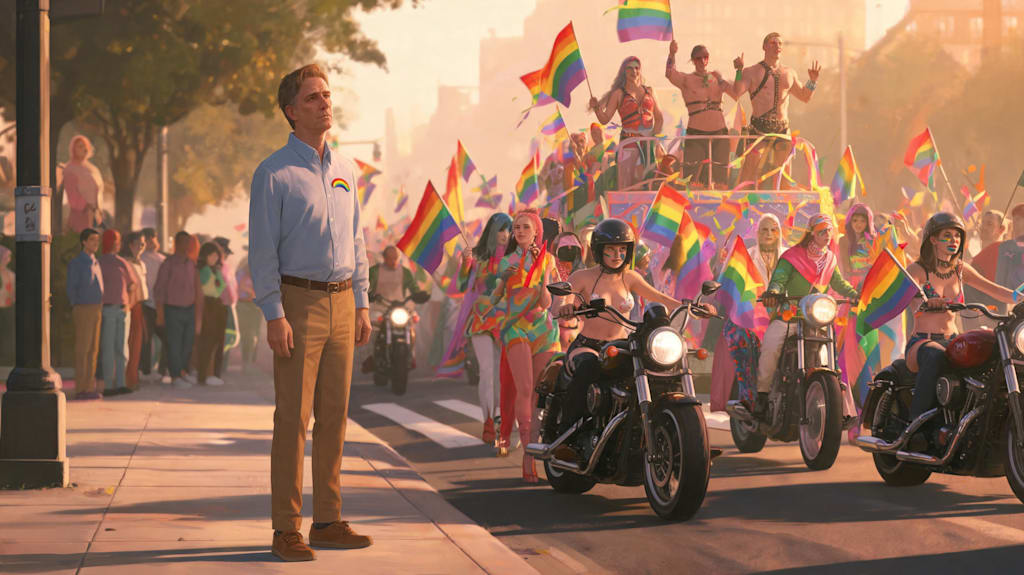
The year I ended up at the front of the Pride parade, Kiehl’s had the branding, Cyndi Lauper had the mic, and I had the creeping sense that I still didn’t quite belong there. I was out, I was proud, I was literally leading the thing — and somehow I still felt like an extra in someone else’s story.
The music was loud, the crowd was wild, and all I could think was: Where’s the float for the people who have to go to work on Monday?
As a Gen X kid who came out “too early”. I’m a gay man who came out at 14, back when being young and queer was not “no big deal.” There were no high school GSA clubs, no corporate rainbow logos, no HR trainings on pronouns. You didn’t “live your truth”; you survived your reality. This was also before an American administration looked us in the eye and tried, very publicly, to erase us — from healthcare protections to military service to basic recognition under the law.
If Pride has always been a protest, those years were a reminder that the protest never ended; it just got better stage lighting. So yes, Pride matters to me. Deeply. Which is exactly why I’ve always felt uneasy saying the next part out loud.
Pride made me proud — and made me feel like an outsider. Every year, the images roll out: men in thongs on floats, topless women on motorcycles, bodies painted, glittered, half‑covered and fully alive. I don’t want that to go away. Those bodies — our bodies — were once criminalized, shamed, and beaten for daring to exist in public. But I’ve always wondered, quietly: Where’s the float for the rest of us?
The ones in khakis and polo shirts. The non‑binary barista in a uniform. The trans woman in scrubs heading into her third 12‑hour shift. The Gen X guy in a pinstripe suit who still remembers when coming out cost people their jobs, and sometimes their lives.
We march off to work, pay our bills, check on aging parents, show up for friends, and try — in small, unglamorous ways — to stay alive and mentally intact. We are as queer as anyone in six‑inch heels at 2 a.m. We just don’t always look good on a billboard.
Our unflattering mirror: substances and survival
Here’s another uncomfortable truth: drugs and alcohol have always been woven into the story of my community. Not because we’re inherently reckless or morally flawed, but because for a long time, bars and clubs were some of the only spaces we had. When home wasn’t safe, school wasn’t safe, and work definitely wasn’t safe, there was always a bar with dim lighting, loud music, and other people who understood why you flinched every time someone said the word “family.”
That history leaves a mark. Today, LGBTQ+ people still experience significantly higher rates of substance use and addiction than the general population, especially young people. That isn’t gossip; it’s data.
Pride, as we currently stage it, can feel like a month‑long permission slip to keep numbing out. Another party. Another drink. Another high. Another chance to forget how much it still hurts to be legislated, debated, and dehumanized on the evening news. I don’t say this to shame. I say it as someone who has watched friends disappear into that numbing — slowly, over years — until they were just gone.
There’s also the sex. Pride is often portrayed as one long montage of harnesses, leather, crop tops, jockstraps, pasties, and a surprising number of people who somehow have both the time and emotional stability to go to the gym nine days a week.
Again: I am not mad at the harness.
I am not asking anyone to “tone it down.” Many of us have heard that exact phrase — or something much uglier — our entire lives. I admire the people who can walk down the center of a city street in a thong and feel more free than afraid. They earned that. But I can’t help asking: when our enemies want to reduce us to what we do in bed, are we accidentally doing some of their work for them? Right now, sexual orientation and gender identity are being mashed together and weaponized — often by people who pretend not to know the difference.
While we’re out here celebrating, lawmakers are passing bills about bathrooms, sports teams, healthcare access, and curriculum, all under the banner of “protecting children” from our alleged hyper‑sexuality.
At the same time, trans people — especially Black trans women — are experiencing epidemic levels of violence, with studies showing they are far more likely to be attacked or murdered than cisgender people. That is the backdrop against which we roll out the floats.
So I ask myself: when the cameras pan across the crowd, who do they see? The thong on the float? Or the trans woman of color who may not make it home safely that night? This isn’t about “good gays” and “bad gays”. I need to be excruciatingly clear about this part. I am not the “good kind” of gay, wagging a finger at the “bad kind.”
I have danced in those clubs, gone home with strangers, made terrible decisions, and soothed my own pain with things that were never designed to heal me. There is no moral distance between the guy in the thong and the guy in khakis.
We’re both carrying our own ghosts. What I’m calling out is not individual choice, but the optics we keep choosing as a community — the version of ourselves we keep putting front and center, year after year, even as our most vulnerable members are dying.
If Pride is our biggest stage, I’m simply asking who keeps getting the spotlight, and who is still standing in the dark. What would it look like for Pride to get wider instead of “tamer”?
A few ideas:
- A 9‑to‑5 float: nurses in scrubs, teachers in cardigans, retail workers in their name tags, office workers in their slightly‑wrinkled suits — all marching together under a banner that says, “We are everywhere you work.”
- A “Sober and Still Loud” block: visible, celebrated space for people in recovery or people who just don’t want to drink or use, proving that joy doesn’t have to be chemically enhanced to be real.
- A Trans Front Line: the parade literally led — or co‑led — by trans women of color and other trans and non‑binary humans, with organizers naming out loud the violence they face and the protections they deserve.
- A Grief and Rage moment: a planned pause in the music to read the names of those we’ve lost to violence, suicide, addiction, and neglect, reminding everyone that Pride exists because closets and closets‑with‑rainbows have killed us.
None of this requires taking a single thong off a single body. It just asks us to widen the frame. Pride, for the kid in khakis. I keep coming back to that feeling at the front of the parade — that split‑screen in my head. On one side: the noise, the color, the dancing, the bodies. On the other: a quiet question — Is there room in this story for someone like me? The Gen X kid who came out “too early.”
The man who has complicated feelings about substances because he’s seen what they can take. The guy who doesn’t lead with his sexuality at work, not because he’s ashamed, but because he wants to be known for all of who he is. I don’t want Pride to be less wild. I want it to be wider.
I want a Pride where the man in the thong, the lesbian on the motorcycle, the non‑binary teen in a hoodie, the sober queer in khakis, and the trans woman in scrubs who is just trying to make it through her shift all know they belong in the same story.
Because if we’re going to tell the world we’re proud, then I want to see all of us up there. Not just the parts that look good on a float.
Written where human nervous systems and machine logic collide. AI‑assisted, human owned.
About the Creator
Joshua Estrin, PhD
Queer AI anarchist tracking unit economics, politics, and pop culture as the world spirals toward full Handmaid’s Tale. Built $48M in revenue - Superman hat non‑negotiable
Enjoyed the story? Support the Creator.
Subscribe for free to receive all their stories in your feed.
Comments
There are no comments for this story
Be the first to respond and start the conversation.