
Divine or Divisive?
A transgender Jesus challenges tradition—but does Cosimo Cavallaro’s latest work redefine faith or rely on spectacle?

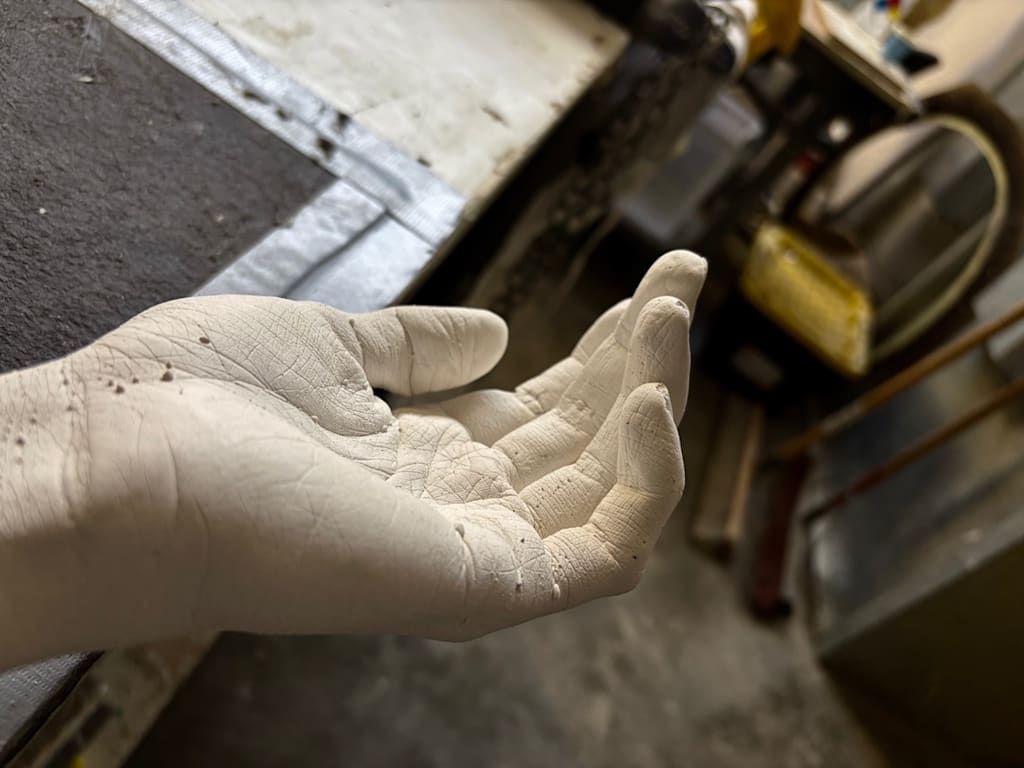
In an era when religious imagery is as likely to trend on social media as it is to hang in a museum, the line between provocation and profundity has rarely felt thinner. That tension is at the center of a new work by Cosimo Cavallaro, whose upcoming installation Passion of the Crust reimagines Jesus Christ as a transgender figure—cast entirely in chocolate and designed to melt, slowly and deliberately, before a global audience.
The project arrives at a moment already charged with debate over sacred symbolism. When Donald Trump recently shared an image depicting himself as Jesus, backlash was swift and widespread, with critics accusing him of blasphemy, self-aggrandizement, and the politicization of faith. Supporters, meanwhile, framed it as satire or an expression of devotion. Regardless of intent, the reaction underscored a persistent cultural sensitivity: depictions of Christ—especially unconventional ones—remain among the most volatile artistic choices.
Cavallaro’s work steps directly into that fraught terrain. Scheduled to be unveiled on May 17 as part of a live, pay-per-view event, the sculpture presents a life-sized, nude, transgender Jesus, modeled after fashion figure Rain Batingana. The figure will be placed on a heated aluminum plate and filmed by multiple cameras as it melts over the course of three hours, set to the swelling crescendos of Maurice Ravel’s Boléro. The result, Cavallaro suggests, is not destruction but transformation—a meditation on impermanence, embodiment, and the narratives imposed upon sacred icons.
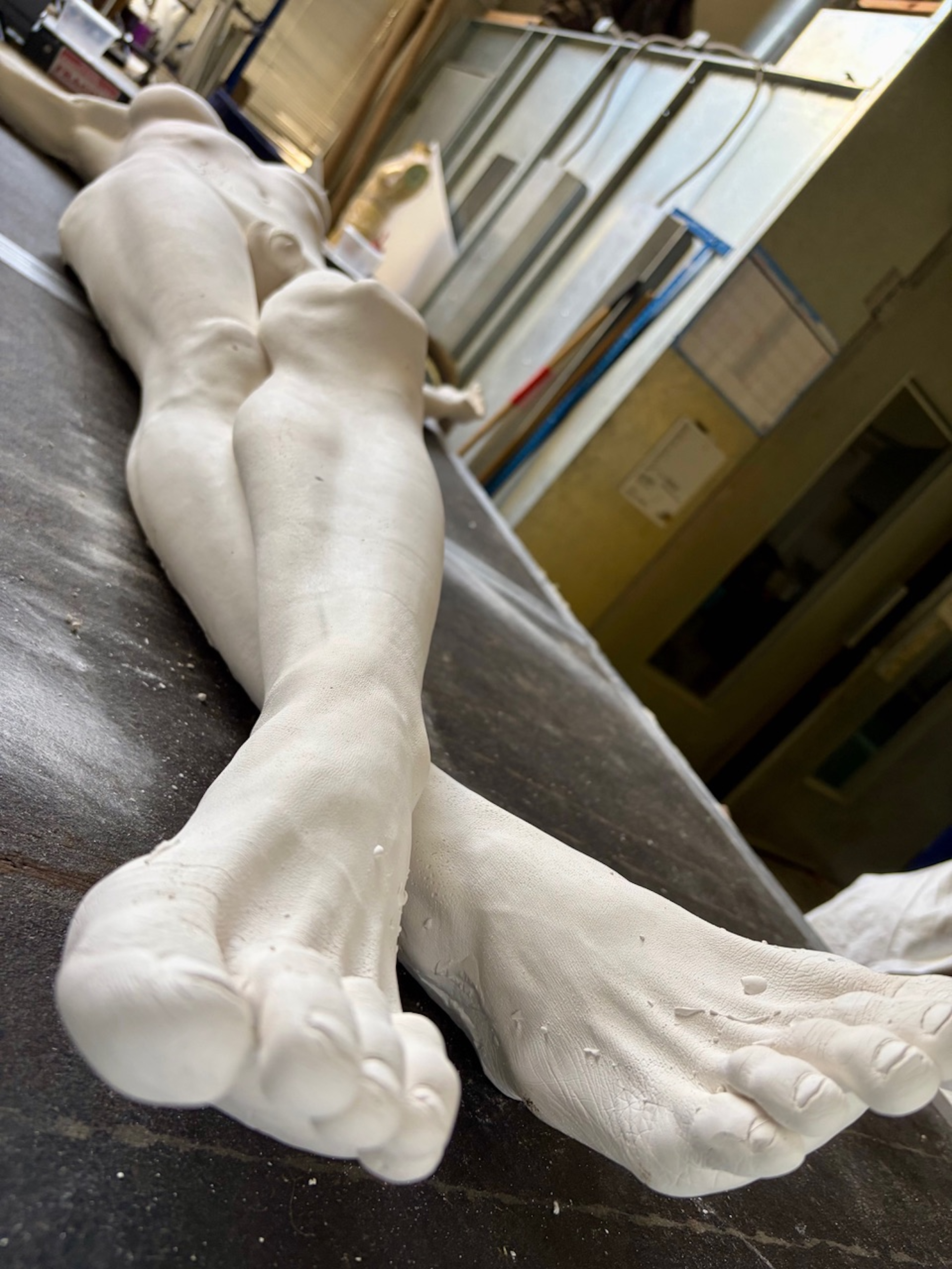
Yet for all its conceptual framing, the question lingers: does Passion of the Crust meaningfully expand the language of religious art, or does it rely too heavily on shock value?
Cavallaro is no stranger to controversy. His 2007 sculpture My Sweet Lord, which also depicted Jesus in chocolate, ignited international debate and was ultimately canceled before public exhibition. Throughout his career, he has worked with perishable materials—cheese, chocolate, ketchup—often emphasizing decay and ephemerality. In that sense, the melting Christ is consistent with his artistic vocabulary. The medium is the message: bodies dissolve, icons erode, meaning is unstable.
But the addition of a transgender identity complicates the equation. For some, it represents a bold and necessary intervention, challenging centuries of rigid, gendered depictions of divinity. It invites viewers to consider whether the figure of Christ—so often invoked as universal—can truly encompass marginalized identities. Cavallaro himself has framed the work as an act of expansion rather than redefinition, suggesting that divinity resists confinement.
For others, however, the piece risks collapsing complex theological and lived realities into a single, highly stylized gesture. The use of a transgender body—particularly one rendered nude and consumed by spectacle—raises questions about representation and agency. Is the work amplifying transgender visibility, or instrumentalizing it? Does the symbolism deepen understanding, or does it flatten identity into a provocation designed to elicit reaction?

These tensions are amplified by the context of its release. May 17 is internationally recognized as the International Day Against Homophobia, Biphobia, and Transphobia, commemorating the World Health Organization’s 1990 decision to declassify homosexuality as a mental disorder. This year, the date also coincides with “Rededicate 250,” a government-backed initiative to symbolically reaffirm the United States’ relationship with God ahead of its 250th anniversary. In positioning Passion of the Crust against this backdrop, Cavallaro’s work becomes not just an artwork, but a counter-narrative—one that challenges official expressions of faith with a more fluid, contested vision.
Still, provocation alone does not guarantee artistic success. The history of religious art is filled with works that shocked in their time but endured because they offered more than controversy—because they revealed something new about belief, humanity, or the divine. From Michelangelo’s muscular Christ in the Sistine Chapel to Andres Serrano’s Piss Christ, the most lasting works have balanced disruption with depth.
Whether Cavallaro achieves that balance remains an open question. The spectacle of a melting chocolate body, livestreamed for $9.99, risks veering into the territory of performance as commodity—an experience consumed as quickly as the sculpture itself dissolves. At the same time, its very ephemerality may be the point: a critique of how easily images of faith are created, circulated, and discarded in the digital age.
What is clear is that Passion of the Crust is less about providing answers than about forcing confrontation. It asks viewers to grapple with their own assumptions about gender, sanctity, and the boundaries of artistic expression. It also exposes the uneven standards by which such expressions are judged. If Trump’s self-depiction as Jesus is dismissed as hubris or parody, and Cavallaro’s transgender Christ as blasphemy or activism, what does that reveal about who is permitted to reinterpret the divine—and to what end?
In the end, the artistry of a transgender Jesus may not lie solely in its execution, but in its ability to provoke precisely these questions. Whether one views the work as profound, offensive, or somewhere in between, it underscores a truth that artists have long understood: the most contentious images are often the ones that refuse to settle into easy meaning.
Chocolate Jesus Melts presents Passion of the Crust livestream will be available globally as a live pay-per-view event for $9.99 at chocolatejesusmelts.com, with the PPV replay also available for post-event viewing.
About the Creator
Enjoyed the story? Support the Creator.
Subscribe for free to receive all their stories in your feed.
Comments
There are no comments for this story
Be the first to respond and start the conversation.