
The first crack appeared in the kitchen ceiling at 2:13 in the morning.
I know the exact time because I was awake, sitting at the table in the dark with my laptop open, pretending to work while actually rereading old messages from my ex-wife. The apartment was silent except for the hum of the refrigerator and the occasional drip from the faucet I had been meaning to fix for months.
Then came the sound.
A soft pop.
Not loud. Not dramatic. Just the sound of something giving up quietly.
A thin line split across the ceiling above the sink, and a drop of brown water landed beside my coffee mug.
I stared at it for a second.
Then another drop fell.
Then another.
Most people would have called the landlord immediately.
But I had already called the landlord three times that month about different issues: the broken heater, the mold near the bathroom vent, the front door lock that jammed if the weather changed too quickly. Every time he answered with the exhausted tone of a man who regretted owning property but regretted normal employment even more.
“Just keep an eye on it,” he usually said.
So I decided not to call.
That was the first mistake.
The second mistake was believing YouTube tutorials had made me more capable than I actually was.
I found a video called *How to Repair Minor Ceiling Water Damage Yourself*. The man in the video smiled constantly, which should have been suspicious. Nobody smiles that much while discussing structural problems.
According to him, the important thing was to act quickly before the leak spread.
I liked that advice because it made me feel proactive instead of irresponsible.
So at three in the morning, I climbed onto the kitchen counter with a flashlight and a screwdriver and poked a small hole into the crack to “release trapped water pressure.”
That phrase came directly from the video.
For about half a second, I felt smart.
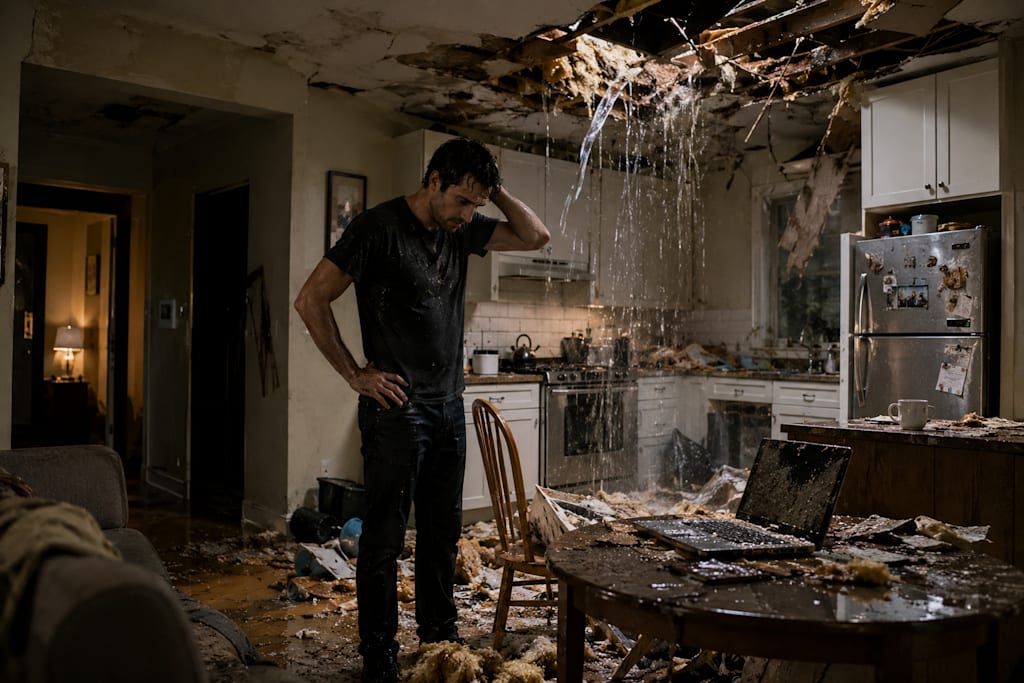
Then the ceiling burst open.
Not collapsed entirely. Just enough.
A stream of filthy water exploded downward with surprising force, hitting the sink, the stove, my shirt, and finally the laptop sitting open on the table behind me.
The laptop died instantly.
A sharp little blink, then darkness.
I remember standing there soaked and stunned while water poured through the hole in steady, aggressive waves.
The correct response would have been simple: turn off the electricity, call the landlord, maybe call emergency maintenance.
Instead I panicked about the laptop.
Because the laptop contained everything.
Tax documents. Work files. Photos. Notes. Half-finished writing projects I kept promising myself I’d return to. More importantly, I had a presentation due that morning for a client who already thought I was unreliable.
So while water continued leaking from the ceiling, I grabbed towels and focused entirely on saving the computer.
I dried it with paper towels first.
Then I remembered hearing somewhere that electronics survive water damage if they dry quickly enough.
So I used a hairdryer.
I know how stupid that sounds now.
At the time it felt logical. Heat dries water. Problem solved.
Except the heat apparently pushed moisture deeper inside because the laptop started making a faint crackling noise. A burnt smell followed shortly after.
I unplugged the hairdryer immediately, which was wise, though perhaps four decisions too late.
By then water had spread across the kitchen floor and seeped into the hallway carpet.
Still, I didn’t call anyone.
This is the part I struggle to explain to people afterward: every mistake felt temporary. Reversible. Like I was always one smart decision away from fixing the original problem.
That belief carried me through the next several catastrophic hours.
I searched online for emergency data recovery solutions using my phone. One article suggested placing wet electronics inside rice.
I didn’t have rice.
I did have cat litter.
The internet claimed silica-based litter absorbed moisture similarly.
So I emptied an entire box of cat litter into a storage bin and buried my laptop inside it like a tiny technological funeral.
Then I returned to the ceiling leak.
By now the dripping had slowed slightly, which gave me false confidence. I found another tutorial recommending waterproof expanding foam for temporary ceiling sealing.
At six in the morning, I drove to a hardware store wearing wet jeans and bought three cans.
The cashier asked if I was “working on a project.”
“Yes,” I said.
That word still embarrasses me.
Back home, I sprayed the foam directly into the hole. At first it worked beautifully. The leak slowed almost immediately. The foam expanded neatly across the crack like sealing cream.
I actually laughed out loud from relief.
Then I heard muffled shouting.
The upstairs neighbor started pounding on his floor.
Apparently the foam had expanded upward too, pushing into the pipes beneath his sink cabinet. One of the pipes shifted loose enough to start leaking directly into his apartment.
Which then overflowed back down into mine.
Except now the water had nowhere to drain because I had sealed the original opening.
The ceiling bulged downward like a swollen blister.
I finally called the landlord.
He arrived forty minutes later with the expression of a man preparing himself for disappointment.
I tried explaining everything quickly before he walked inside, hoping context would somehow soften reality.
It did not.
The moment he stepped into the kitchen, the ceiling gave way entirely.
Water, insulation, soggy plaster, and expanding foam crashed onto the floor in one spectacular collapse. Part of the light fixture came down with it. Gray water splashed across the walls and into the hallway.
The landlord just stared silently.
Then he asked the question I had been avoiding all morning.
“Why didn’t you call me when it first started leaking?”
I didn’t have a good answer.
The honest answer sounded pathetic even inside my own head: because I wanted to prove I could handle something on my own.
That’s the ugly truth underneath most of my disasters. I confuse independence with competence.
The landlord shut off the building water supply. Unfortunately, this affected all six apartments. Unfortunately again, it happened on a Saturday morning when everyone was home.
Within an hour, angry tenants filled the hallway asking questions I couldn’t answer.
One woman had shampoo in her hair when the water stopped.
An older man kept repeating, “How does a ceiling even explode?”
I stayed inside my apartment pretending not to hear them.
Then my phone rang.
My boss.
I had forgotten entirely about the presentation.
My work laptop — the dead one marinating in cat litter — contained the only finalized version.
I tried opening backup files from cloud storage using my phone, but they were outdated drafts missing critical sections. I attempted to explain the situation calmly, but halfway through I heard how insane I sounded.
“There’s water damage,” I said. “And foam. It’s complicated.”
My boss was quiet for a long moment.
Finally he asked, “Are you having some kind of breakdown?”
At the time, I said no immediately.
Now I’m less certain.
By evening, the apartment smelled like mildew and burnt plastic. Industrial fans roared through the kitchen while two repair workers removed sections of ceiling. The landlord barely spoke to me except to mention costs repeatedly in a strained, controlled voice.
Then came the final humiliation.
The cat litter trick had not worked.
When I dug the laptop out of the storage bin, tiny grains had lodged themselves into the ports and cooling vents. The repair technician later described it as “surprisingly destructive.”
That phrase has stayed with me because it perfectly summarizes the entire situation.
Surprisingly destructive.
Not malicious.
Not intentional.
Just a long chain of confident little corrections that slowly transformed inconvenience into catastrophe.
The ceiling repair took three weeks. My insurance covered almost nothing because technically the major damage resulted from “unauthorized repair attempts.” My boss reassigned the client account permanently. The upstairs neighbor avoided eye contact with me after that.
And the worst part is I can still trace the logic behind every decision.
That’s what scares me.
I understand why I made them.
Every action felt reasonable in isolation. Responsible, even. I wasn’t trying to destroy anything. I was trying to stop small problems from becoming larger ones.
But somewhere along the way, fixing the problem became more important than understanding it.
I never stopped to ask whether I actually knew what I was doing.
That realization hit hardest a few weeks later when my ex-wife called after hearing about the apartment from a mutual friend.
“You always do this,” she said.
“At least this time it was only a ceiling.”
I knew exactly what she meant.
During our marriage, I approached arguments the same way I approached leaks: immediate action, constant adjustment, frantic overcorrection. If something felt wrong, I attacked it before understanding it. I filled silence too quickly. Apologized for the wrong things. Forced conversations before emotions settled.
I thought effort alone could repair damage.
But effort without patience is panic wearing work clothes.
That apartment ceiling wasn’t the first thing I ruined trying to save it.
It was just the loudest.
About the Creator
Mr Ali
Hello EveryOne..!!
Enjoyed the story? Support the Creator.
Subscribe for free to receive all their stories in your feed.
Comments
There are no comments for this story
Be the first to respond and start the conversation.