
Take Trump Seriously, Not Literally
Why many of Trump's statements are aimed at specific audiences rather than the public at large
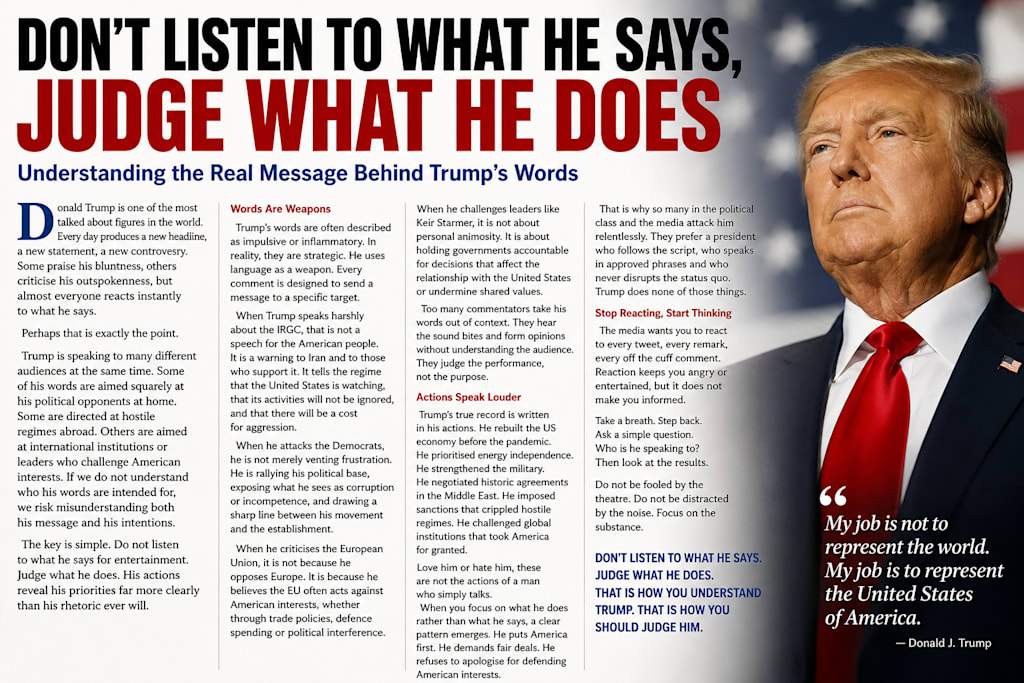
Few political figures have generated as much debate as Donald Trump. Every speech, interview and social media post seems to produce headlines around the world within minutes. Supporters often describe him as refreshingly direct, while critics argue that his language is provocative, divisive or inflammatory. Whatever opinion people hold, there is one aspect of Trump's communication that is frequently overlooked. His words are often directed at specific audiences rather than the public at large.
Modern politics is not simply about making announcements. It is also about negotiation, signalling, persuasion and deterrence. Politicians often tailor their language depending on who they are trying to influence. Business leaders do the same during negotiations, military commanders use carefully chosen language to deter potential adversaries and diplomats frequently communicate messages that are intended as much for foreign governments as for domestic audiences. Trump has made this style of communication one of the defining characteristics of his political career.
When he criticises the Iranian regime or the Islamic Revolutionary Guard Corps, his language is often intended to signal resolve and deterrence. Whether one agrees with that approach or not, the audience is not simply the American public. The message is also aimed at officials in Tehran and others watching events in the region.
When he attacks the Democratic Party, the audience is primarily domestic. His remarks are designed to energise supporters, challenge political opponents and frame policy debates in ways that benefit his campaign or administration.
Similarly, when Trump criticises the European Union or previous leaders such as Sir Keir Starmer, his comments are often understood as part of broader disagreements over trade, defence spending, immigration, or foreign policy. His words may be intended to apply pressure or establish negotiating positions rather than simply express personal dislike.
Many commentators, however, treat every remark as though it were intended for everyone equally. Individual statements are frequently taken in isolation, without considering the political context or the audience being addressed. As a result, debates often focus on the tone of Trump's language rather than the policy objectives he is pursuing.
That does not mean words are unimportant. Political rhetoric can shape public opinion, influence diplomatic relationships and affect social attitudes. Strong language can have significant consequences and deserves careful scrutiny. At the same time, rhetoric alone does not provide a complete picture of any political leader.A more complete assessment considers both words and actions.
Presidents are ultimately judged by the policies they implement, the decisions they make, the appointments they choose, the legislation they support and the outcomes of their administrations. Speeches may dominate the news cycle for a day or two, but government is carried out through decisions rather than headlines.
This principle applies to every political leader, regardless of party or country. Some politicians speak calmly while pursuing controversial policies. Others use highly confrontational language while implementing policies that differ from what critics or supporters expected. Looking only at rhetoric can therefore produce an incomplete understanding of how someone governs.
Trump's supporters frequently argue that many critics become distracted by individual comments instead of examining the broader record of his administration. His critics, by contrast, argue that his rhetoric itself has important political and social consequences and therefore deserves equal attention. Both perspectives highlight different aspects of political leadership.
Perhaps the most sensible approach is not to ignore either words or actions but to distinguish between them. Ask who a statement is intended to influence. Consider the political circumstances in which it was made. Then examine whether subsequent actions match the rhetoric.
Politics has always involved persuasion, theatre and negotiation. Public speeches are rarely delivered solely for the benefit of the audience sitting in front of the speaker. They are often intended for political opponents, allies, foreign governments, financial markets or supporters watching from home. Understanding who the intended audience is can help explain why certain language is chosen.
Donald Trump has often said that people should take him seriously but not necessarily interpret every remark literally. Whether one accepts that description or not, it illustrates an important point about political communication. Public figures frequently use rhetoric as a strategic tool.
In an age of short video clips, social media posts and twenty-four-hour news coverage, it has become increasingly easy to react to isolated sentences while overlooking the wider context. A fuller understanding requires looking beyond individual headlines and considering both the message and the decisions that follow.
Ultimately, political leaders should be judged on the complete record they leave behind. Actions reveal priorities, while words are often aimed at particular audiences for particular purposes. Unless you understand whoSeriously, Not a message was intended for, you may misunderstand what it really means. Judge the words in their proper context, but judge the leader by what they actually do.
About the Creator
Alan Spencer
Have been an author and writer for over 20 years. Have been a journalist, editor, proofreader, and a designer and presenter of training courses. Have written over 100 articles, two books, and around 20 training courses.
Enjoyed the story? Support the Creator.
Subscribe for free to receive all their stories in your feed. You could also become a paid subscriber, letting them know you appreciate their work.
Comments
There are no comments for this story
Be the first to respond and start the conversation.