
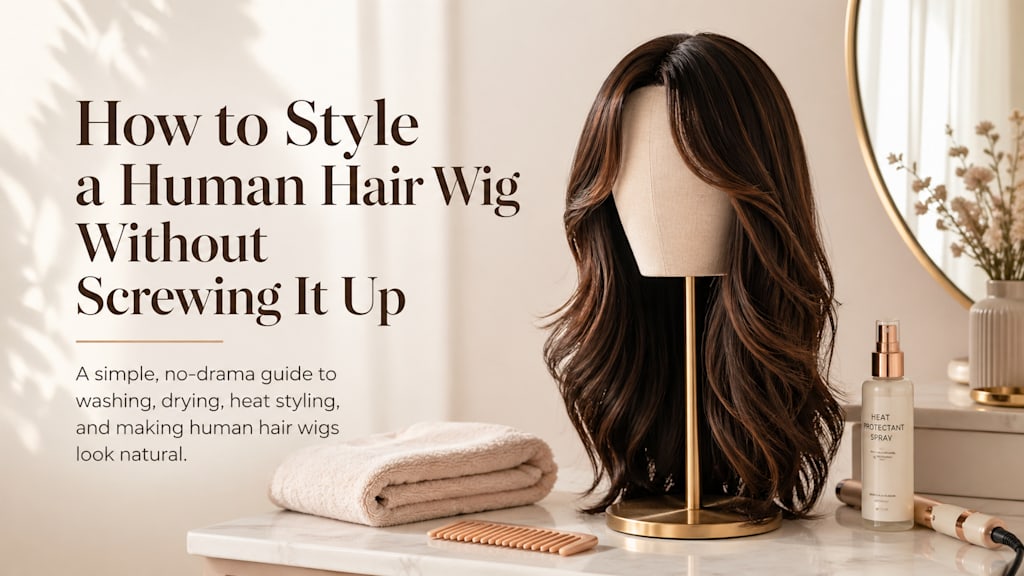
A Pro's Guide: How to Style a Human Hair Wig
What I learned after realizing that a good wig can still look terrible if you treat it like regular hair.

I just think that wigs and makeup and costumes completely transform me.
- Melissa McCarthy
The first time I tried to style a human hair wig, I acted like I knew what I was doing.
I did not.
I had watched enough videos to feel confident, which is usually the first warning sign. I had a brush, a blow dryer, a curling iron, and the kind of optimism that ruins things.
The wig looked beautiful before I touched it. Soft. Smooth. Very “I have my life together.”
Then I started styling it.
Ten minutes later, it looked like it had survived a small emotional breakdown.
That was the day I learned something obvious but useful: a human hair wig is human hair, but it is not the same as the hair growing out of your head.
That little difference matters a lot.
Your own hair gets oil from your scalp. It grows back. It has a whole biological support system happening whether you appreciate it or not. A wig does not. Once the hair gets dry, rough, or damaged, there is no scalp underneath whispering, “Don’t worry, babe, I’ve got this.”
There is just you, your tools, and the consequences.
So if you are trying to learn how to style a human hair wig, here is the truth I wish someone had told me earlier: most of it is about not doing too much.
Very annoying. Very true.
Start by leaving the wig alone for a minute
This sounds stupid, but it helps.
Before I style a wig now, I put it on a wig stand and just look at it.
Not in a dramatic way. I am not having a candlelit conversation with it. I just want to see what I am working with.
Where does the part naturally sit?
Is the front too flat?
Are the ends dry?
Does the hair fall forward?
Does it need shaping, or am I just bored and looking for problems?
That last question is important.
A lot of bad wig styling starts with unnecessary confidence.
I use a wide-toothed comb and start from the ends. Not the roots. The ends. Starting at the top and dragging the comb down through tangles is basically a crime with better lighting.
If there is a knot, I slow down. I hold the hair gently and work through it.
Nothing about this is exciting. But it keeps the wig from shedding more than it needs to.
The first styling session should be boring
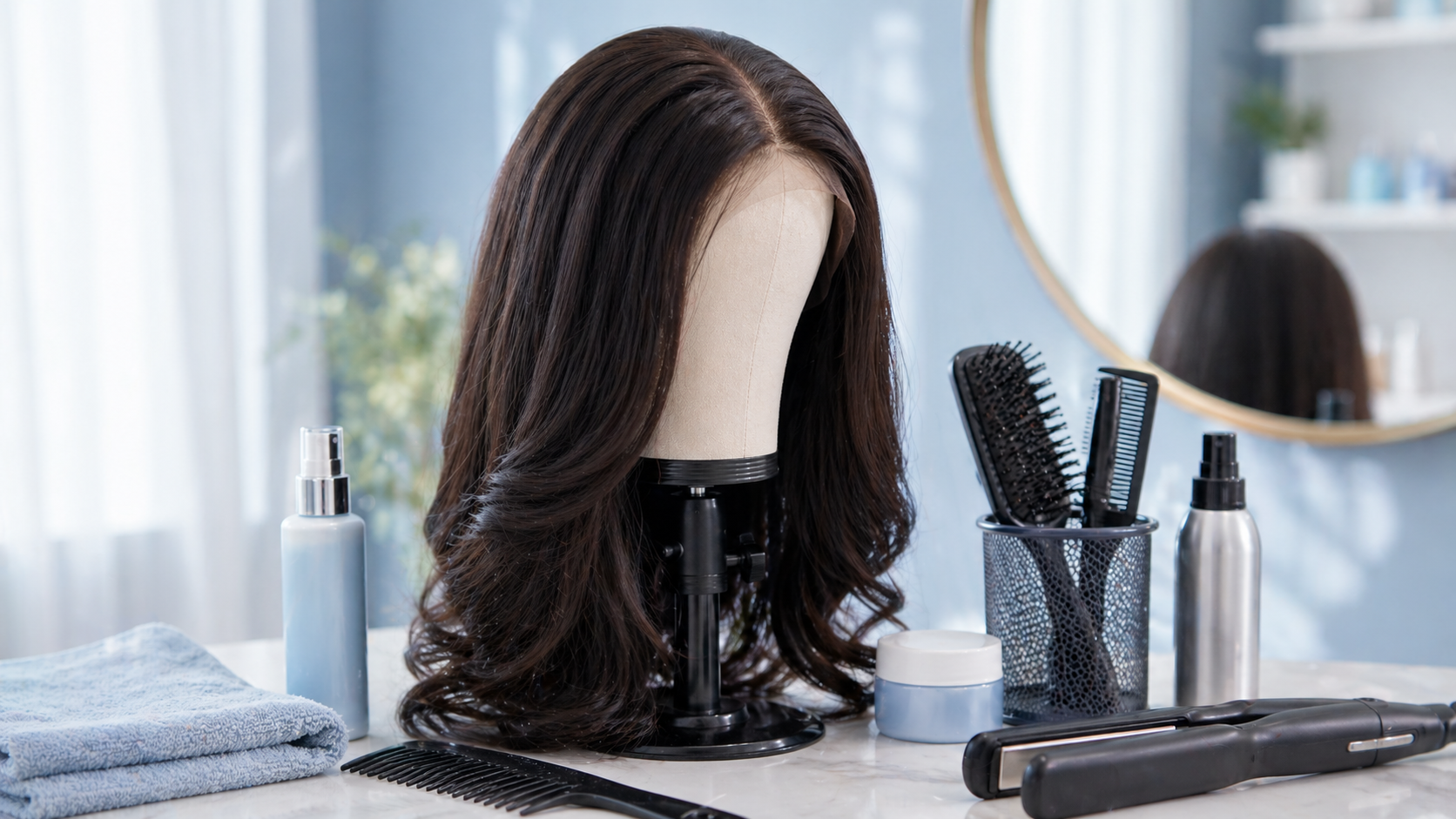
The first time I style a new human hair wig, I try not to get heroic.
No dramatic curls. No random layers. No cutting bangs because I suddenly believe in myself. No dye. No “let’s just see what happens.”
That sentence has ruined many things.
I put it on first. I check the front hairline. I see how the lace sits. I look at it in normal light, because bathroom lighting is a liar. Then I decide what actually needs fixing.
Sometimes the answer is almost nothing.
Maybe the ends need a soft bend. Maybe the front pieces need to move away from the face. Maybe the top needs a little lift. Maybe the wig is fine, and I just need to stop staring at myself like I am trying to identify a suspect.
A new wig can feel strange even when it looks good. That does not mean it needs a full makeover.
Washing is where people get too aggressive
I used to think washing a wig was just washing hair.
Wrong again.
Now I use lukewarm water, not hot water. I use a gentle shampoo. I move in the direction of the hair instead of rubbing everything around like I am trying to start a fire.
I do not scrub the cap. I do not twist the hair. I do not wring it out.
I used to wring it out.
I regret that version of myself.
After shampoo, I condition the mid-lengths and ends. I try not to pack heavy conditioner into the base or knots, especially if the wig has lace. Then I rinse it properly and blot it with a towel.
Blot. Not attack.
There is a difference.
Wet hair is weaker. Wet wig hair is even more annoying because you are not just dealing with hair. You are dealing with hair attached to a base. Pull too hard, and you are stressing the whole thing.
That is not care. That is bullying.
Let it dry before you expect it to behave
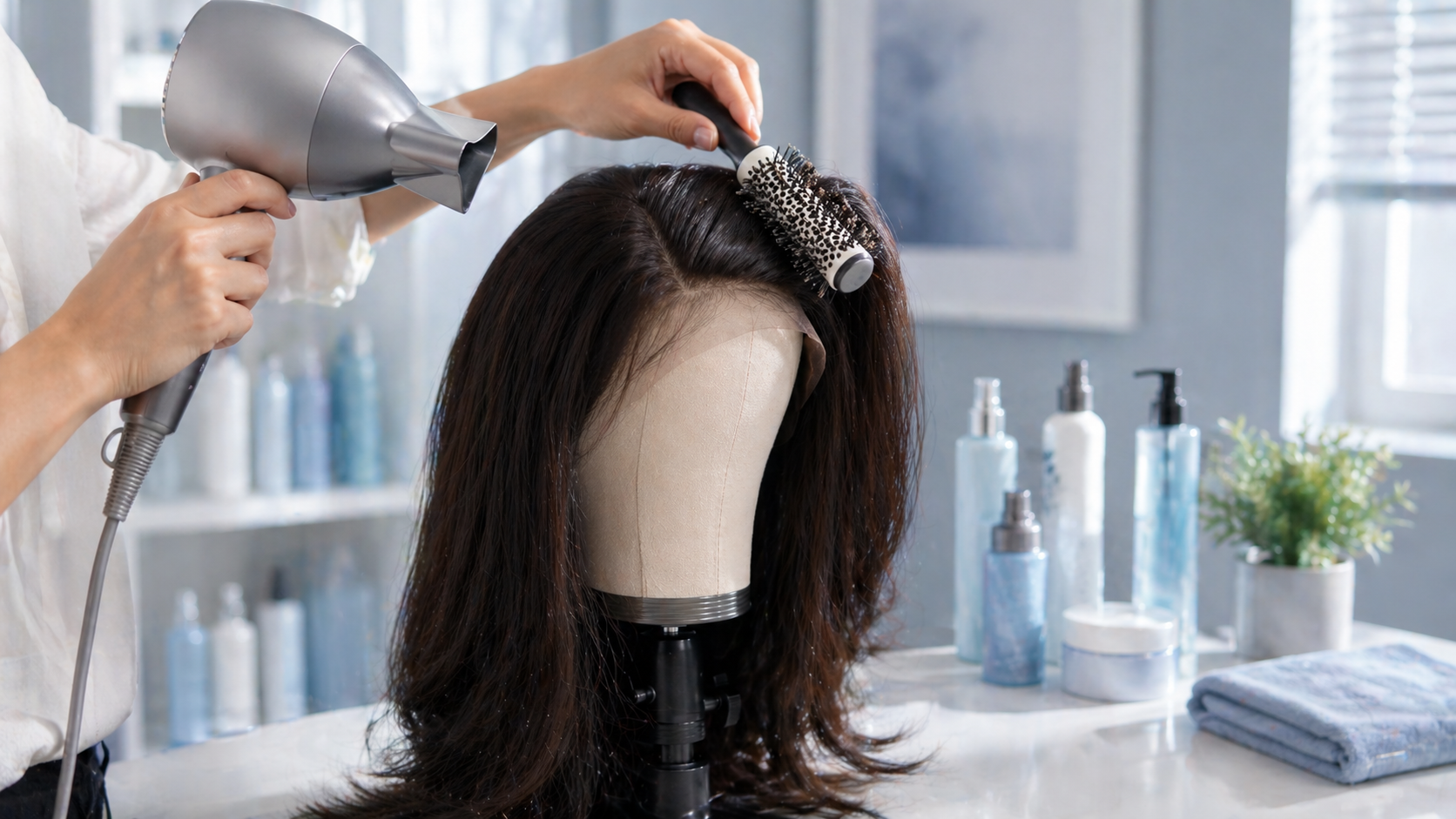
A damp wig will lie to you.
It will look puffy in one place, flat in another, and generally confused. This is not always a problem. It is just wet hair doing wet hair nonsense.
I prefer letting a wig air dry on a wig stand when I have time. It keeps the shape better and gives the hair a chance to settle.
But sometimes I do not have time. Sometimes I need to leave the house looking like a person. So yes, I do blow dry my human hair wig when I need to.
The trick is not to blast it with heat like you are punishing it.
Low or medium heat. Keep the dryer moving. Start gently around the cap, then move through the lengths. I do not drag a brush through it while it is soaking wet. I wait until it is partly dry, then shape it.
This one change made a big difference for me.
The hair looked smoother. The ends felt less angry. The whole wig stopped looking like it had been styled in a rush by someone making bad decisions.
Which, to be fair, it had.
Heat styling is fine. Acting wild with heat is not.
Human hair wigs can usually handle heat styling. That is part of the appeal.
You can curl them. Straighten them. Smooth the front. Add waves. Make them feel more like your own hair.
But “can handle heat” does not mean “please cook me.”
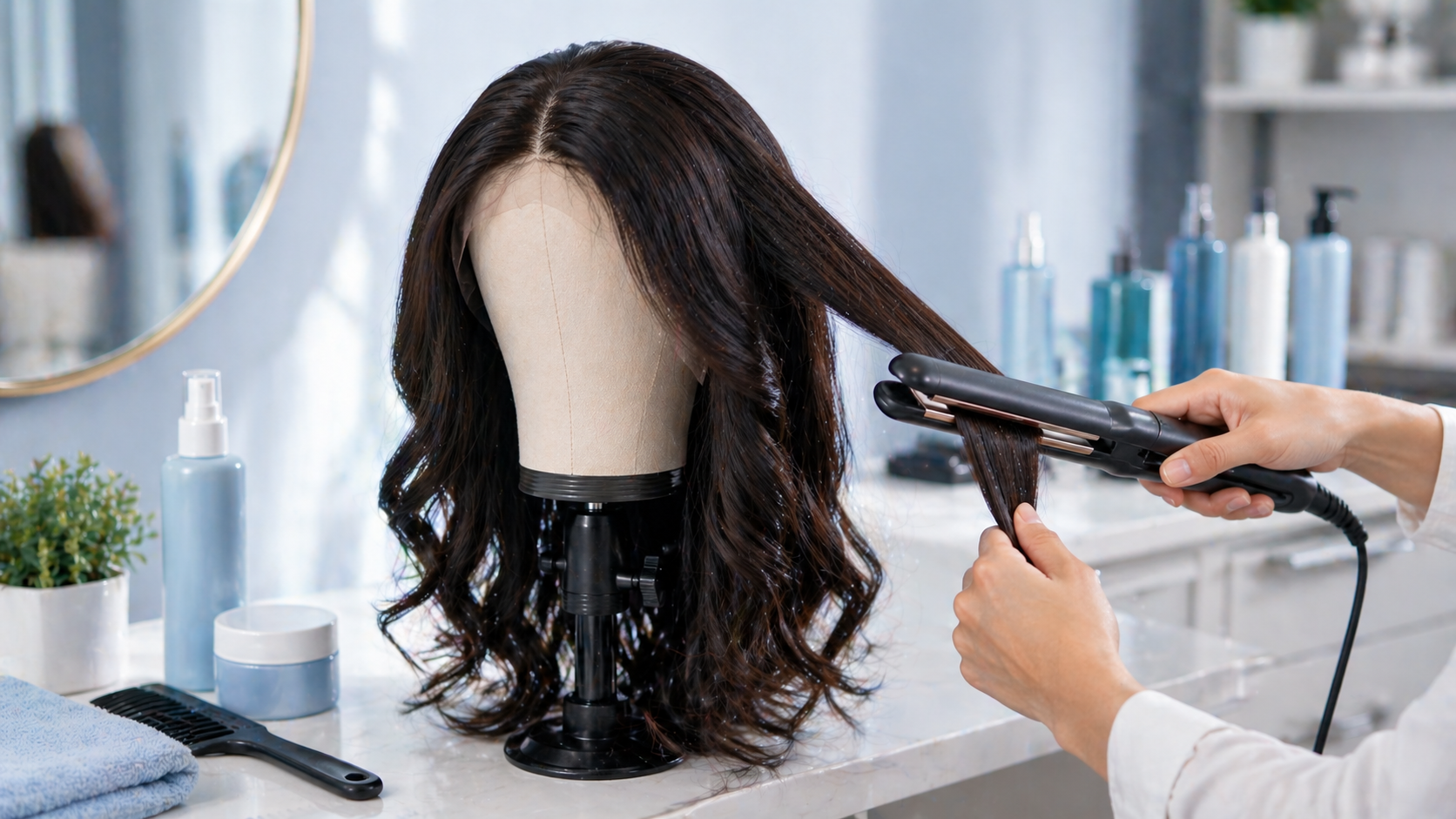
I always use heat protectant now. I keep the temperature moderate. I work in small sections. I do not clamp the same piece of hair again and again because I am chasing some perfect curl that no one on earth will notice.
Also, I do not press hot tools into the lace.
The lace did nothing wrong.
A soft wave usually looks better than a perfect curl anyway. Perfect curls can make a wig look too done. Too stiff. Too much like you tried extremely hard, which is sometimes worse than not trying enough.
The goal is not “pageant hair.”
The goal is “my hair just happens to look decent today.”
Even if that is a complete scam.
The front is where everything goes wrong
If a wig looks fake, I usually notice the front first.
The hairline is too thick. The lace is too shiny. The part is too perfect. The front sits too low. There is too much product. Something is just off.
The front matters because that is where people look.
I try to keep that area soft. I use less product near the hairline. I avoid heavy spray. I make sure the wig is not sitting too far forward on my forehead.
The four finger rule can help as a rough starting point. Some people use about four fingers from the eyebrows to estimate where the front hairline should sit. It is not a sacred law. Faces are different. Wigs are different. Foreheads are definitely different.
So I use it as a guide, then adjust by eye.
If it looks natural and feels secure, that is the answer.
Short wigs and toppers are not automatically easier
I used to think short wigs would be easier because there is less hair.
That was cute of me.
Short wigs have less hair to manage, yes. But they also have less hair to hide mistakes. The sides, crown, neckline, and front pieces all have to sit right.
A long wig can hide a weird section with waves. A short wig has no mercy.
Toppers and hair pieces have their own issues. They need to blend with your own hair, which means the color, texture, density, and direction all have to make sense together.
If a topper is too thick, it can look obvious. If the color is slightly off, it can look separate from your own hair. If the front does not sit right, the whole thing feels wrong.
With these pieces, I do less.
Blend first. Shape a little. Stop early.
Stopping early is underrated.
Human hair wigs and synthetic wigs are not the same thing
This is where beginners get into trouble.
Human hair wigs (especially those from Newtimes Hair) and synthetic wigs do not play by the same rules.
A human hair wig gives you more styling freedom. You can use controlled heat, change the shape, smooth it, curl it, and create a more personal look.
Synthetic wigs are different. Some are heat-friendly. Some are very much not. Use the wrong tool and you can ruin the fiber fast.
So when someone asks how to style wigs for beginners, I think the first question should be: what kind of wig is it?
Human hair?
Synthetic?
Lace front?
Topper?
Cosplay wig?
Everyday wig?
Those are different situations.
A cosplay wig might need drama. Strong shape. Spray. Teasing. Big energy.
An everyday wig needs to look believable when you are buying coffee and hoping nobody stares at your hairline.
Different job.
Different rules.
The simple routine I actually use now
I keep it basic.
Wash gently.
Dry properly.
Use heat protectant.
Style in small sections.
Keep the front soft.
Stop before I start inventing problems.
That is it.
No complicated ritual. No twenty-step routine. No pretending every wig needs a full salon production.
Most wigs look better when you do the right small things and then leave them alone.
I wish that were a more exciting answer.
It is not.
But it works.
What Is the Four Finger Rule for Styling Wigs?
The four finger rule is a quick way to guess where the front of the wig should sit.
Many people place about four fingers between the eyebrows and the start of the wig hairline. It gives you a rough idea of a natural front placement.
But it is not sacred law.
Some foreheads are higher. Some are lower. Some lace fronts are built differently. Some people prefer a slightly different placement.
Use the rule as a starting point. Then use your eyes.
Your face gets the final vote.
Not sexy. Not complicated. Just useful.
Because how to style wigs cosplay is not the same as styling a human hair wig for everyday wear. Cosplay wigs often need stronger shapes, teasing, spray, cutting, and drama.
Daily wear wigs need believability.
Different game.
What I would tell my past self
I would tell her to calm down.
I would tell her that a wig does not need to be perfect to look natural. Actually, perfect is often the problem.
Real hair has movement. A little bend. A few imperfect pieces. A part that is not carved into the earth. Ends that move when you walk.
A good human hair wig should feel like hair, not evidence.
So now, when I style one, I try to make it look less styled.
That is the funny part.
I do the work, so it looks like I did not do much work.
And honestly, that is the whole trick.
A human hair wig starts to look better when you stop trying to dominate it and start working with it.
Wash it gently. Dry it like you care. Use heat like an adult. Respect the front. Let the hair move.
And for the love of your own sanity, know when to stop.
About the Creator
Natalee Chand
With 10+ years in hair, I specialize in extensions, wigs & systems, crafting trend-savvy content. My blog educates & inspires stylists and salon owners with expertise in techniques, styling & innovations in the evolving hair landscape.
Enjoyed the story? Support the Creator.
Subscribe for free to receive all their stories in your feed. You could also become a paid subscriber, letting them know you appreciate their work.
Comments
There are no comments for this story
Be the first to respond and start the conversation.