
The map drawn on a melting glacier
What the Ice Erases Faster Than We Can Read A City That Exists Only in Liquid Light

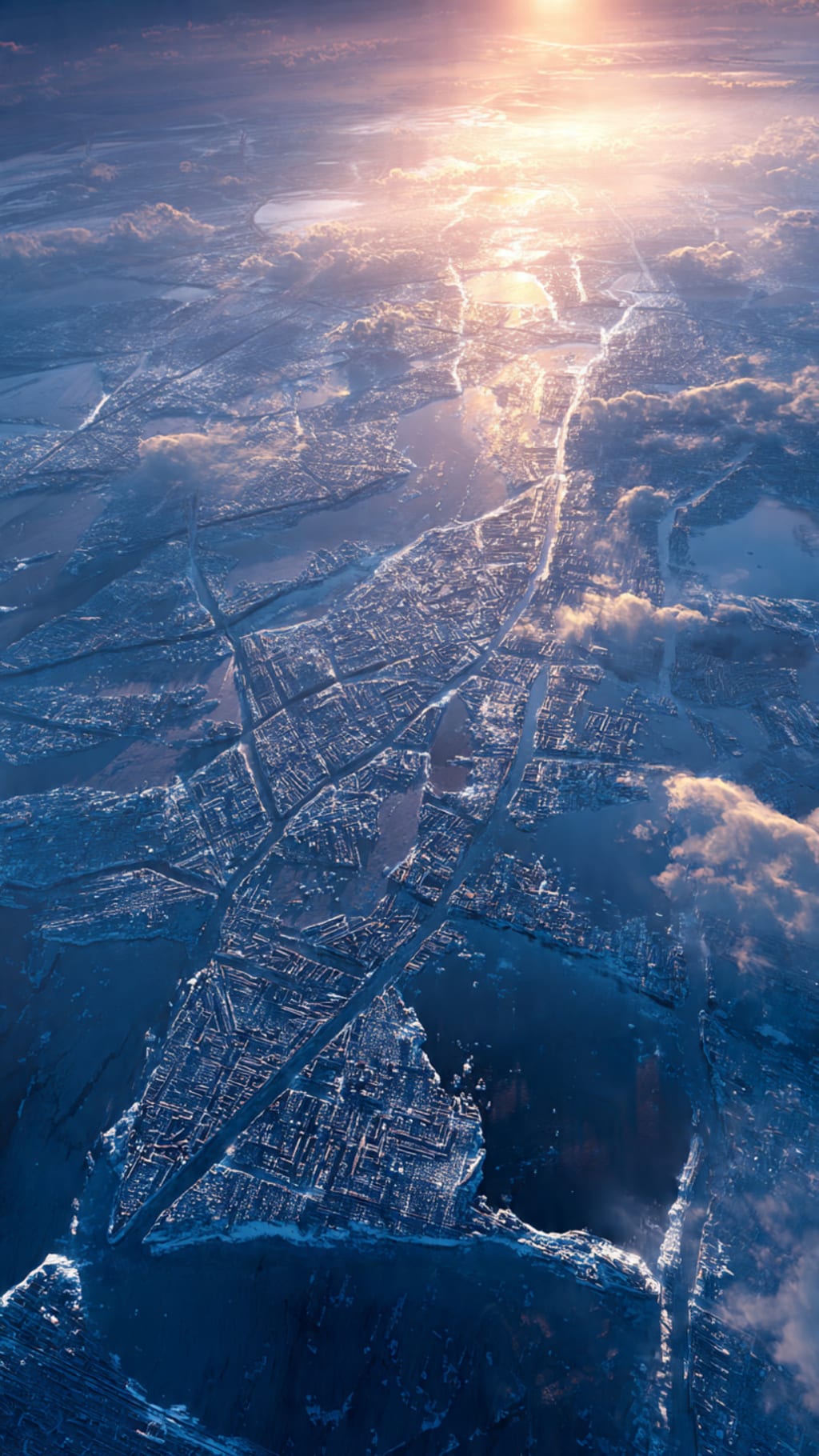
The helicopter pilot refused to fly lower. From the sky, the glacier looked alive. White cracks moved across its frozen surface like veins under skin, glowing faintly beneath the morning sun. Every few minutes, a piece of ice the size of a building collapsed into the dark water below. The sound arrived late — deep, thunderous, final. Dr. Elias Vey pressed his forehead against the cold helicopter window and stared at the impossible lines carved into the glacier. Roads. Perfect roads. Not random cracks. Not natural fractures. Streets. Intersections. Districts. A city map. “Tell me you see that,” he whispered. The pilot remained silent. The radio on Elias’s chest crackled with static. Then a voice emerged from the research station far behind them. “Temperature rising faster than predicted. You have less than two hours before the shelf breaks.” Elias ignored the warning. Below him, hidden inside centuries of ice, was something no satellite had ever recorded clearly. A shape too organized to be natural. An enormous pattern stretching for miles beneath the translucent glacier. And it was melting. Fast. The world had spent decades watching glaciers disappear, but this one had become famous for another reason. Every summer, as more ice vanished, strange geometric patterns appeared underneath the surface. Scientists first believed they were mineral formations. Then someone connected the lines together. The result resembled a complete city blueprint. News channels called it The Frozen Atlas. Conspiracy theories exploded across the internet. Some claimed it was Atlantis. Others believed it was evidence of a lost civilization older than history itself. Elias hated those theories. He believed in facts. But facts were becoming difficult to explain. The helicopter landed roughly on a stable patch of ice. Elias jumped out with his equipment and immediately felt the glacier vibrating beneath his boots. Not shaking. Breathing. He forced the thought away. The air smelled strangely metallic. Meltwater flowed through narrow channels around him, reflecting silver light into the clouds above. Ahead, beneath a layer of crystal-clear ice, massive structures emerged in faint outlines. Towers. Bridges. Entire blocks. A city trapped inside frozen light. Elias activated his scanner and slowly walked forward. The map beneath the glacier was too precise. Every line matched the mathematical ratios of modern urban planning. But carbon dating from nearby ice samples suggested the structures were older than recorded civilization itself. That should have been impossible. Yet the evidence remained frozen under his feet. He stopped near a circular formation buried deep below the surface. Unlike the rest of the city, this section glowed faintly blue. His scanner malfunctioned instantly. Static burst across the display. Then words appeared. NOT EMPTY. Elias froze. The message disappeared. He stared at the dead screen, his heartbeat echoing louder than the wind. “Probably interference,” he muttered. But his voice sounded uncertain. A loud crack split the glacier nearby. Chunks of ice slid into darkness below as freezing water surged upward through new fractures. Elias stumbled backward, nearly dropping the scanner. Then he saw movement beneath the ice. At first he thought it was water distortion. But no. Something moved through the streets below. Slowly. Deliberately. A shadow crossing intersections buried beneath thousands of years of ice. Elias backed away in horror. His rational mind searched desperately for explanations. Light reflection. Pressure waves. Hallucination caused by exhaustion. But the shadow stopped directly under him. Waiting. The ice beneath his boots glowed brighter. Then the glacier began to melt faster. Not naturally. Not gradually. Entire layers turned transparent within seconds, revealing the city below in impossible detail. Towers stretched downward farther than light could reach. Vehicles — or something resembling vehicles — remained frozen along massive roads. And everywhere, lights awakened beneath the ice. One by one. Street after street. Like a city returning to life. Elias heard screaming through his radio. “GET OUT NOW!” the station operator shouted. “The glacier is collapsing!” Too late. The ice beneath Elias shattered. He fell. The world exploded into freezing water and blinding blue light. He expected death instantly, but instead he crashed onto solid ground. Stone. Warm stone. Elias coughed violently and looked upward. Above him stretched transparent ice like a glass sky, with the ocean floating beyond it. Sunlight poured through cracks overhead, illuminating the impossible city around him. It was intact. Not ruined. Waiting. Massive structures towered above silent streets lined with glowing symbols. Rivers of light flowed through channels in the walls like liquid electricity. The air carried a low humming sound that vibrated inside his chest. The city was alive. A sudden voice echoed behind him. “You arrived earlier than expected.” Elias turned sharply. A figure stood in the distance. Human-shaped, though something about its movements felt unnatural — too smooth, too precise. Its skin reflected pale blue light, almost transparent beneath the glowing streets. Elias stepped backward. “Who are you?” The figure tilted its head. “That question has changed many times across history.” Its voice sounded calm. Ancient. Tired. Elias struggled to breathe. “This city… what is this place?” The figure looked upward toward the melting glacier ceiling. “A memory.” More cracks spread through the ice sky above them. Water streamed downward in silver curtains. “The ice protected us longer than predicted,” the figure continued. “But your world became warmer faster than your species understood.” Elias stared at the glowing streets around him. “You’re not human.” The figure smiled sadly. “Neither are you. Not entirely.” Before Elias could respond, the ground trembled violently. Above them, the glacier finally began to collapse. Entire sections shattered like falling glass, sending oceans crashing into the hidden city. Alarms echoed through the streets in a language Elias somehow almost understood. The figure stepped closer. “We left this map for your civilization to find when the ice disappeared.” “Why?” “Because your world is approaching the same ending as ours.” The lights around the city dimmed. Buildings disappeared beneath rising black water. “And because memory survives longer than empires.” The ceiling broke apart completely. Sunlight flooded the ancient city for the first time in thousands of years. Then the ocean swallowed everything. Days later, rescue teams found no trace of Elias Vey. No city. No ruins. Only fragments of melted ice drifting across dark Arctic water. But satellite images captured something strange before the glacier vanished forever. A perfect map. Briefly visible beneath the liquid light. And in the center of it, new lines had appeared. Lines no one could explain. Lines shaped exactly like modern cities across the world.
About the Creator
Enjoyed the story? Support the Creator.
Subscribe for free to receive all their stories in your feed.
Comments
There are no comments for this story
Be the first to respond and start the conversation.