lenses
Lenses that ensure the sharpest photos with plenty of detail and contrast; the best places to buy the best lens brands that fit your camera, individual style and price range.
How to Choose Lenses for Portrait Photography
Camera lenses for portraits need specific features to capture stunning shots. The 50mm lens sits in the sweet spot for natural looking photos. It matches how your eyes see the world. 85mm and 135mm lenses create more dramatic looks. They compress facial features in flattering ways.
By Faheem Bhatti SEOabout a year ago in Photography
How Product Photography Impacts Brand Perception
Customers always notice images before reading descriptions, making product photography vital for brand reputation. Strong product visuals create immediate trust, encouraging buyers to explore more. A brand that invests in professional product photography builds authority in competitive markets, while poorly executed photos often reduce credibility. Each image communicates quality, dedication, and professionalism, which directly influences how customers perceive a brand online.
By Mamunabout a year ago in Photography
A Journey in Photography
M Mehran Photography has always been more than a hobby for me. It is a way of seeing the world, of capturing fleeting moments that often go unnoticed. It is a language without words, a medium where silence speaks louder than sound, and light paints stories more vividly than memory ever could. --- The First Camera I got my first camera when I was sixteen—a simple DSLR, secondhand, with scratches along the body. My parents told me it was “just a toy,” but to me, it was a doorway. I carried it everywhere: crowded streets, empty parks, family gatherings. At first, I took pictures of nothing in particular, snapping at flowers, clouds, and my own reflection in puddles. But slowly, I began to notice the world differently. Photography forced me to pay attention, to see the ordinary as extraordinary. Shadows became textures, sunlight became poetry, and strangers’ faces told stories I had never noticed. --- Capturing Stories The first time I truly understood the power of photography was at a local market. People bustled between stalls, haggling over prices, carrying baskets of vegetables and fruits. I lifted my camera and focused on an elderly man with hands worn from decades of labor. Click. The photo froze him in a moment I could never have captured with my memory alone—the wrinkles on his face, the intensity in his eyes, the subtle tilt of his head as he weighed a fruit. When I showed the photo to my friends, they were silent. Not because it was perfect, but because it told a story. Photography, I realized, was about revealing what often goes unnoticed. --- The Challenges Photography is not just about pointing and shooting. It is patience, observation, and risk. I spent hours waiting for sunsets, chasing fleeting shadows, and navigating rain-soaked streets for the perfect frame. Sometimes, the world refused to cooperate: clouds hid the sun, streets emptied, light failed. Yet, in those moments, I learned something essential: photography is not just about capturing reality—it is about perception. Two photographers can stand in the same spot and see entirely different worlds. The lens, after all, reflects not just the external scene, but the heart and mind of the one behind it. --- Connection Through Images Photography also connects us to others in ways words cannot. I began taking portraits, capturing people from all walks of life: street performers, vendors, children at play. Each face revealed a unique story, and each photo became a bridge between my vision and their reality. One day, I photographed a young girl sitting on the steps of her house, her shoes worn, eyes wide with curiosity. She laughed when I showed her the image. For a brief moment, the photo became a shared experience, a memory preserved, a connection forged through light and shadow. --- Photography as Reflection Over time, I noticed that photography mirrored my own inner world. My early photos were hesitant, timid, safe. As I grew bolder in life, my photos became more daring, experimental, emotional. I learned to use light and composition not just to show what I saw, but what I felt. A photo of a stormy sky might capture my sense of chaos. A quiet street at dawn could reflect solitude or hope. Photography became a journal of emotions, an external map of my internal landscape. --- The Imperfections Not every photograph is perfect. Some are blurred, overexposed, or poorly framed. But even in imperfection, there is beauty. Mistakes often reveal truth. A blurry hand reaching out, a shadow cut off unexpectedly, a stray leaf in the frame—all of it can evoke emotion more powerfully than technical perfection. Photography taught me to embrace imperfection in life as well. Just as a photo can tell a story despite its flaws, we too can grow, evolve, and find meaning even when life doesn’t fit neatly into our expectations. --- A Moment of Recognition I will never forget the first time someone told me my photo moved them. It was a simple street scene: a man feeding pigeons in a quiet plaza. The composition was ordinary, but something about it captured the simplicity and fragility of everyday life. “That’s beautiful,” they said. “It makes me feel something I can’t explain.” In that moment, I realized photography is more than art. It is empathy. It is connection. It is a silent dialogue between the photographer, the subject, and the viewer. --- The Ongoing Journey Even now, photography continues to teach me. It teaches observation, patience, humility, and wonder. It reminds me that life is fleeting, that moments vanish in an instant, and that memory alone is never enough. Through the lens, I preserve fragments of existence, glimpses of beauty, truth, and impermanence. Every photo is a story, a memory, a reflection of a moment that will never happen again. And in capturing it, I also capture myself—my attention, my emotion, my perspective. Photography is not just what I see; it is how I see, who I am, and what I choose to remember. --- Closing Reflection Photography is more than images—it is life paused, felt, and shared. It transforms ordinary moments into lasting impressions, fleeting glances into eternal stories. Every photograph is a conversation, an exploration, a testament to the beauty, complexity, and fragility of existence. And in every photo I take, I am reminded: life is ephemeral, but moments—captured, preserved, and shared—can last forever.
By Muhammad Mehranabout a year ago in Photography
Real Estate Photography, Lifestyle Branding, and Professional Photo Editing
Real estate has always relied on strong visual appeal to attract buyers and investors to properties. In today’s market, the relationship between real estate photography, lifestyle branding, and professional photo editing has grown even more powerful. Customers now expect more than simple property listings; they want aspirational images that highlight both lifestyle and emotional connection. Professional photo editing helps create that experience by ensuring photographs look flawless, persuasive, and deeply aligned with lifestyle branding strategies.
By Mamunabout a year ago in Photography
"Life Beneath the Moonlight: A Journey to Humanity’s Second Home"
"Life Beneath the Moonlight: A Journey to Humanity’s Second Home" When we look up at the night sky, the Moon feels timeless — a silver guardian that has watched over Earth for billions of years. Poets wrote about it, lovers confessed under its glow, and dreamers promised that one day, humans would walk on it. In 1969, that dream came true. But in this imagined story, the Moon is more than a place we visited. It is a place we live.
By Wings of Time about a year ago in Photography
“The Mirror of Regret
In a quiet neighborhood of a busy city lived a man named Hamid. He was known for his charm and intelligence, but he carried with him a secret that weighed heavily on his soul. To anyone who met him, Hamid looked like a normal man in his mid-forties, but inside, he was battling memories that refused to leave him. Hamid had once been full of potential. As a boy, he was sharp, ambitious, and full of dreams. His teachers admired him, and his parents often said, “One day, our son will make us proud.” But Hamid had a weakness: he loved comfort more than effort. Instead of working on his future, he wasted his days in idle chatter, long hours of television, and friendships that led him nowhere. Whenever someone advised him to focus, he would laugh and reply, “Don’t worry, I still have time.” Years passed quickly, and time, as it always does, showed its true power. His school friends went ahead with their lives—some became successful businessmen, others moved abroad, and some built families with dignity and stability. Hamid, however, kept drifting from one meaningless job to another. He was neither poor nor rich, but he had no direction, no true accomplishment, and no respect. One evening, after returning from another long and tiring day, Hamid entered his room and stood before the mirror. He looked into it as though for the first time. His eyes seemed dull, his face had lines of stress, and his posture reflected exhaustion. For a moment, he thought, “Is this the life I dreamed of as a boy?” As he continued to stare into the mirror, he felt as though it was speaking back to him. The mirror reflected not only his present but also his past—the opportunities he had wasted, the time he had thrown away, the people who had once believed in him. He imagined himself as a boy again, full of dreams, standing on the other side of the mirror and asking: “Why did you waste me?” The weight of regret crushed him. That night, Hamid could not sleep. He kept replaying moments from his youth—the days he could have studied harder, the jobs he could have pursued, the chances he had ignored. He realized he had been blaming life for his failures, but the truth was, it was his own laziness and procrastination that had stolen his future. But regret alone does not change life—action does. The next morning, Hamid made a decision. Though he could not change the past, he could still reshape the future. He began with small steps. He started waking up earlier, exercising, and reading. Instead of wasting hours on useless distractions, he invested time in learning new skills. He joined a local training center to improve his knowledge in business management. It wasn’t easy—his body was not used to discipline, and people around him doubted his sudden change. Some mocked him, saying, “You’re too old to change. Why bother now?” But Hamid remained silent and consistent. He knew the mirror would not forgive another wasted year. Slowly, his life began to shift. He became more confident, and opportunities he once ignored started to reappear. Within three years, Hamid had launched a small trading business. It wasn’t an empire, but it gave him dignity and stability. More importantly, he had earned back something he had lost years ago: self-respect. Hamid’s transformation became an inspiration for younger men in his community. When they asked him for advice, he would take them to the same mirror in his room and say: “This mirror taught me my greatest lesson. For years it showed me regret, but when I chose to change, it showed me hope. Do not wait for tomorrow. Tomorrow is a lie we tell ourselves. If you waste today, tomorrow will never arrive.” His words struck deeply because they came from someone who had lived through regret and risen from it. Hamid’s story became known as “The Mirror of Regret” in his neighborhood, a reminder that while time once lost never returns, determination can still carve a new path. Moral of the Story Life is short, and time is the most precious gift. Laziness and procrastination may feel comfortable in the moment, but they build a future of regret. Success does not come overnight, but with small, consistent steps. If you find yourself staring at a mirror filled with disappointment, remember—it is never too late to begin. The past may not change, but the future is still in your hands.
By Ihtisham Ulhaqabout a year ago in Photography
🌸 A Journey to Stronger Hair
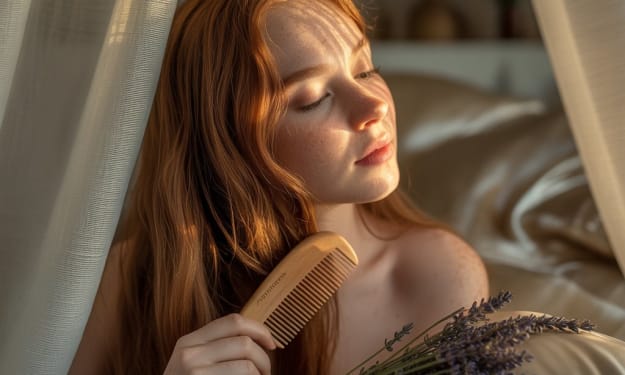
For years, I struggled with hair fall. Every morning, I dreaded brushing my hair, knowing that dozens of strands would end up tangled in the comb. My once-thick ponytail had turned thin, and every photo I saw of myself made me more insecure. I bought expensive shampoos, tried miracle serums, and even went through medical checkups, but nothing seemed to give me lasting results. One evening, while scrolling on my phone, I stumbled upon a simple post that said: “Healthy hair doesn’t just depend on products; it depends on lifestyle.” That line stayed with me, and I decided to test it out. ✨ Step 1: Saying Goodbye to Heat Damage The first change I made was avoiding harsh heat. For years, I relied on straighteners and blow-dryers before every outing. It was my way of feeling “put together.” But little did I know, the heat was silently weakening my strands. I challenged myself to go a whole month without using any heating tools. At first, it was tough—I missed the sleek look. But slowly, I learned to love my natural waves. I even discovered heatless styling methods, like braiding damp hair overnight for soft curls. My hair started to feel less brittle, and I could finally see fewer strands on my pillow each morning. ✨ Step 2: The Silk Pillowcase Secret Speaking of pillows, I replaced my cotton pillowcases with a silk pillowcase. I had read that silk reduces friction, preventing hair breakage while sleeping. Honestly, it felt luxurious and soft, like a little act of self-care every night. Over time, I noticed that my morning tangles reduced, and my hair looked smoother and shinier. ✨ Step 3: A Simple Wooden Comb Next came my wide-tooth wooden comb. I didn’t realize how much damage my plastic brush was causing. Every tug felt like a tiny battle against my strands. But with the wooden comb, detangling became gentle. It glided through my hair without snapping it. I also read that wooden combs help distribute natural oils from the scalp, which explained why my hair started to look healthier. ✨ Step 4: Stress Management – Healing Inside to Heal Outside Hair fall isn’t always about what we do on the outside—it’s also about what’s happening inside. I was under a lot of stress, juggling work deadlines and personal responsibilities. Stress, I realized, was a silent trigger for my hair fall. So, I began practicing yoga and meditation. At first, even sitting still for five minutes felt impossible. But slowly, I learned to focus on my breath, calm my thoughts, and release my worries. Not only did my stress reduce, but I also started sleeping better—and good sleep always reflects in your hair and skin. ✨ Step 5: Fueling My Body with the Right Foods Lastly, I focused on my diet. I added more protein-rich foods: eggs for breakfast, lentils in my lunch, fish twice a week, and a handful of nuts as snacks. I also drank more water throughout the day. Within weeks, my hair started feeling stronger, and even my nails grew faster. It was like my body was finally getting the nutrition it had been craving all along. 🌟 The Transformation Six months later, when I looked in the mirror, I saw a different version of myself—not just because my hair looked thicker and healthier, but because I felt more confident and peaceful inside. My hair no longer controlled how I felt about myself. Instead, it became a reflection of the small, consistent care I gave to my lifestyle. I realized that true beauty isn’t about expensive treatments or quick fixes—it’s about daily habits, self-love, and patience.
By Ismail khan about a year ago in Photography
How to Create a Standout Client Experience as a Headshot Photographer
Increasing image quality alone is no longer enough to distinguish. Customers are not just buying a picture - they are investing in an experience that makes them feel strong, valuable and energetic.
By Mamunabout a year ago in Photography
How I Learned to Take Better Photos: Simple Tips for Beginners Using Any Camera or Phone
When I first got into photography, I had no idea what I was doing. My first picture? A blurry photo of my cat with half her face cut off. I thought it looked cool — until I compared it to actual good photos. That’s when I realized: taking great photos isn’t about having a fancy camera. It’s about knowing how to use what you have.
By Mehran Amanabout a year ago in Photography
How is a Graphic Designer the Best Friend of a Wedding Photographer?
Wedding photography captures the most important moments of a couple’s life. It requires an eye for detail, creativity, and technical skill. But even the most skilled wedding photographer needs support to ensure their work stands out. This is where graphic design companies become invaluable. From background removal services to image cutout services, graphic design companies offer the tools and expertise that allow wedding photographers to deliver flawless, stunning images. Let’s dive into the ways graphic design companies enhance wedding photography and become the best friend of a wedding photographer.
By Mamunabout a year ago in Photography
The Optical Labyrinth: Analyzing the Visual Mechanics of Black-and-White Geometric Illusions
Introduction The image in question represents a high-contrast, black-and-white optical illusion that utilizes concentric circular patterns, wave-like geometries, and alternating checkerboard motifs to create a strikingly immersive visual experience. These designs—commonly associated with the Op Art movement of the mid-20th century—manipulate spatial perception through mathematically structured distortions. The result is a synthetic yet disorienting field of visual data that appears dynamic, despite its static nature. This article explores the principles underpinning such visual phenomena, including the psychological, neurological, and artistic implications embedded within these complex visual systems.
By Fazal Malikabout a year ago in Photography