film
Film is the perfect medium for catching life's greatest moments; learn how to create the right build and buy the right tools, software, and more.
The People We Meet on Vacation: Moments, Connections, and Lasting Impressions
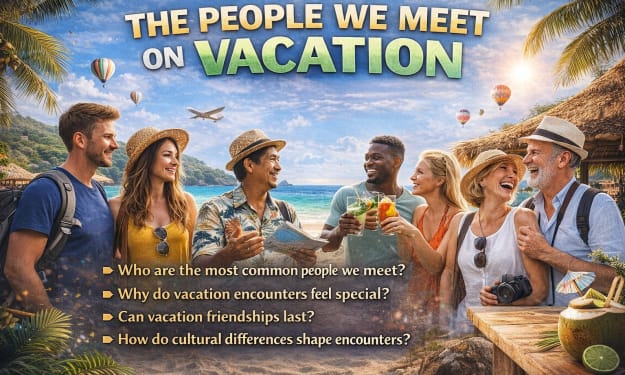
The People We Meet on Vacation: Moments, Connections, and Lasting Impressions Vacations are more than a break from daily routines. They are a unique social experience where people from different backgrounds cross paths in unexpected ways. The people we meet during a holiday often leave strong impressions, even if the interaction lasts only a few minutes. These encounters can shape memories, influence perspectives, and sometimes turn into lifelong friendships. Understanding who we meet on vacation helps explain why travel feels so meaningful to many people. **Who Are the Most Common People We Meet on Vacation** Many travelers wonder about the types of people they usually meet during holidays. Tourists often meet fellow travelers who share similar interests, such as exploring landmarks, enjoying local food, or relaxing by the beach. There are also locals who provide insight into culture and traditions. Hotel staff, tour guides, drivers, and shop owners become part of the vacation story, offering both service and human connection. **Why Do Vacation Encounters Feel More Meaningful** People often ask why conversations on vacation feel deeper and more genuine. One reason is that travelers are usually more relaxed and open. Away from daily stress, people are more willing to talk, share stories, and listen. Time feels slower, and small conversations can turn into memorable moments. This openness creates emotional connections that may not happen in everyday life. **How Do Fellow Travelers Influence Our Experience** Fellow travelers play a big role in shaping a vacation. Meeting someone on the same journey can lead to shared activities, recommendations, and even travel companionship. Many people recall trips where a chance meeting led to discovering hidden places or trying new experiences. These interactions add excitement and unpredictability to travel, making each trip unique. **What Role Do Locals Play in Vacation Memories** Locals are often the heart of a travel experience. People frequently search for information about connecting with locals while traveling. Conversations with residents offer authentic views of daily life, traditions, and values. Locals may suggest places not found in guidebooks, share cultural stories, or simply offer kindness that leaves a lasting impression. These encounters often become the most cherished memories of a vacation. **Can Vacation Friendships Last Long Term** A common question is whether friendships formed on vacation can last. Some do, while others remain beautiful short-term connections. Social media and messaging make it easier to stay in touch, and many people continue relationships long after returning home. Even when contact fades, the memory of the connection remains meaningful and positive. **Why Do We Feel Closer to Strangers While Traveling** Many people are curious about why strangers feel familiar on vacation. Travel removes social barriers and routines, allowing people to present their true selves. Without labels or expectations, conversations feel honest and free. This emotional freedom helps create quick bonds that might take years to form in normal life. **How Do Cultural Differences Shape These Encounters** Cultural differences often enrich vacation interactions. Language barriers, customs, and traditions can lead to curiosity and learning. Travelers frequently ask how cultural differences affect communication. While misunderstandings may occur, they often lead to laughter and shared understanding. These moments expand perspectives and encourage respect for diversity. **What Do These People Teach Us About Ourselves** The people we meet on vacation often reflect parts of ourselves we do not notice at home. Conversations can inspire new ideas, challenge beliefs, or encourage personal growth. Many travelers return home with a broader outlook, influenced by the people they encountered along the way. **Why Do We Remember Vacation Encounters for Years** Memories of vacation encounters last because they are tied to emotion and novelty. People often remember a kind stranger, a helpful guide, or a fellow traveler who shared a special moment. These memories become part of personal stories, reminding us of human connection beyond borders and routines.
By America today 9 months ago in Photography
Why Editing is Important in Films
People often call film editing the "invisible art of cinema," but it is one of the most important things that make a movie successful. Editing changes the story, sets the pace, and makes the audience feel something. Even the best acting, cinematography, or special effects may not have an effect if they aren't edited correctly. The editor's job is to take raw footage and turn it into a smooth story that keeps viewers interested and clearly shows the director's vision.
By T SP9 months ago in Photography
My Year, in Prattling and Photos. Top Story - January 2026.
It's been a year since... last year. Ironically, it seems I've found myself a new tradition of getting sick during the New Year holidays. At least, this year (that is, this inter-year period remarkable for its shiny decorations in the streets and houses, and closed supermarkets and pretty much everything), I'm doubtlessly doing better: I've managed to come visit my friends in Germany for Christmas (which I failed to do last year) and—after having some good quality time eating machanka, playing Munchkin and swinging machetes (the last one obviously crept into this checklist only for the sake of the phonological form)—I came back home via proverbial Deutche Bahn and probably less known Schweizerische Bundesbahnen, my body hosting a family of viruses, virions and who knows what other tiny critters somewhere inside my chest.
By Andrei Z.9 months ago in Photography
Aurora Borealis Forecast: How to Predict the Northern Lights and See Them at the Right Time
The aurora borealis prediction has become very significant to travelers, photographers, scientists, and skywatchers who aspire to see the wondrous Northern Lights. One of the most amazing phenomena in nature is called Northern Lights or aurora borealis. These colored lights move across the night sky in green, purple, pink, and occasionally red, and this is something one can experience in a lifetime if one is lucky enough to observe them. Nonetheless, the sightings of the aurora are not guaranteed. This is why it is crucial to know how to predict the aurora borealis to choose the most appropriate time for observation.
By ZUBAIR10 months ago in Photography
A Deep Dive into the Vivo X300
In a crowded smartphone market, the Vivo X300 stands out not just as another flagship device, but as a serious contender for photography lovers, power users, and anyone who wants top-tier performance in a relatively compact form. With its powerful hardware, thoughtful design, and advanced camera system, the X300 aims to strike a perfect balance between portability, productivity, and imaging prowess. Here’s a detailed look at what makes the Vivo X300 compelling—and where it could be better
By abualyaanart11 months ago in Photography
“The Photograph That Shouldn’t Exist”
The Photograph That Shouldn’t Exist By [Ali Rehman] Elias Rowan never believed in curses, omens, or anything that couldn’t be explained by logic. He spent his life cataloging artifacts in dusty archives, identifying the age of paper from its fibers, determining truth from forgery with the confidence of a scientist.
By Ali Rehman11 months ago in Photography
The Power of Personal Projects: Expressing Yourself Through Photography
Photography has always been a tool for documentation, creativity, and exploration—but perhaps its most powerful use lies in self-expression. While client work and assignments can sharpen technical skills, it’s through personal projects that photographers truly discover their voice. These projects—driven by curiosity, emotion, or personal experience—allow you to tell stories that matter to you, unfiltered by external expectations.
By Jeremy Berman Findlay Ohio11 months ago in Photography
Regretting You – The Story, the Buzz, and the Questions Fans Are Asking
Background and Overview** Regretting You is a romantic drama film adapted from a 2019 bestselling novel of the same name by a popular author. The movie brings together a strong cast including Allison Williams playing Morgan Grant, and McKenna Grace playing her daughter Clara. The story is directed by Josh Boone and written by Susan McMartin. It was filmed beginning in early 2025, primarily in the Atlanta area, even though the original novel was set in a fictional small town in Texas. The film is distributed by a major studio and released in the United States in late October 2025, after a premiere abroad in Germany earlier. It runs for approximately 116–117 minutes and holds a PG-13 rating for mature themes, teen drug and alcohol use, and some language. **Plot and Themes** At its core, Regretting You explores the complex relationship between a mother and her teenage daughter, set against the backdrop of a tragic accident that claims the lives of two close family members: Morgan’s husband Chris and Morgan’s younger sister Jenny. This event sets off a domino of emotional fallout: secrets are exposed, trust is eroded, and relationships are forced to change. Morgan has to navigate grief, betrayal, and her evolving relationship with Clara, who herself is growing into adulthood, facing first love, ambitions, and the push-and-pull between independence and connection with her mother. Clara develops a romance with Miller (played by Mason Thames), a student who complicates her world even more. Meanwhile Jonah (Dave Franco) is a figure from Morgan’s past whose presence intensifies the emotional stakes. The film addresses themes of loss and recovery, of mother-daughter bonds that must be reconceived, and of hidden truths finally coming to light. There is a focus on how accident and tragedy force characters to ask whether they really know the people they love, and how the past always echoes into the present. **Critical Reception and Public Response** The critical reception of Regretting You has been mixed to largely negative. Many reviews point out that while the intentions are earnest and the performances have commitment, the execution often falls into melodrama, with tonal inconsistencies and emotional beats that feel forced. One common critique is that the transition from grief to romance-drama is too abrupt, making some plot developments feel ungrounded or contrived. On major review aggregators, the film has scored poorly with critics, though audience reaction has been more favorable in certain segments, especially among fans of the original novel or viewers drawn to mother-daughter dramas. On social media forums, comments range from “watchably sweet” to “overdone and eye-roll inducing” depending on viewer expectations. Some fans of the novel have expressed concern that the film adaptation did not capture the depth of character relationships and instead prioritized dramatic twists and aesthetics. There is also commentary around the fact that the film is part of a wave of adaptations of this author’s works, which adds pressure and scrutiny. Despite the critique, the film has strong built-in audience visibility due to the popularity of the source material and the attention around its cast and director. **What People Are Searching and Asking** When you look at search trends and forum questions regarding Regretting You, a number of recurring queries stand out: * What is Regretting You about? * Who is in the cast of the film? * When was Regretting You released in theaters? * Is Regretting You based on a book and how closely does it follow the novel? * What is the runtime and rating of the film? * Where was Regretting You filmed and what changes were made from the book? * How has the film been received by critics and audiences? * When will Regretting You be available for streaming or digital purchase? * Why did certain plot choices change (for example the setting) in the adaptation? * How is the mother-daughter relationship depicted and does it resonate? Here's a quick breakdown of the answers: The film’s synopsis: Regretting You tells the story of Morgan Grant and her daughter Clara, their bond tested by a tragic car accident that changes everything. The sorrow leads to revelations of betrayal, secret relationships, and the challenge of rebuilding family around unspoken truths. Cast: The lead roles are Morgan (Allison Williams) and Clara (McKenna Grace). Supporting roles include Jonah (Dave Franco), Miller (Mason Thames), and others such as Scott Eastwood and Willa Fitzgerald in key parts. Release information: The movie premiered internationally in October 2025, and in the United States on October 24, 2025. Runtime is roughly 116–117 minutes, rated PG-13. Adaptation and changes: The film is indeed based on the novel. While major themes and characters carry over, the setting was changed to Georgia for filming and certain narrative details were adjusted for the screen version. Reception: The reviews from critics have skewed negative, pointing to over-sentimentality and structural weaknesses. Yet fan interest remains high due to the novel’s audience. Streaming and digital release details have yet to be officially announced, but since the film is distributed by a studio with its own streaming platform, viewers expect it to appear on that service within months of theatrical release. **Significance and Why It Matters** Regretting You matters for several reasons. First, it continues the trend of popular romance and drama novels being adapted into major films, which speaks to audience demand and studio strategy. Second, it touches on universal themes: loss, family, hidden secrets, the generational gap between mother and daughter, and the idea that pain and love can coexist. Third, it offers an opportunity to reflect on how adaptations reshape stories for film: choices like changing setting or condensing narrative threads highlight the trade-offs between fidelity to source material and cinematic practicality. Finally, the film’s mixed reception underscores a broader tension in entertainment between audience expectations built on source material and critical assessment of creative execution. **Final Thoughts** If you are a viewer drawn to emotional family dramas with romance, Regretting You offers an accessible entry point, especially if you are familiar with the book or the actors involved. It may not break new ground in dramatic filmmaking, and it may leave certain viewers frustrated by its pacing or tonal shifts. But for many, it promises a heartfelt story of grief, reconciliation and the evolving relationship between a mother and daughter. For those curious about film adaptations, it also provides a case-study in how stories are translated from page to screen and how audience expectations shape reception. Whether you end up loving it or critiquing it, Regretting You has generated enough discussion to warrant a close look — and perhaps some reflection on the messy, beautiful ways in which people grow through pain and connection.
By America today 11 months ago in Photography
Behind the Fences: What’s Really Going On at the White House?**
Behind the Fences: What’s Really Going On at the White House?** For weeks, the internet has been buzzing with one big question: why does the White House suddenly look like a construction site? People are searching, guessing, and spreading wild theories. Some say it’s a secret renovation. Others whisper it’s something more dramatic. But the real reason is far simpler, and far more revealing, than most people realize. At the heart of the story is an ambitious plan to expand and modernize parts of the White House, the same building that has stood for over two centuries as the symbol of American power. For many, it’s shocking to see cranes, fences, and bulldozers surrounding the nation’s most famous home. But to the people behind the project, this is about preservation, not destruction. The White House, like any old building, suffers from the wear of time. Pipes rust. Wiring ages. Walls crack. Even the foundations shift slightly after decades of storms and renovations. Still, people are asking the same questions online: why now? Why spend hundreds of millions of dollars when there are so many other issues in the country? Is this really about safety, or is it political theater? These questions flood search engines every day. And while officials say the work is purely structural, curiosity refuses to die. The biggest source of speculation comes from the massive new ballroom being planned near the East Wing. The government’s official explanation is that it will serve as a large space for formal gatherings, ceremonies, and state events. But many are skeptical. Some think it’s a vanity project, something designed to leave a personal mark on the building. Others see it as part of a long tradition of presidents modifying the White House to suit their own taste. If you look through history, the White House has never really been frozen in time. It’s been rebuilt, expanded, and redecorated countless times. Theodore Roosevelt overhauled it in 1902. Truman gutted and reconstructed it entirely in the late 1940s. Even Obama and Biden made smaller upgrades for technology and accessibility. Every administration adds its own layer to the mansion’s story. The current renovations, whether you support them or not, are just another chapter in that evolving legacy. But it’s not just about walls and paint. The White House is a reflection of how America sees itself. When it’s polished and elegant, it sends a message of stability and pride. When it’s surrounded by scaffolding and dust, it becomes a symbol of transition, even uncertainty. Maybe that’s why people are so obsessed. The image of bulldozers and excavators near those white columns feels like a metaphor — for politics, for change, for the cracks beneath the surface of power. Searches keep rising: “What’s happening at the White House?” “Is it being rebuilt?” “Is there something they’re hiding?” These are not just questions about construction; they’re questions about trust. The public wants transparency. They want to believe that the renovations are about safety and improvement, not ego and image. Yet in the age of social media, every photo of a fenced-off lawn becomes fuel for speculation. So what is really happening behind those fences? In truth, the answer is both ordinary and extraordinary. On one level, it’s just construction work — replacing outdated systems, building new spaces, ensuring the structure survives another hundred years. On another level, it’s a reminder that even the most powerful places need repair. The White House, like the country it represents, is always under construction. In the end, the sight of heavy machinery and workers in hard hats doesn’t have to be a symbol of decay. It can be a sign of renewal. Whether people see it as progress or a political move depends on how much they trust the builders — and the leaders — who ordered the work. But one thing is certain: as long as those cranes stand tall and the noise of drills echoes across Pennsylvania Avenue, people will keep searching for answers. And maybe that’s what makes this renovation so fascinating. It’s not just about a building being fixed. It’s about a nation trying to rebuild its faith in what stands behind those white walls.
By America today 12 months ago in Photography
Beyond the Classroom: A Journey of Discovery
Beyond the Classroom: A Journey of Discovery How a Study Tour Transformed Learning into a Real-World Adventure There are some lessons that textbooks alone can't teach. For our class, that truth came to life the moment we stepped out of our school gate and onto the bus that would take us on our long-awaited study tour. It wasn't just a break from routine—it was a window into the real world, where learning could be touched, seen, and experienced. Our destination was the historical city of Jaipur, Rajasthan—a place rich in culture, architecture, and stories of the past. As the bus rolled through changing landscapes, laughter, music, and excited chatter filled the air. But beneath the fun, we all knew this was more than just a trip. It was an opportunity to learn differently. Our first stop was the majestic Amber Fort. Standing tall against the rugged hills, the fort seemed like a storybook castle. Guided by a local historian, we wandered through grand courtyards, delicate mirror work halls, and secret passageways. We learned not just about the Rajput kings and queens, but about their values, warfare techniques, and architectural brilliance. Seeing those details in person made our history textbook feel suddenly alive. The next day, we visited the Jantar Mantar, a UNESCO World Heritage site and an ancient astronomical observatory. Until then, many of us had struggled to understand how people in the past studied stars without modern technology. But standing in front of those giant instruments—like the world’s largest sundial—we saw firsthand the intelligence and precision of Indian astronomers centuries ago. It sparked a whole new appreciation for science and mathematics. Our itinerary also included the Albert Hall Museum, Hawa Mahal, and a walk through the vibrant local markets. While the sights were impressive, some of the most important learning moments came from talking to local artisans and shopkeepers. Through simple conversations, we got insights into their way of life, the challenges they face, and their pride in preserving traditional crafts. It reminded us that education isn't just about facts—it's also about understanding people and cultures. In the evenings, we gathered for reflection sessions led by our teachers. We shared what we had learned, what surprised us, and how the experience was different from classroom lessons. It was heartening to see even the quieter students open up, connecting deeply with the places we had visited. What made this study tour truly special wasn’t just the historical sites or fun moments. It was the way it encouraged independent thinking, group collaboration, and practical learning. We learned to manage our time, keep track of belongings, support one another, and adapt to a new environment—all skills that can’t be taught from a desk. On the final day, as we sat around a campfire under the starlit sky, someone said, “This trip didn’t feel like school, but I think I learned more than ever.” Everyone nodded. It was a shared feeling. When we returned home, we didn’t just bring souvenirs or photos—we brought back memories, friendships, and a fresh perspective on learning. Our study tour taught us that education is not confined to four walls. Sometimes, the best lessons are waiting just beyond the classroom. --- Reflection: Study tours are not just fun excursions; they’re powerful learning experiences. They inspire curiosity, deepen understanding, and connect theoretical knowledge with the real world. For students, such journeys can ignite passions and shape future goals in a way few traditional lessons can.
By Muhammad Saad 12 months ago in Photography