
LED Wall Installations That Turn Corporate Stages Into Immersive Experiences
The corporate event world was forever changed the moment
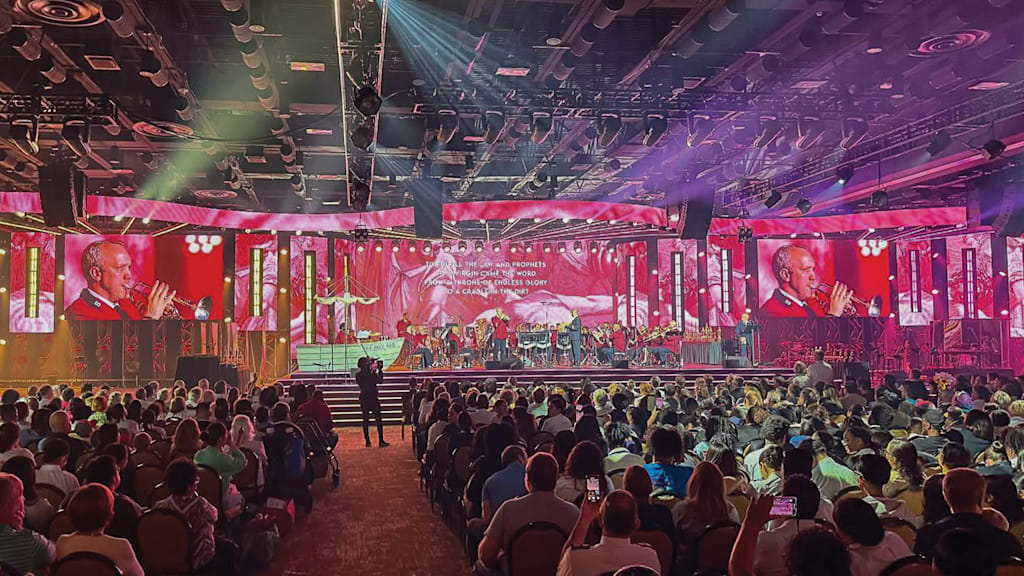
The corporate event world was forever changed the moment a LED video wall replaced the last paper backdrop on a conference stage. That shift — subtle at first, seismic in retrospect — now defines the entire grammar of live corporate communication. Today, the most sophisticated production teams are not simply hanging panels; they are architecting immersive environments where pixel pitch, refresh rate, and content mapping converge to make a Fortune 500 keynote feel closer to a stadium rock show than a quarterly earnings call.
From Projection Screens to Pixel Architecture
Before LED tile technology dominated corporate stagecraft, the gold standard was a fat Christie Roadster or Barco FLM projector throwing 20,000 lumens at a silver screen. The first purpose-built LED walls for corporate use appeared around 2005, with early adopters like Samsung and Daktronics supplying tiles that were heavy, power-hungry, and possessed pixel pitches no finer than P6 — meaning six millimeters between each LED cluster. That was fine for a sports scoreboard. On a keynote stage where presenters walked within arm's reach, it looked like a quilt of colored light.
The pivot came fast. By 2012, manufacturers including ROE Visual, Absen, and Unilumin were shipping P3 and P4 tiles that held up beautifully at conversational distances. Production houses began spec'ing full-stage installs: a 12-meter-wide center screen flanked by angled side panels, all driven by a single Brompton Technology Tessera processor that could sync frame timing to within microseconds. The corporate stage had become a canvas.
Pixel Pitch, Viewing Distance, and the P2 Revolution
The single most important specification decision in any LED wall installation is pixel pitch selection relative to minimum viewing distance. A quick rule of thumb that experienced vendors like PRG and VER have long deployed: multiply pixel pitch in millimeters by 1,000 and you get the minimum comfortable viewing distance in millimeters. A P2.6 tile — 2.6 mm pitch — therefore demands a viewer no closer than 2.6 meters. In a 500-seat corporate theater, that is rarely a constraint. In an intimate boardroom briefing for 40 executives, it becomes the decisive specification.
The ROE Visual BP2V2 and the Absen Polaris 2.5 have become two of the most trusted panels in corporate deployment precisely because they hit the P2.5 sweet spot: fine enough for on-camera talent, bright enough — typically 800–1,000 nits — to punch through heavy stage wash from Robe BMFL or ETC Source Four fixtures without blooming. Refresh rates of 3,840 Hz, standard on Brompton-driven systems, eliminate the moiré-like scan lines that would otherwise haunt broadcast captures.
The Role of Content Management in Stage Design
Hardware is only half the story. The real intellectual muscle of a modern LED wall production sits in the server rack. disguise (formerly d3 Technologies) established itself as the production industry's creative platform of choice through its timeline-based media server workflow, allowing designers to build multi-layer content timelines that respond to live cue triggers, MIDI commands, or even OSC data fired from a speaker's RF mic.
Working alongside disguise, Resolume Arena has built a fierce following among the more improvisational corporate creative directors who prefer a clip-based VJ workflow that can pivot instantly when the CEO decides mid-keynote to skip four slides. Meanwhile, Pixera by AV Stumpfl has carved out ground in the architectural and hybrid event market, its node-based compositing engine handling 8K content across complex multi-surface LED environments with the elegance of a broadcast graphics suite.
Structural Loads, Rigging, and the Physics of Scale
A fully populated P2.6 LED wall at 12 meters wide and 5 meters tall — a common corporate main stage format — will weigh in the vicinity of 800 to 1,200 kilograms depending on tile manufacturer and the trussing infrastructure supporting it. This is where the collaboration between the LED vendor, the structural rigger, and the venue becomes mission-critical.
Leading production companies including Staging Concepts, TAIT, and Stageco have developed proprietary LED wall support systems that integrate lifting hardware, cable management, and power distribution into a single modular frame that can be assembled in hours rather than days. Stageco's ground-support structures, originally designed for outdoor festival main stages, have been adapted for convention center ballroom environments where no ceiling point can accept more than 500 kilograms of dead load.
Curved, Wrapped, and Volumetric: Beyond the Flat Surface
The flat LED video wall is the baseline. The truly transformative corporate installations of the past five years have bent, wrapped, and sculpted the display surface into architectural forms that dissolve the boundary between screen and stage. ROE Visual's Carbon series — designed with flexible magnetic tile connections — has enabled production designers at firms like Moment Factory and Obscura Digital to build concave back-walls that wrap around the presenter like a curved horizon, producing a sense of scale impossible to achieve with a flat plane.
The 2022 Salesforce Dreamforce keynote in San Francisco deployed a 270-degree curved LED environment that covered the entire back wall, floor, and ceiling segments of a 6,000-seat arena. The disguise gx 2 server cluster driving the installation handled over 140 million pixels in real time, with a team of four operators monitoring signal path, color calibration, and content on separate monitoring stations. The result was a visual environment so immersive that audience members reported losing their spatial orientation — a sensation previously reserved for planetarium domes.
Color Calibration: The Science That Makes It All Believable
LED color calibration is where the science of display technology meets the art of cinematography. Every LED tile comes from the factory with measurable variation in its red, green, and blue diode output — variations that, left uncorrected, produce a patchwork quilt effect where seam lines between panels become visible at low brightness levels. The fix is colorimetric calibration using spectroradiometers like the Konica Minolta CS-2000, which measure each tile's actual output and feed correction coefficients back to the Brompton Tessera or NovaStar VX controller.
In broadcast contexts — where a live stage feeds IMAG screens and simultaneous streaming for hundreds of thousands of remote viewers — calibration is not optional. The extended color gamut capabilities of premium tiles like the Unilumin Upanel S series, covering 115% of Rec. 709 color space, mean that content created for digital delivery can be reproduced on-stage with broadcast-grade fidelity. This is the detail that distinguishes a $300,000 production from one costing three times as much.
Integration With Broadcast and Camera Systems
The intersection of LED wall production and live broadcast has driven some of the most important technical innovations in the past decade. The proliferation of LED virtual production stages — popularized by The Volume technology developed by Industrial Light & Magic for The Mandalorian — has migrated directly into corporate event production. Presenters now deliver talks standing in front of real-time rendered environments where the stage camera's position, tracked via Mo-Sys StarTracker or Stype RedSpy systems, informs the LED wall's perspective rendering in real time.
The implication for corporate AV is profound. A global technology company can stage a single physical event in San Jose and deliver a live broadcast experience to satellite audiences in London, Singapore, and São Paulo — each receiving a broadcast feed that looks like a locally produced studio show. The LED wall is no longer a backdrop; it is the production itself.
Practical Deployment Tips for Production Teams
For production managers approaching their first large-scale LED wall deployment, the single most valuable investment is pre-production testing time. Insist on a full content playback test — not just a static signal check — at least 48 hours before doors open. This is the window to identify dead pixels, tile color variance, and controller mapping errors before they become a crisis during the live keynote.
Build your power distribution plan from the LED system backward. A 100-tile installation drawing 300 watts per tile represents 30 kilowatts of continuous load — enough to trip facility breakers if circuit assignment is not coordinated with the venue's electrical team. Socapex distribution systems, properly fused and phase-balanced, are the industry standard for touring LED deployments. Document every circuit, label every cable, and commission a qualified electrician to verify ground continuity before powering up.
The corporate stage has become the most technically demanding environment in live event production — and the most rewarding. When every pixel is calibrated, every content cue is locked, and the first presenter steps into the light of a perfectly tuned immersive LED environment, the audience does not think about technology. They feel something. That is the entire point.
About the Creator
Enjoyed the story? Support the Creator.
Subscribe for free to receive all their stories in your feed.
Comments
There are no comments for this story
Be the first to respond and start the conversation.