wild animals
Animals the way nature intended it; explore the world of wild animals and the controversies surrounding domestication and hunting of feral beasts.
Capuchin Monkey Assaulted at City Zoo: Viral Video Triggers Animal Welfare Investigation
Outrage and Reflection After Monkey Assault Incident at City Zoo In a disturbing incident that has sparked widespread anger and renewed calls for stricter enforcement of animal protection rules, a visitor at a local zoo was caught on camera striking a monkey inside its enclosure. The event, which unfolded on a busy weekend afternoon, has triggered an internal investigation, possible criminal charges, and a broader community conversation about how humans interact with animals in captivity. According to zoo officials, the incident occurred near the primate habitat during peak visiting hours. Witnesses reported seeing an adult visitor lean over a protective barrier and reach into a section of the enclosure where a young capuchin monkey was perched near the glass viewing area. Within moments, the individual allegedly struck the monkey before staff intervened. A bystander’s cellphone video, which quickly circulated on social media, shows the monkey recoiling and retreating to the back of the enclosure. The footage also captures the swift response of zoo personnel, who arrived within seconds and escorted the visitor away from the exhibit. Zoo representatives later confirmed that the monkey was examined immediately by on-site veterinary staff. Fortunately, no serious physical injuries were detected. However, animal care specialists noted that even brief aggressive encounters can cause stress and behavioral disruption for primates. Immediate Response Zoo management issued a statement within hours of the incident, condemning the behavior and reiterating its commitment to animal welfare. “We are deeply disturbed by what occurred,” the statement read. “Our animals depend on us—and on the respect of our visitors—for their safety and well-being. This type of conduct is unacceptable.” Security officers removed the individual from the property, and local authorities were contacted. Police confirmed they are reviewing surveillance footage and witness statements to determine whether charges related to animal cruelty, trespassing, or disorderly conduct will be filed. The zoo also announced that it is conducting an internal review to assess whether additional safeguards are necessary. While barriers and signage were already in place, officials are considering enhancements such as increased staffing during peak hours, clearer warning signs, and potential structural modifications to prevent physical reach into enclosures. Why Such Incidents Matter Though isolated, incidents like this highlight an important issue: animals in zoos are particularly vulnerable to human misconduct. Unlike wild animals that can escape or defend themselves, zoo animals live in controlled environments designed to balance visibility for educational purposes with safety. Primates, especially capuchins, are intelligent and highly social creatures. They are also sensitive to stress. Sudden aggression from a human—even if brief—can affect their behavior, appetite, and social dynamics within their group. Animal welfare experts emphasize that zoo animals rely on predictable routines. “Any unexpected or threatening interaction can have psychological consequences,” explained one wildlife behavior specialist. “Even if there are no visible injuries, stress responses can linger.” The incident also raises concerns about public understanding of zoo boundaries. While many visitors respect posted rules, a small number may underestimate the seriousness of reaching into enclosures or attempting physical interaction. The Role of Social Media The viral spread of the video intensified public reaction. Within hours, thousands of users had shared the clip, expressing outrage and calling for accountability. Many commenters questioned how the visitor was able to reach the animal at all, while others demanded stricter penalties. While social media can amplify awareness, it also highlights the delicate balance zoos must maintain between accessibility and security. Modern zoo design often incorporates open viewing spaces and glass panels to foster educational engagement. However, such openness can sometimes create opportunities for misconduct if individuals choose to ignore clear boundaries. Zoo officials acknowledged the role of public vigilance in responding quickly. “We are grateful to the guests who immediately alerted our staff,” a spokesperson said. “Community awareness helps us protect the animals.” Legal and Ethical Implications Animal cruelty laws vary by jurisdiction, but intentionally striking an animal in a controlled setting can carry significant penalties. Legal experts note that even if the animal was not seriously injured, the act itself may constitute cruelty under state statutes. Beyond legal consequences, the ethical implications are equally important. Zoos operate under strict animal care standards, often accredited by professional organizations that mandate comprehensive welfare protocols. Visitors, by purchasing tickets, implicitly agree to follow posted rules designed to uphold those standards. Incidents like this challenge the trust between institutions and the public. Zoos depend on community support to fulfill their educational and conservation missions. When a visitor violates that trust, it not only endangers animals but also undermines broader conservation messaging. The Bigger Picture: Human–Animal Boundaries This event underscores a broader societal issue: the misconception that animals in managed environments are somehow less deserving of personal space or respect. In reality, zoo animals are not domesticated pets. They remain wild species with complex behaviors and instincts. Capuchin monkeys, in particular, are known for their intelligence and curiosity. They often approach viewing areas out of interest in visitors. However, this natural curiosity does not equate to consent for physical interaction. Educational programs at zoos frequently emphasize the importance of observing animals without interfering. Many facilities include signage explaining why feeding, touching, or tapping on glass can be harmful. Nevertheless, incidents continue to occur, often due to impulsive behavior or a desire for attention. Experts argue that education must go beyond signs. Interactive talks, staff presence, and clear communication about consequences may help deter misconduct. Community Reaction Local residents have expressed both anger and concern. Some are calling for lifetime bans for individuals who harm animals, while others are urging the zoo to review its infrastructure. Parents who frequent the zoo with children say the incident provides a teaching moment. “It’s important for kids to see that actions have consequences,” one parent said. “Animals deserve respect, whether they’re in the wild or in a zoo.” Animal advocacy groups have also weighed in, urging the public to remember that zoo animals are ambassadors for their species. “These animals play a role in conservation and education,” one advocate stated. “Protecting them is a shared responsibility.” Moving Forward
By Pets and animals 7 months ago in Petlife
Mount Chiltan and the Markhor: A Wildlife Conservation Miracle in Balochistan
If someone has never seen Balochistan or does not know much about it, they might assume that this mountain is located in some remote area of the province. After all, when wildlife is disappearing across Balochistan, how could such a large number of markhors possibly exist near the province’s largest city? But Mount Chiltan is not only located next to Quetta, the capital of Balochistan the city’s population has expanded right up to its foothills. How Did the Mountain Get the Name Chiltan? It is commonly believed that a dervish once lived in this mountain with his 40 children. Because of these forty children or brothers, the mountain came to be known as “Chiltan”. This is not just hearsay; the same story is even included in school textbooks in Balochistan. However, Nazir Ahmed Kurd, who serves as Deputy Conservator of Forests at Hazarganji Chiltan National Park, disagrees with this explanation. According to him, the story about the 40 brothers is incorrect. “In fact, there are 40 different locations in this mountainous region, each with its own specific name. That is why it is called Chiltan,” he said. He added that they invite officials responsible for the education curriculum to visit and conduct proper research with them so that accurate information about the mountain’s name can be included in textbooks. Markhor – A Species of Wild Goat
By Pets and animals 7 months ago in Petlife
Sindh Ibex Documentary – Endemic Wild Goat of Pakistan Facts & Habitat
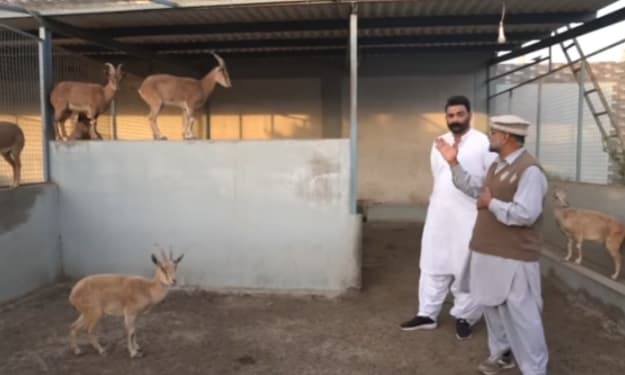
I am currently in the province of Sindh, Pakistan. The district is Thatta, and here in Thatta we have a friend, Mr. Shahid Brohi. He has established a very beautiful wildlife breeding farm here. He has fulfilled all legal requirements, and the farm is registered with the Sindh Wildlife Department. According to international standards, he has built proper enclosures and cages, and he keeps various species of mammals and birds here. Today, I would like to show you an animal that very few people have seen in a zoo or a wildlife breeding farm. This is the Sindh ibex. The Sindh ibex is also known as the Sindh wild goat. This is a female ibex. The difference between the male and female can be identified by their horns. The female’s horns are approximately six inches long, whereas the male’s horns are much longer, curving backward from the head. We will show you the male in another enclosure.
By Pets and animals 7 months ago in Petlife
The Whispering Alley
Whispering Alley In the heart of an old city, where cobblestone streets wound like forgotten veins and lanterns flickered against weathered walls, there was an alley known only to those who listened carefully. Locals called it the Whispering Alley, though few could explain why. To most, it was just a narrow passage between two crumbling buildings. But to the cats of the city, it was a kingdom.
By Alhouci boumizzi7 months ago in Petlife
To locate food, spider monkeys employ collective intelligence.
It's difficult to find fruit in a tropical forest. Throughout the seasons, fruit trees come and go, and their places frequently shift. Due to their heavy reliance on fruit, spider monkeys must search wisely in order to succeed.
By Francis Dami8 months ago in Petlife
The Lost Penguin
The first time I saw the penguin, it wasn’t in a zoo or on a nature show. It was on my feed—just one lone bird, walking away from the colony, slow and deliberate, as if it had decided the world outside its group was where it belonged. And for some reason, I couldn’t stop thinking about it.
By John Smith8 months ago in Petlife
The Summer I Was Chosen by a Northern Mockingbird. Top Story - January 2026.
During the long, suspended days of the pandemic, a wild mockingbird began visiting my driveway and chose me, again and again. What started as a strange encounter became a brief, meaningful connection that I still carry with me.
By Erica Roberts 8 months ago in Petlife