
I Found a Fist-Sized Snail in a Guangzhou Green Belt. Then I Learned What It Was.
It’s called the African giant snail, and it’s one of the world’s worst invasive species. It can strip crops, crowd out native wildlife, and carry a parasite that causes meningitis.
Guangzhou. A red light.
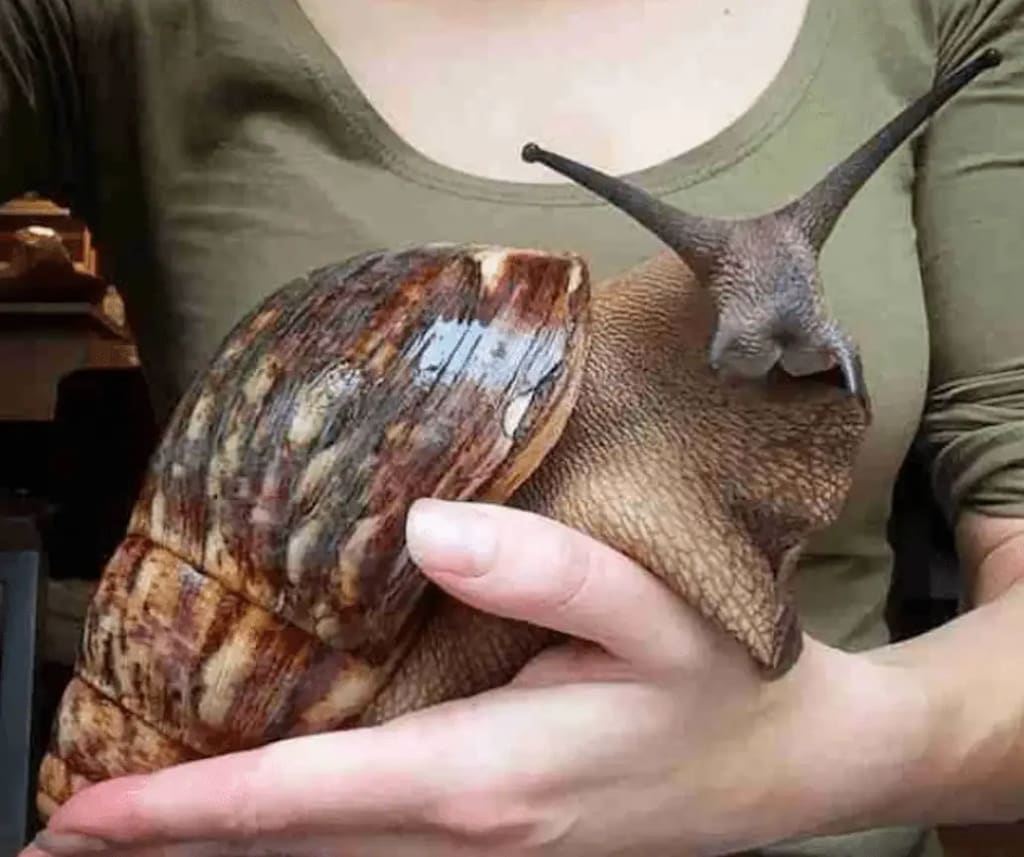
A woman sat in her car and looked at the green belt by the road. Under a low shrub lay a snail. Its shell was burnt brown, marked with cloud-like patterns, swollen, larger than an adult man’s fist. She filmed it. In the comments, someone quickly typed five characters: African giant snail.
The African giant snail is a major invasive species. Its Chinese name is the brown-cloud agate snail. Taxonomically, it is now usually written as Lissachatina fulica; older literature more often uses Achatina fulica. It is native to East Africa. In 2000, the International Union for Conservation of Nature listed it as one of the world’s 100 worst invasive alien species. In 2022, it entered China’s List of Key Managed Invasive Alien Species.
It has been in China for nearly a hundred years. The most reliable date is 1931. There are two accounts of how it arrived. One says that when Mr. Tan Kah Kee was building Xiamen University, plants were introduced from Southeast Asia, and the snail came to Xiamen with them. The other says that in 1931, when plants were imported from Singapore, the soil or plant materials carried eggs or juveniles of the African giant snail. Both accounts point to the same thing: it hitched a ride on human transport.
It lays its eggs in soil. Once flowers, seedlings, potted plants, and plants with soil are moved, the eggs and juveniles can travel with them. Early research also suggested that populations in southwestern China, such as Yunnan, may have entered the country independently through trade routes in the Indochina Peninsula. The Xiamen case was simply the one that got recorded.
Later, it spread along the hot, humid regions of South China. It can now be seen in Fujian, Hubei, Hunan, Guangdong, Guangxi, Hainan, Sichuan, Guizhou, Yunnan, as well as Hong Kong, Macao, and Taiwan. Over the decades, stable populations have formed in many parts of the south. Complete eradication is no longer realistic.
It gained a foothold for several reasons.
It can eat. Research has found that it can feed on more than 500 species of plants. Vegetables, fruits, grain crops, flowers, seedlings, young tree leaves, and bark are all on the menu. To get calcium, it will even nibble on cement.
It can reproduce. The African giant snail is hermaphroditic. After two individuals mate, both have reproductive potential. According to agricultural control materials, in a suitable environment it can lay eggs multiple times a year, with 30 to 700 eggs at a time, and a lifetime total that can reach several thousand. If two or three individuals occasionally get into a place, for many large animals that may not be enough to form a population. For this snail, as long as the environment is warm and humid and food is plentiful, things can quickly spin out of control.
It can hitchhike. Its eggs are in the soil, and juveniles may hide in plant roots or potting soil. The transport of flowers, seedlings, and potted plants is its channel.
And it is unsafe to eat. France has a famous dish: escargot. It originally used the French snail, also called the Roman snail. Some people thought: if the French snail works, the African giant snail is bigger, so it should work too. The meat is tough. Once cooked, it has the texture of chewing gum that will not break down, or even gnawing on a leather shoe. In parts of Africa, there is a tradition of eating it, but that is there. Here, it carries another label: Angiostrongylus cantonensis, the rat lungworm.
A. cantonensis is the parasite found in apple snails. A nationwide survey in 2006 to 2007 confirmed that the African giant snail and the apple snail are very important intermediate hosts of A. cantonensis in China. If a person eats raw snails containing infective larvae, undercooked snails, or fresh vegetables contaminated by snails and slugs, they can become infected. In severe cases, eosinophilic meningitis can occur.
The 1985 case shows the risk. In Taiwan, the head of the Kimlan soy sauce brand believed a folk remedy that eating raw snails was highly nourishing. A family of five ate African giant snails they had raised themselves, raw. They soon all became infected with A. cantonensis, and all five died. The incident shocked the public at the time and has since been repeatedly cited in public health.
A. cantonensis is only one of more than 30 pathogens that can parasitize the African giant snail. It may also carry pathogenic bacteria such as Pseudomonas aeruginosa and Salmonella. It is quiet and slow, its shell patterned like agate. But when it moves, it carries an invisible reservoir of pathogens.
For agriculture and ecology, it is equally troublesome. It gnaws on vegetables, fruits, grains, flowers, and seedlings. It crowds native snails and other small invertebrates out of their ecological niche. It hides in soil, grass, wall corners, and near drains. When dry, it retracts into its shell; when wet, it crawls out. Spraying pesticides may harm other organisms, and manual collection cannot cover all areas. Once a population is established, control becomes a long war of attrition.
In recent years, it has been spreading north. A 2025 study in Global Ecology and Conservation compiled 247 occurrence records across Eurasia and found that 10 densely populated cities in central and northern China have reported African giant snails. This is linked to human activity and climate change. So far, no reports show that it can overwinter stably in northern regions; observed individuals may be more related to human transport, release, or locally warm environments. No stable northern population has been reported yet.
It appears after rain for a simple reason. The African giant snail likes warm, humid environments above 20°C. When the weather is dry or the temperature is unsuitable, it reduces activity, retracts into its shell, reduces water loss, and often hides in soil, grass, and cracks. After rain, humidity is high, the ground is wet, and it crawls out to forage, mate, and move around. So after rain, green belts, grass, and dark wall corners are where it is most likely to appear.
If you see one, leave it alone. Do not touch, pick up, eat, keep, or release it.
If you accidentally touch it, immediately wash with soap and running water for at least 3 minutes. If the skin is broken, disinfect with povidone-iodine. If fever, headache, stiff neck, or other symptoms appear within 72 hours, seek medical attention as soon as possible and tell the doctor you may have been in contact with a snail.
If found at home or in the neighborhood, do not crush it bare-handed. Wear gloves and a mask, use long tongs or a tool to put it into a container with salt or lime, seal it, and discard it. The contaminated area can be sprinkled with quicklime to keep it dry. Wash hands thoroughly after handling.
Keep pets under control. Cats and dogs may also face risks if they touch or eat it.
If you find a large number of African giant snails, report it to property management, the community, agricultural authorities, or disease control departments. It is a matter of urban public health and ecological management.
The light turned green. The woman drove away. The snail was still in the green belt, the burnt-brown patterns on its shell like agate, and also like a stone that cannot speak. After the next rain, it may still be there. Just go around it.
About the Creator
Jin
Writer of reamstories
https://reamstories.com/jin
Enjoyed the story? Support the Creator.
Subscribe for free to receive all their stories in your feed. You could also become a paid subscriber, letting them know you appreciate their work.
Comments
There are no comments for this story
Be the first to respond and start the conversation.