
Fred Rogers: The Gentle Strength of a Soft-Spoken Man
Mr. Rogers' Neighborhood

Introduction
Fred Rogers is a television icon whose scope and vision broke barriers that others were not able to touch. Mr. Rogers opened the door to forward-thinking not only to children but also adults. Mr. Rogers was woke before woke was even a thing. May, I state that I use the term woke in a positive light? The world would be a better place if we were more in tune with what is going on with other people and turned on by compassionate thinking and yearning for learning for the betterment of society and getting along as one. United we stand, divided we fall comes to mind. Fred Rogers was very much about uniting people.
Fred Rogers was born in Latrobe, Pennsylvania in 1928 into a wealthy family. His father ran a few manufacturing firms. One is a very successful brick company. As the Great Depression hit Rogers witnessed the divide between the rich and poor at a very early age. As a result, Rogers learned the importance of spending your money wisely. These lessons were often used in his television show as he encouraged his young viewers to use money for the good of all and worked to halt the widening wealth gap in the United States.
As a child, Rogers spent a good amount of time alone playing with puppets and playing the piano. Introverted Rogers was bullied because of his weight and was called “Fat Freddy” by the children in the schoolyard.
Rogers lived a lonely childhood playing with a ventriloquist's dummy and stuffed animals. He'd often lose himself in fantasy worlds he created in his mind.
In 1950 Rogers graduated from college with a Bachelor of Music. After graduating in 1951, he worked at NBC in New York City as floor director of Your Hit Parade, The Kate Smith Hour, and The Gabby Hayes Show, and as an assistant producer of The Voice of Firestone. Rogers continued through the 1950s and early 1960s developing, producing, and appearing on various children's programs.
In 1962 he attended a theological seminary and graduated with a Bachelor of Divinity. He became an ordained Presbyterian minister. Instead of working in the church, he worked as a minister for children and their families through television.
Mr. Rogers' Neighborhood began airing nationally in 1968 and ran through 2001 producing 895 episodes.
The show ran for 33 years making it the second longest running children's program. Sesame Street holds the record with 54 years and counting.
Fred Rogers was a very special man. He always put the well-being of others first. He chose to lift others and give them a feeling of self-confidence and self-worth. He spoke slowly and carefully enunciated his words. His tone was kind and gentle.
With his show, Rogers continuously strived to break barriers and bring people together.
Lifetime Achievement Award
In 1997 Fred Rogers was given a Lifetime Achievement Emmy Award. The presenter stated, “For giving generation upon generation of children confidence in themselves, for being their friend, for telling them again and again and again that they are special and that they have worth.” This statement was the embodiment of Fred Rogers' philosophy in life, not only toward children but toward all people.
Educational Television
Fred Rogers set a high standard for educational television, emphasizing character development and emotional intelligence. He was not afraid of tackling controversial or taboo topics such as race, self-confidence, and disabilities. He did this with grace.
Racial Equality
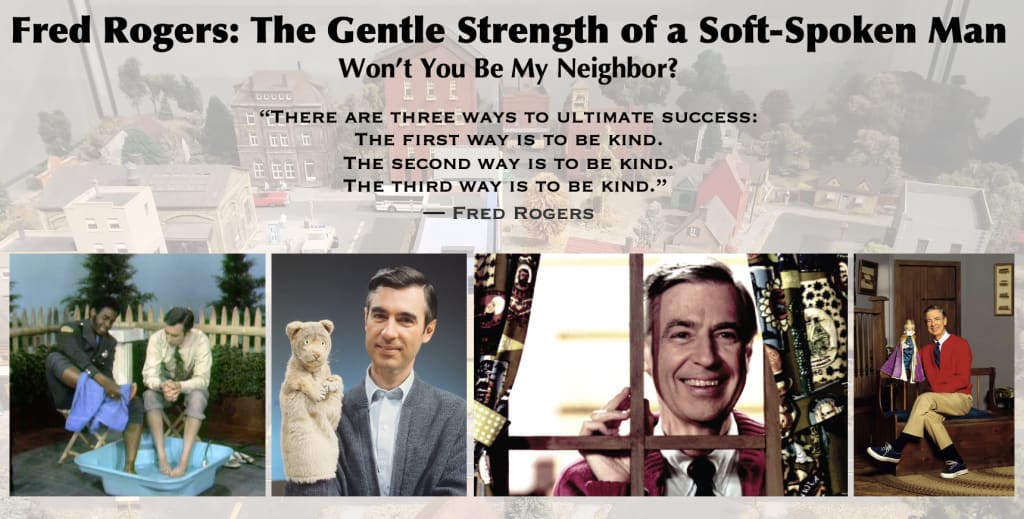
Fred Rogers always championed racial equality. In 1968 Rogers cast African-American actor François Clemmons as Officer Clemmons on his show, marking the first time a Black actor was given a recurring role on a children's show. To drive the point the following year Rogers had a scene in the show where he was resting his feet in a kiddie pool, and invited Clemmons to do the same. This was during a time when swimming public pools were still segregated across the United States. It was a strong statement against racism, made even stronger when Rogers let Clemmons dry his feet with his towel on screen.
Bold Topics
Rogers took on many other bold topics and explained them to children in a non-judgmental, non-threatening manner in which they could understand.
In 1981, Rogers took on the subject of divorce on the show, making it clear to the children watching that they were not to blame for their parents' struggles and that even adults weren't comfortable with the topic. (Collider.com)
Conflict
In 1983 Rogers produced a five-episode series called "Conflict" addressing the fears and misunderstandings during the height of the Cold War, using the Neighborhood of Make-Believe to depict the escalation of tensions and the importance of diplomacy. He described the matter in an understandable way, without being condescending.
Death
Fred Rogers died on February 27, 2003 at the age of 74 from stomach cancer. He remained busy to the very end having served as Grand Marshal of the 2003 Rose Parade, with Art Linkletter and Bill Cosby, in January.
Communicator
Fred Rogers was not only one of the greatest communicators of our time but also a philosopher whose ideas are still relevant today.
“The only thing evil can't stand is forgiveness."
“Taking care is one way to show your love. Another way is letting people take good care of you when you need it.”
💖💖💖💖💖
Sources: IHeartRadio blog / Wikipedia / Collider.com / YouTube
With Love, RHC ❤️
About the Creator
Rick Henry Christopher
Writing fulfills my need for intellectual stimulus, emotional release, and soothing the bruises of the day.
I’m an open book. I’m not afraid to show my face or speak my mind
https://www.facebook.com/groups/vocalplusassist
Enjoyed the story? Support the Creator.
Subscribe for free to receive all their stories in your feed. You could also become a paid subscriber, letting them know you appreciate their work.
Comments
There are no comments for this story
Be the first to respond and start the conversation.