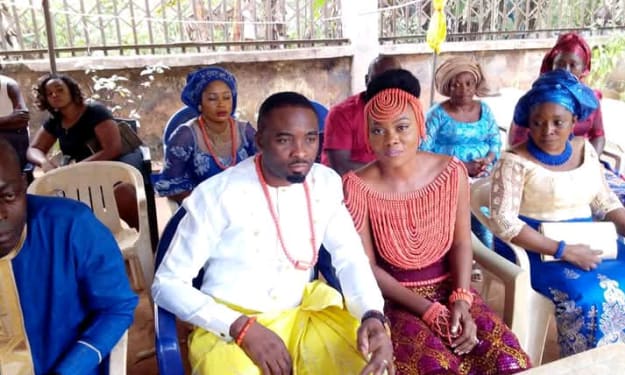
grooms
Grooms should enjoy their wedding as much as the brides—here’s to all the men getting hitched.
A Modern Guide to Finding the Right Match Online
In today’s fast-paced world, where meeting people organically can be difficult, datingsider (dating sites) have become a lifeline for those looking to connect, build relationships, and find love. Whether you're searching for something casual or hoping to meet "the one," the digital dating scene offers endless possibilities—if you know where to look.
By Mian Abdulrahmanabout a year ago in Marriage
When Raindrops Remembered Us
When Raindrops Remembered Us A chance encounter, a forgotten melody, and the love that never truly left It was a quiet, rainy afternoon when Aanya walked into the old bookstore at the corner of Rose Street. The rain had started gently, tapping against the windows like an old lullaby. She shook off her umbrella and smiled at the familiar scent of paper, ink, and memories.
By Samar Omarabout a year ago in Marriage
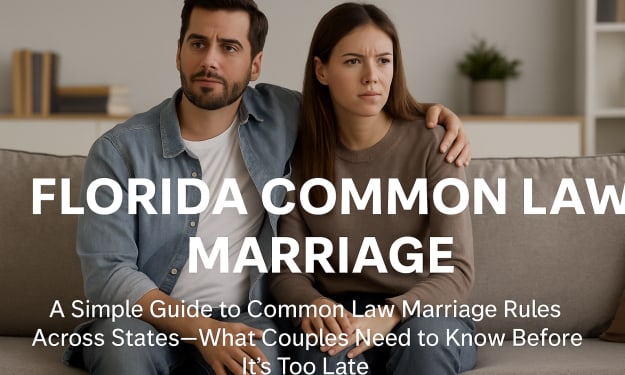
Understanding Common Law Marriage in the United States
Marriage is not always about a wedding, a ring, or a license. In many cases, it depends on what the law says, not what the couple believes. In some states, if two people live together and act like a married couple, the state may treat them as legally married. This is called common law marriage. But not all states agree with that idea.
By Talha Zulfqarabout a year ago in Marriage
I Was the Second Wife… But She Was Still in His Heart
**“I Was the Second Wife… But She Was Still in His Heart”** She wasn’t dressed in red, the color of joy and new beginnings. No — she wore maroon. The color of old wounds, of love faded but never forgotten. Her face was bare, free of makeup, yet her eyes told stories that no words could express—stories of pain, bitterness, and a love that lingered beyond the grave of their marriage. She stood just a few feet away from us, watching. Watching me wear my bridal dress, watching him slip the ring on my finger, watching us promise forever. But her gaze was not blessing; it was an accusation. A silent reminder of what he once had and what I was trying to replace. I smiled through my vows, but inside, I trembled. I noticed the flicker of pain in her eyes. I felt it in the air around us, thick and suffocating. Every time he touched me, I felt her anger—sharp and silent—like a knife buried deep in the quiet spaces between us. I was the bride. The new wife. The second choice. But she was the memory he never let go. Marriage is supposed to be about two souls joining in a bond of love and trust. But what happens when one soul is still stitched tightly to another? When the heart you’re trying to hold is still beating for someone else? She was his first love, his first wife—the woman who had seen him when he was raw, unpolished, and unafraid to be himself. Before the world carved scars on his heart. Before time hardened him into the man I was trying to love. And me? I was the second wife. The second chance he gave himself. A fragile hope born out of heartbreak and loneliness. A new chapter that started on pages stained with memories of a love that once was. Some nights, I caught him staring into the darkness, his hand in mine but his thoughts far away. In those moments, I asked myself the question that haunted my every breath — am I enough? Or am I just a placeholder? A bandage on a wound that still bled for her? One evening, I found him holding an old photograph. There she was—smiling softly in a sari, radiant in a way I could never be. His eyes softened as they traced every curve of her face, every detail frozen in that still image. That night, I didn’t cry. I quietly turned away to the other side of the bed and whispered to the empty space, “You can love her. But please… don’t forget to see me too.” Because being the second wife isn’t about stealing love or fighting to be first. It’s about surviving in the echoes of a love that came before. It’s about finding your own place in a heart that’s already half full of another. Love isn’t always neat or simple. Sometimes, it’s messy and tangled with pain and regret. Sometimes, it means loving someone who still carries pieces of another woman inside him. But I held on to hope — hope that one day, I wouldn’t just be the shadow in his past, but the light in his future. That my love would fill the empty spaces he left behind and heal the cracks in his heart. Until then, I stood quietly beside him, holding my own broken pieces together. Loving him not only for who he was but for the imperfect story we were writing together. Being the second wife isn’t about winning a battle for his heart. It’s about making peace with the love you’re given and choosing to love even when it hurts. And in all the silent struggles, the stolen glances, and the lonely nights, I found my strength. A strength not born from being first but from choosing to stay and love fiercely despite the odds. Because sometimes love isn’t about being the first. It’s about being the one who doesn’t give up — even when the heart is divided, even when the past lingers, and even when the road ahead is uncertain. I was the second wife. But I was also a woman who loved fiercely, quietly, and with a hope that someday, all the broken pieces would come together to create something whole.
By Immy writerabout a year ago in Marriage
Love Marriage
In the heart of a conservative Indian town called Bhairavpur, tradition wasn't just a way of life — it was the law of the land. Families were tightly knit, customs were sacred, and marriage was always arranged, never chosen. Among the thousands who followed this path without question was a young woman named Meera. Meera was the eldest daughter of the respected Sharma family — gentle, cultured, and known for her obedient nature. She had grown up helping her mother in the kitchen, learning classical dance, and quietly preparing for a life that would eventually be shaped by someone else’s choice — a groom selected by her parents. But Meera’s destiny was about to change. It began at a local library, a rare haven in the town for open-minded thinkers. That’s where she met Aarav — a confident, kind-hearted man who had just returned from Delhi after completing his engineering degree. He wasn’t like anyone she had known. While others spoke in hushed tones about duty and honor, Aarav talked about dreams, choice, and courage. He believed in love — not just the romantic kind — but love as a reason to live authentically. Their connection was instant. What started as shared glances and casual conversations about books soon blossomed into deep discussions, laughter, and late-night texts. Within months, Meera and Aarav were in love — deeply, sincerely, and quietly. But in Bhairavpur, love before marriage was taboo. Worse, choosing one’s partner — especially across caste or class — was a direct challenge to family honor. When Meera’s parents started searching for a “suitable” match for her, the ground beneath her began to tremble. She knew that revealing her love for Aarav would cause a storm — not just in her family, but in the whole community. But love, true love, demands courage. One evening, Meera sat with her father on the verandah. The air was tense, her hands trembling, but her voice was steady. She told him everything — about Aarav, their shared values, and how she couldn’t imagine a life with anyone else. Her father’s eyes widened in disbelief. Her mother burst into tears. Accusations flew — “What will society say?” “You’ve brought shame upon us!” “Have we raised you for this?” The next few days were a storm of emotional blackmail, silence, and threats. Aarav too faced intense pressure from his family. “You can’t marry a girl from a conservative family like that,” they told him. “They’ll never accept you.” But the couple refused to back down. Instead, they stood together — not in rebellion, but in quiet resistance. Aarav approached Meera’s father respectfully, not as a challenger, but as someone who genuinely wanted to be a part of the family. He spoke about his values, his career, and most importantly, his love and respect for Meera. It didn’t melt hearts overnight. There were weeks of cold silences, extended family interventions, and even a threat of disownment. But what eventually changed everything wasn’t just their stubbornness — it was their commitment. Meera didn’t elope. She stayed home, cared for her parents, and showed them daily that her love didn’t make her disobedient — it made her honest. Aarav didn’t insult their customs. He listened, helped out with local initiatives, and proved he wasn’t “outside” their world — he just wanted to build a new one with Meera. Slowly, walls began to crumble. One morning, Meera’s father called her into the room. He held her mother’s hand and said simply, “If this boy makes you this brave, then he must be special.” That winter, Meera and Aarav were married — not in secret, but with blessings. The town whispered at first, but soon, the story of their love became a tale of pride. Young people started to speak more openly. Some elders began to listen instead of scold. The winds were changing in Bhairavpur. --- The Effects of Love Marriage Their story wasn’t just about romance — it became a symbol of evolution. Here’s how love marriages, like Meera and Aarav’s, can transform lives and societies: Empowerment of Choice: Love marriage reinforces that individuals — especially women — have the right to choose their life partners. Cultural Fusion: It breaks down barriers of caste, religion, or class, bringing diversity and tolerance into families. Strengthened Relationships: Since love marriages often stem from understanding and emotional compatibility, they can lead to deeper bonds. Redefining Honor: True honor lies in acceptance, respect, and love — not blind conformity to societal pressure. Generational Shift: One courageous couple can inspire many more to believe in love, understanding, and personal agency. --- Conclusion Love marriage isn't just a romantic ideal — it's a declaration of identity, a step toward mutual respect, and sometimes, a gentle rebellion against outdated norms. In a world where hearts often go unheard beneath the noise of tradition, stories like Meera and Aarav’s remind us that when hearts choose — the world, eventually, listens.
By Mati Henry about a year ago in Marriage
Romeo and Juliet: The Timeless Tragedy of Star-Crossed Lovers
For centuries, Shakespeare's masterpiece defined love, conflict, and fate. Romeo and Juliet is one of those stories that has captivated readers like no other. This tragic tale of a young love doomed by family disputes, written by William Shakespeare around 1595, has survived time and inspired numerous productions, from ballets to blockbuster films. However, Romeo and Juliet is a complex investigation of passion, violence, and the destructive power of hatred, despite its romanticized reputation. This in-depth analysis delves into the play’s themes, historical context, and enduring legacy—revealing why, more than 400 years later, we still can’t escape the story of these star-crossed lovers.
By Silas Blackwoodabout a year ago in Marriage
Traditional Marriage in Nigeria – The Igbo and Yoruba Cases
Everything you need to know about wedding traditions in Nigeria. The diversity in cultural behavior of different ethnic groups in Nigeria opens up a vista of variegated traditional marriage systems. With over 250 ethnic groups and 371 tribes, the country offers an abundant wealth of marriage practices.
By Uchenna Cosmas Nwokafor about a year ago in Marriage
The Whisper Behind the Veil
The wedding celebrations had come to an end. The music had faded, the guests had left, and the once-busy house was now calm. Fatima sat on the edge of her new bed, her hands still covered in intricate mehndi, her heart fluttering in her chest. She was a bride now—someone's wife. Just hours ago, she was a daughter preparing to leave her childhood home.
By Salar Khanabout a year ago in Marriage
The Box That Carried What My Heart Could Not.
There are moments in life when silence is louder than screams. When the heart whispers what the mouth cannot say. That day, I packed a box. A plain, brown box. But inside it, I placed everything my heart could no longer hold.
By Sayed Zewayedabout a year ago in Marriage
The Algorithm of Us
In a world where love was no longer a matter of chance but a matter of code, Aria and Eli were the anomaly. Their story didn’t begin with sparks flying across a crowded room or glances exchanged under starlight. It began with a compatibility score: 52%. In a society where 90% was considered ideal and anything under 70% was frowned upon, 52 was practically a glitch. Aria, a senior data analyst at the world’s leading relationship algorithm platform, HeartMatch, believed in numbers. Everything from morning coffee preferences to childhood trauma patterns was fed into the system. The algorithm boasted a 99.7% success rate. For Aria, love was math—clean, calculated, predictable. Eli, on the other hand, was a freelance coder and digital philosopher who believed emotions could never be truly quantified. “We are not equations,” he said once during a viral podcast interview. “We are chaos wrapped in skin.” So when HeartMatch mistakenly paired Aria with Eli, she was furious. She submitted a complaint to the platform, requesting a reassessment. But instead, her supervisor said, “It’s experimental. We’re testing variables—don’t break it yet.” Reluctantly, Aria agreed to one coffee date, purely for “data integrity.” They met at a small café where Eli, with his unkempt hair and analog watch, looked like a relic from a forgotten era. Aria arrived five minutes early, he arrived ten minutes late. Their first conversation was tense, peppered with statistical arguments from her and poetic metaphors from him. “Your smile registers increased dopamine release in my test subjects,” she said. “Maybe love is just the willingness to be wrong for someone,” he replied. It was infuriating—and oddly intriguing. One date turned into three. Three turned into ten. Over time, Aria found herself questioning the very platform she helped build. She laughed more. She stopped checking scores and started listening. Eli, for all his quirks, made her feel seen in ways no algorithm ever had. But cracks soon formed. Aria’s colleagues were concerned. Her score with Eli hadn’t improved. “You're undermining the credibility of HeartMatch,” her manager warned. “You’re a public figure in the data community. What kind of message are you sending?” Aria began to spiral. Was love without data sustainable? Could she trust her instincts over the code she’d sworn by for years? One night, she and Eli had their first real fight. “I’m scared,” she admitted. “What if we’re just the exception that proves the rule? What if we crash?” Eli looked at her, his expression soft. “Then we crash. But it’s our story to crash, not the algorithm’s.” The next day, Aria made a decision that shook the tech world. She quit her job at HeartMatch and wrote a public essay titled: "The Algorithm Got It Wrong—And That’s Okay." The piece went viral. Some applauded her bravery; others criticized her betrayal of data science. But Aria didn’t care. For the first time, she felt human—not just a number, not just a variable. Months passed. Aria and Eli moved in together. They fought, they laughed, they made mistakes. It wasn’t perfect—but it was real. On their one-year anniversary, Eli took her back to the same café. This time, he arrived five minutes early. He handed her a small box with a note inside. “There’s no formula for this. Just faith. Will you marry me?” Aria didn’t hesitate. “Yes,” she whispered, tears in her eyes. “Yes to all the chaos.” The media exploded. Headlines read: “The Woman Who Built the Algorithm That Couldn't Predict Her Own Love Story.” But Aria just smiled. Some things, she had learned, weren’t meant to be solved. They were meant to be felt.
By Syed Kashif about a year ago in Marriage