
I Was Too Busy Seeing My Fat to See His Love
When I Stopped Seeing My Weight and Started Seeing Our Love

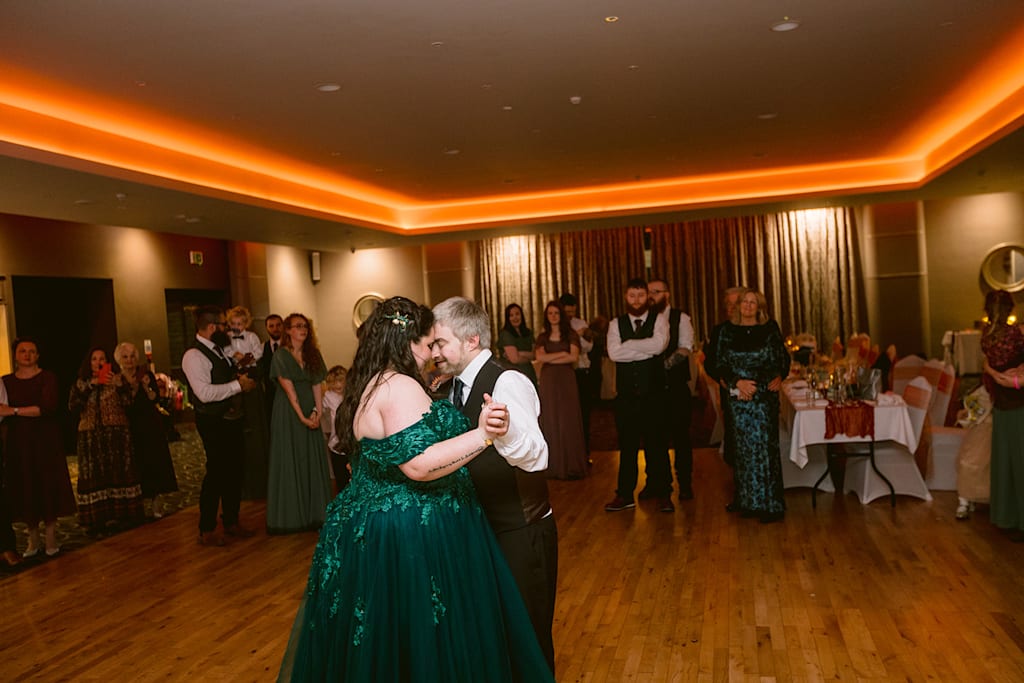
When I first opened one of the photographs from my wedding, I cried.
Not because it was a particularly emotional moment captured on camera, although it was. Not because I was overwhelmed by the memory of marrying the man I love, although that feeling was certainly there too.
I cried because the first thing I noticed was my weight.
There I was, wearing the emerald-green wedding dress I had fallen in love with, dancing with my new husband, surrounded by people who had come to celebrate us. It was a photograph of one of the happiest moments of my life. Yet, instead of seeing the happiness, I found myself looking at my body.
I noticed the width of my waist. I noticed the way the fabric sat against me. I noticed how much space I occupied in the photograph. I examined the parts of myself I have spent years being taught to dislike, almost as though I were looking for evidence that I had somehow failed at being a bride.
It is a horrible thing to admit, particularly when I know how fortunate I am to uhave married someone who loves me so completely.
Yet that is the reality of being a fat bride in a world that has spent decades teaching women that their wedding day is supposed to be the day they look their absolute thinnest, prettiest and most conventionally beautiful.
We are told that every bride is beautiful, yet the images used to demonstrate that beauty tend to follow a remarkably narrow definition of what a bride should look like.
She is slender. Her waist is small. Her arms are delicate. Her dress falls effortlessly over a body that apparently requires no accommodation, no consideration and certainly no apology.
When a plus-size bride appears in wedding advertising, there is often an accompanying narrative about confidence, bravery or learning to love her curves. It is as though simply existing in a larger body while wearing a wedding dress is an extraordinary act of defiance.
I did not want my wedding day to be an act of defiance.
I wanted it to be my wedding day.
I wanted to marry Scott. I wanted to wear a beautiful dress. I wanted to dance, laugh, celebrate and make memories with the people I love. I wanted to feel like a bride without having to spend the entire day proving that fat women deserve to feel beautiful too.
Unfortunately, the years of conditioning do not disappear simply because somebody puts a ring on your finger.
Long before my wedding, I had already made certain decisions about my appearance based on the parts of my body I felt uncomfortable showing. I knew I did not want a traditional white wedding dress. I chose a rich, dark emerald green, a colour I adored and one that felt much more like me. I wanted sleeves that covered the tops of my arms because, despite everything I believe about body acceptance, I still felt the need to hide them.
There is a strange contradiction in being someone who advocates for body positivity while simultaneously standing in front of a mirror and wishing parts of your own body were different.
I can tell another woman that she deserves to wear whatever makes her happy, regardless of her dress size, and mean every word.
I can tell her that her arms do not need covering, that her stomach does not need disguising and that she should never feel ashamed of occupying space.
Then I can look at myself and struggle to offer the same kindness.
That contradiction does not make my beliefs insincere. It makes me human.
Body acceptance is not a magical destination where every insecurity disappears. Sometimes it is simply recognising that the cruel voice in your head is not telling you the truth, even when you are not quite ready to stop listening to it.
My wedding day was particularly complicated because my relationship with my body has changed considerably since developing Multiple Sclerosis.
I have had to learn to live in a body that does not always behave the way I expect it to. A body that experiences fatigue, weakness, pain and balance problems. A body that sometimes needs a walking stick or crutches. A body that can turn an ordinary activity into something requiring careful planning and recovery.
I have spent a great deal of time grieving the things my body used to do more easily.
Dancing is one of them.
I have always loved performing. Musical theatre, movement and the freedom of expressing myself through dance have been enormous parts of my life. MS has complicated that relationship. There are things I cannot do as easily as I once did, and moments when I have to weigh the joy of participating against the physical consequences that might follow.
So there was something especially meaningful about dancing with my husband at our wedding.
I was there.
I was standing.
I was dancing.
I was wearing a dress I loved, with a man I loved, celebrating a future I was incredibly excited to begin.
Yet when I first saw the photograph, I reduced that entire moment to the size of my body.
I looked at a photograph of love and saw fat.
That realisation upset me almost as much as the photograph initially had.
Because what exactly had I expected?
Did I think that being photographed on my wedding day would somehow make me thinner? Did I imagine that the magic of the occasion would change my body into something more socially acceptable? Had I convinced myself that a beautiful dress, carefully styled hair and professional makeup would somehow erase the fact that I am a fat woman?
Of course I was going to look like myself.
I had spent months planning a wedding that reflected who Scott and I are. We had chosen meaningful music, personal rituals, beautiful colours and little details that represented our relationship. We had deliberately rejected traditions that did not feel right for us.
I had never wanted to be a conventional bride.
So why was I suddenly judging myself against the most conventional expectations of what a bride should look like?
I think the answer lies in how deeply those expectations become embedded.
The wedding industry has an extraordinary ability to make women feel that their appearance is one of the most important elements of the day. There are bridal diets, wedding weight-loss plans, exercise programmes promising the perfect bridal body and endless suggestions about how to look smaller in photographs.
Even the language surrounding wedding dresses can be revealing.
We are encouraged to find something flattering, something slimming, something that creates the illusion of an hourglass figure or conceals our supposedly problematic areas.
There is nothing wrong with wanting to feel comfortable and confident in what we wear. The problem begins when the underlying message is that our natural bodies are something to correct.
For fat brides, that pressure can be relentless.
We are expected to celebrate our bodies while also being offered a thousand ways to disguise them.
We are told we deserve to feel beautiful, provided we choose the right neckline, the right sleeves, the right silhouette and the right camera angle.
We are reassured that photographs can be edited.
We are reminded to stand a certain way, position our arms carefully and angle our bodies to appear smaller.
Somewhere along the way, the wedding photograph becomes less about remembering the moment and more about whether we approve of how much of ourselves is visible within it.
I know this because that was exactly what I did.
Then I looked at the photograph again.
Not immediately. I needed a little time to get past that first reaction. Eventually, I returned to it and made myself look beyond the things I had been criticising.
This time, I looked at Scott.
I looked at the way he was leaning towards me. I looked at how close our faces were, how naturally we fitted together in that moment and how completely absorbed we seemed to be in one another.
I looked at the expression on his face.
There was so much tenderness in it.
He wasn’t looking at my waist.
He wasn’t studying the size of my arms or wondering whether the dress made me appear larger than I wanted.
He was looking at his wife.
The woman he had chosen to marry.
The woman he wanted to dance with.
The woman he loves.
For the first time, I saw the photograph for what it actually was.
It was not a photograph of a fat bride.
It was a photograph of two people in love.
Of course, I was still fat in the photograph. Nothing about my body had changed between the first time I looked at it and the second.
What changed was what I allowed myself to see.
The first time, I was looking at myself through the expectations of a society that has taught women to scrutinise their bodies.
The second time, I was looking at a moment through the love of the man standing beside me.
There is something quite heartbreaking about realising that a stranger could look at your wedding photograph and immediately recognise the happiness in it, while you, the person actually experiencing that happiness, might be too distracted by your own insecurities to notice.
I wonder how many other brides have done exactly the same thing.
How many women have received their wedding photographs and immediately zoomed in on their stomachs?
How many have complained about their arms?
How many have asked photographers to remove a double chin, narrow a waist or make them look smaller?
How many have looked at a photograph of the happiest day of their lives and felt disappointed because their bodies did not look the way they hoped?
I suspect the answer is far too many.
I also suspect this is not limited to fat brides.
Women of all shapes and sizes can struggle with body image, particularly when photographs preserve a moment we cannot revisit or change. There is an enormous pressure attached to wedding photographs because they are supposed to last a lifetime.
We imagine our children looking at them. Our grandchildren, perhaps. We imagine them framed on walls, displayed in albums and shared with friends and family.
We want them to be perfect.
Yet I have started to wonder whether we have confused perfection with appearance.
When I think about the photographs of my grandparents and other couples whose relationships I admire, I do not remember the size of their waists.
I remember their smiles.
I remember the way they looked at each other.
I remember the feeling of seeing two people whose love was so obvious that it seemed to exist beyond the photograph itself.
I have never looked at an old wedding photograph of somebody I love and thought their arms should have been smaller.
So why would I imagine that somebody looking at mine would care?
More importantly, why was I allowing that possibility to matter more than the memory itself?
My wedding photographs are not evidence of how successfully I managed to disguise my body.
They are evidence that I was there.
That I married the man I love.
That I danced despite the challenges my body sometimes presents.
That I wore an emerald-green dress because it made me happy.
That we surrounded ourselves with people who wanted to celebrate our marriage.
That, for one extraordinary day, we created something that belonged entirely to us.
I do not want to look back on those memories in twenty years and remember how much time I wasted wishing I were smaller.
I want to remember the way Scott looked at me.
There is an important distinction here, because I do not believe body acceptance should depend entirely on whether somebody else finds us attractive.
My worth does not come from having a husband who loves me. I was worthy of love, respect and happiness long before I met him. I would still deserve those things if I were single.
Equally, I do not want to suggest that another person’s approval should be the solution to years of body insecurity.
Scott’s love did not suddenly cure my complicated relationship with my appearance.
What it did was remind me that there was something far more important happening in that photograph than the way I looked.
I had become so focused on evaluating my body that I had forgotten to appreciate what my body had allowed me to experience.
Those arms I had wanted to cover were wrapped around my husband.
That waist I had been criticising was part of the body he was holding close.
Those legs, which have become increasingly unreliable because of MS, were allowing me to dance.
That body I had spent so much time judging had carried me through an extraordinary day.
It had allowed me to stand beside Scott, exchange our vows, celebrate our marriage and make memories I will treasure for the rest of my life.
Surely that deserves more gratitude than criticism.
I am not going to pretend that I will never look at another photograph and notice my weight first. Years of insecurity do not disappear because of one beautiful moment of clarity. There will probably be other photographs that make me uncomfortable. There will be days when I struggle to practise the acceptance I so readily encourage in other people.
That is part of the process.
I am learning that I do not have to love every photograph of myself to recognise that the moment it captured was worth remembering.
I do not have to believe that every angle is flattering.
I do not have to pretend that I never feel insecure.
I simply have to stop allowing those insecurities to erase the happiness that was there.
Being a fat bride was not always easy. There were moments when I worried about how I would look, whether my dress would sit properly, whether I would feel beautiful and whether I would be comfortable seeing myself in photographs.
I wish I could tell the woman who was worrying about those things that she was going to be beautiful on her wedding day, although not necessarily in the way she had been taught to measure beauty.
She was going to be beautiful because she was happy.
Because she was loved.
Because she was surrounded by people who cared about her.
Because she was wearing a dress that reflected her personality rather than somebody else’s expectations.
Because she was marrying someone who looked at her as though there was nowhere else in the world he would rather be.
Most importantly, she was going to be beautiful because she was herself.
Not a smaller version.
Not an edited version.
Not a version who had spent months trying to become more acceptable before walking down the aisle.
Just herself.
I look at that photograph differently now.
I still see the emerald-green dress. I still see my body. I still see the woman who has spent years struggling with the word fat, sometimes embracing it and sometimes allowing it to hurt her.
I haven’t magically stopped being aware of my size.
I have simply stopped allowing it to be the most important thing in the picture.
Now I see my husband’s face.
I see the way he is leaning towards me.
I see how completely we are caught up in our own little world, despite the room full of people around us.
I see a moment that belongs to us.
I see love.
One day, when we are much older, I hope we look back at this photograph together. I hope we remember the music, the laughter and the feeling of holding each other close on the day we celebrated our marriage.
I hope I look at that younger version of myself with the tenderness I struggled to offer her when the photograph was first taken.
Perhaps I will even wonder why I was ever so unkind to her.
Because the truth is that I was never too fat to be a beautiful bride.
I was never too fat to deserve a wonderful wedding.
I was never too fat to dance with my husband.
I was never too fat to be loved.
The first time I looked at this photograph, I saw how much space my body occupied.
The second time, I saw how much love existed within that space.
And for once, my weight was the least interesting thing about me.
About the Creator
Millie Hardy-Ashton
I’m Millie Hardy-Ashton, writer, theatre practitioner and PhD researcher. Through personal reflection, humour and honest commentary, I explore disability, accessibility, creativity, popular culture and the beautifully messy business of life
Enjoyed the story? Support the Creator.
Subscribe for free to receive all their stories in your feed. You could also become a paid subscriber, letting them know you appreciate their work.
Comments
There are no comments for this story
Be the first to respond and start the conversation.