
Why Roofing Contractors Are Finally Adopting AI in 2026
A practical guide to AI tools, real adoption data, and where roofing contractors should start in 2026
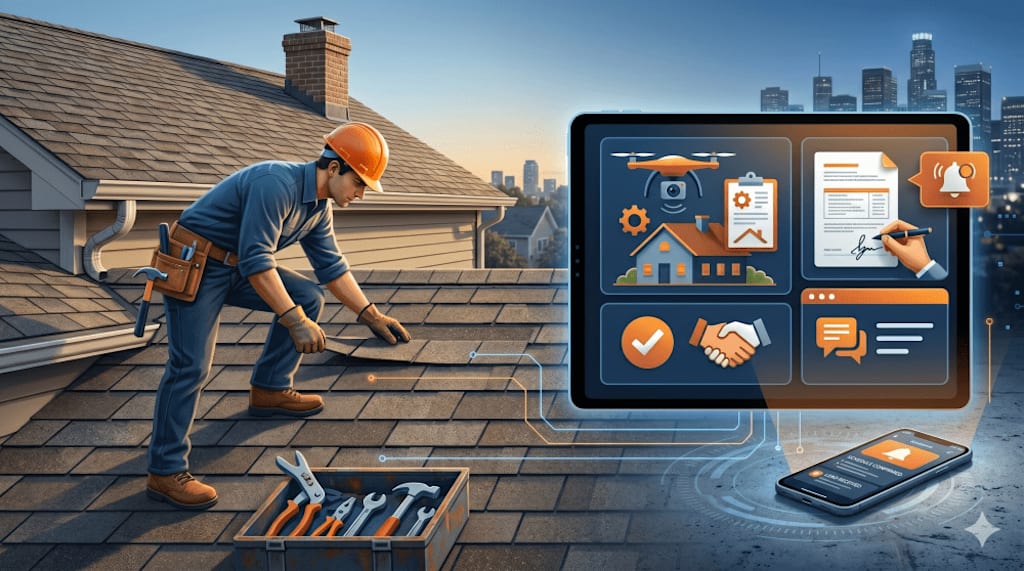
AI adoption among roofing contractors has more than doubled in one year. 38% of contractors now report measurable business impact from AI, up from 17% in 2025. The reason is simple: rising costs, labor shortages, and intense competition are forcing roofing businesses to find smarter ways to operate.
This article covers what AI means for roofing contractors, how it works in practice, the real benefits, common mistakes, and a step-by-step guide to getting started.
What Is AI for Roofing Contractors?
AI for roofing contractors refers to software tools that automate or improve core business functions including phone answering, scheduling, estimating, inspection reporting, and customer follow-up.
These tools do not replace roofers. They replace the manual, repetitive office work that sits between the first customer call and the final invoice. The goal is to complete more jobs with the same crew, respond faster to leads, and build a more consistent customer experience without adding overhead.
The State of AI Adoption in Roofing Right Now
The data tells a clear story about where the industry stands.
40% of roofing contractors now use some form of AI, up from 29% in 2024. Another 36% are actively discussing implementation. The percentage with no plans to use AI at all has dropped from 32% to just 9%.
Despite this growth, fewer than 30% of roofing contractors use AI specifically in marketing, and 79% still rely entirely on manual processes for answering phones, scheduling estimates, and following up with leads. That gap is where early movers are winning.
Roofing companies that have deployed AI for phone answering and appointment setting report 3x higher lead capture rates during storm season compared to their pre-AI performance.
How AI Works in a Roofing Business
Here is how AI tools are actually being used in roofing operations in 2026.
AI Phone Answering and Lead Capture
When a homeowner calls after a storm, AI voice agents answer immediately, collect the address and damage description, check availability, and book the inspection appointment automatically. This happens 24 hours a day without a receptionist.
Top roofing companies answer 95 to 98% of incoming calls compared to the industry average of 60 to 70%. That gap translates directly to revenue, especially during high-volume storm periods when every missed call is a job going to a competitor.
AI Estimating and Quoting
AI estimating tools generate roof measurements and material costs from satellite imagery, drone footage, or photos in minutes. This collapses a process that used to require a site visit and 30 to 45 minutes of manual calculation into under two minutes of automated output.
AI is increasingly being applied to cost estimation and budgeting by 24% of contractors and bid management by 22%, making it one of the fastest-growing workflow improvements in the roofing industry.
AI Drone Inspection and Reporting
AI-powered drones inspect roofs and automatically generate damage reports with annotated photos, measurements, and material recommendations. This speeds up the insurance claim process and removes the need for manual roof access on every inspection.
AI Scheduling and Dispatch
AI scheduling tools assign inspection and installation jobs to crews based on location, availability, and job type automatically. For roofing companies managing multiple crews across large service areas, this eliminates the daily manual coordination that drains dispatcher time.
Automated Customer Follow-Up
AI platforms like Housecall Pro run automated follow-up sequences based on estimate status, job completion, and seasonal timing. A homeowner who received an estimate but did not book gets a follow-up message at 24 hours, 72 hours, and one week automatically. A past customer whose roof is now three years old gets a seasonal maintenance reminder without anyone on your team lifting a finger.
Benefits of AI for Roofing Contractors
More leads captured during storm season. Storm-driven demand spikes unpredictably. AI voice agents answer every call around the clock, capturing jobs that would otherwise go to competitors when your office is overwhelmed.
Faster estimates. Satellite and drone-based AI estimating cuts quote time from 30 to 45 minutes to under two minutes. Faster quotes mean higher close rates.
Lower operational costs. Automating scheduling, follow-up, and reporting reduces the need for additional admin staff as the business grows.
Better customer experience. Automated appointment confirmations, arrival notifications, and post-job follow-ups make every customer interaction feel professional without manual effort.
Stronger online visibility. AI content tools help roofing businesses produce consistent Google Business Profile updates and local SEO content that reduces dependence on paid lead aggregators.
75% of roofing contractors expect revenue growth in 2026, and differentiation is increasingly tied to professionalism and customer experience. AI is the most direct way to improve both without adding headcount.
Step-by-Step Guide: How to Start Using AI in Your Roofing Business
Step 1: Audit Your Missed Calls
Pull your missed call data from the last 30 days. Multiply by your average job value. That number is your immediate AI opportunity. For most roofing businesses, this number is large enough to justify an AI phone agent immediately.
Step 2: Deploy AI Phone Answering First
Start with AI call answering before any other tool. This is where roofing businesses lose the most revenue and where AI delivers the fastest return. Most AI voice platforms for contractors run between $100 and $400 per month.
Platforms like Housecall Pro include automated booking built into their field service management workflow, making it accessible without a separate integration.
Step 3: Add AI Estimating
Once calls are captured, speed up your quoting process. Implement a satellite or photo-based AI estimating tool. Test it on 10 jobs and compare your close rate before and after. Most roofing businesses see measurable improvement within the first month.
Step 4: Automate Follow-Up Sequences
Set up automated follow-up messages for three groups:
- Jobs completed in the last 90 days requesting reviews
- Past customers due for a maintenance check based on job date
- Set up automated follow-up messages for three groups:
This alone recovers a significant amount of revenue that currently slips through the cracks after every estimate and completed job.
Step 5: Use AI for Local SEO Content
Record a 60-second voice memo after each job describing the problem and the solution. Use an AI writing tool to turn it into a Google Business Profile post or short blog article. Publish once per week. Over 90 days, this builds a library of locally specific, technically credible content that improves your organic search visibility.
Step 6: Review and Expand
After 90 days, review which tools delivered measurable ROI. Expand from there into AI scheduling, drone inspections, or reporting automation based on what your operation needs most.
Common Mistakes Roofing Contractors Make With AI
Trying to implement everything at once. The most common failure mode is deploying too many tools simultaneously, getting overwhelmed by setup, and abandoning all of it. Start with one tool, prove ROI, then add the next.
Choosing the wrong starting point. Many contractors start with AI marketing content when their biggest revenue leak is missed calls. Always audit your operation first and start where the money is being lost.
Ignoring follow-up automation. Most roofing businesses have years of past customer data they never use. Automated re-engagement with past customers is consistently the highest-ROI use case after phone answering, and most contractors skip it entirely.
Using AI to replace human judgment on complex jobs. AI handles repetitive, high-volume tasks well. It does not replace the expertise needed for complex damage assessments, insurance negotiations, or custom proposals. Use AI to free up your time for the work that actually requires your skills.
Not measuring results. Deploy one tool and track one metric before adding another. Cost per lead, booked job rate, and missed call recovery are the three numbers that tell you whether AI is working in your operation.
Frequently Asked Questions
Does AI replace roofing crews?
No. AI automates office and administrative tasks including phone answering, scheduling, estimating, and follow-up. The hands-on work of roof installation and repair requires skilled tradespeople that AI cannot replace.
How much does AI cost for a roofing business?
A functional AI stack covering phone answering, scheduling, and follow-up typically runs $150 to $400 per month for a small roofing business. Most operators recover this cost within the first month through captured missed calls alone.
Which AI tool should a roofing contractor start with?
Start with AI phone answering. It addresses the single biggest revenue leak in most roofing businesses and delivers the fastest return. Once that is working, add scheduling automation or estimating tools.
Is AI only for large roofing companies?
No. Larger roofing companies are currently twice as likely to deploy AI tools compared to smaller operations, but the tools themselves are priced for small businesses. This gap is actually the opportunity for small and mid-sized roofing contractors to close the competitive distance before the window narrows.
How long does it take to see results from AI?
Most roofing businesses see measurable results from AI phone answering within the first two weeks. Estimating improvements typically show up in close rates within 30 days. Follow-up automation results compound over 60 to 90 days as re-engagement sequences run through the customer list.
Summary
AI adoption among roofing contractors has more than doubled in one year, driven by a clear business case: more leads captured, faster estimates, lower costs, and better customer experience.
The opportunity right now is significant. 79% of roofing contractors still rely entirely on manual processes for their most critical workflows. The contractors deploying AI today are capturing jobs their competitors miss and building operational advantages that compound over time.
Start with AI phone answering. Add estimating automation. Build follow-up sequences for past customers. Review results at 90 days. Then expand.
The roofing businesses that move in 2026 will be the hardest to catch in 2027.
Have questions about using AI in your roofing business? Drop them in the comments.
About the Creator
Richel E.
Content Specialist dedicated to producing educational, insight-driven content across multiple industries, simplifying complex technical concepts into clear, actionable guidance for new and growing businesses.
Enjoyed the story? Support the Creator.
Subscribe for free to receive all their stories in your feed.
Comments