
When the Grid Goes Dark: Choosing Backup Power for Wildfire Season
Why standard rooftop solar shuts down during a blackout—and how batteries, solar storage, and standby generators really compare.

You’re halfway through cooking breakfast, trying to squeeze in a quick shower before work, and suddenly the entire house goes quiet.
The refrigerator stops humming. The kitchen lights blink out. Within seconds, you’re standing by the counter doing mental math: how long will the power stay out this time? A couple of hours is a minor headache. Anything longer puts a full fridge and your phone battery on a countdown.
During California’s wildfire season, that scenario isn’t a rare fluke—it’s a routine reality. When utilities call a Public Safety Power Shutoff, they’re trying to prevent electrical equipment from sparking a fire. Having backup power makes riding out those blackouts far easier, though picking between solar panels, home batteries, and standby generators means looking closely at how each system performs when the grid drops.
Why Wildfire-Season Outages Hit Differently
A planned wildfire shutoff is nothing like losing power because a transformer blew during a storm.
California utilities use intentional shutoffs as a last-resort safety measure overseen by the California Public Utilities Commission. When strong winds, dry vegetation, and low humidity line up, utilities de-energize power lines so equipment can’t ignite dry brush. Your power can get cut even when there’s no wildfire anywhere near your neighborhood.
Not every blackout comes with an advance warning, either. In high-fire-risk areas, utilities also use sensitive protective settings that trip lines offline the instant branches or debris contact them. Those outages hit with little or no notice, leaving households guessing when service will return.
How the Four Main Backup Options Stack Up
Keeping a few LED lights on and charging two phones takes very little electricity. Running all of that plus a refrigerator and central air conditioning is a completely different challenge. What you want to power determines how large your system needs to be—and how fast you’ll drain stored energy.
Rooftop Solar Panels Alone: Many homeowners assume their panels keep producing usable electricity during a blackout. In reality, standard grid-tied solar shuts down when utility power fails. Inverters stop sending power onto utility lines so roof electricity doesn’t energize lines repair crews expect to be dead. Without specialized equipment to isolate your home and provide limited daytime power, standalone solar won’t keep your lights on.
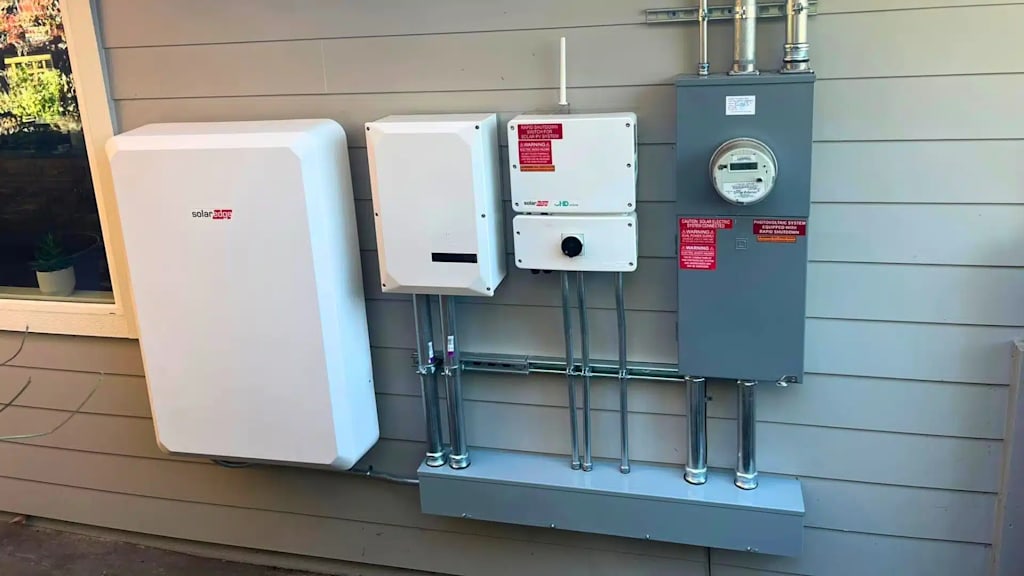
Home Battery Storage: A battery holds a fixed block of electricity and switches over automatically when the grid drops—without fuel, exhaust, or engine noise. Capacity is measured in kilowatt-hours (kWh). A typical household fridge uses roughly 1.5 to 2 kWh per day. On a common 13.5-kWh battery, running only that fridge gives you a few days of power. Add Wi-Fi, lights, TVs, or central AC, and stored energy disappears fast. Once empty, a standalone battery needs another source to recharge.
Solar Panels with a Battery: Pairing solar with storage fixes a standalone battery’s biggest limitation. While the sun is out, panels power your home and route surplus energy into the battery for overnight use. How well this holds up over a multi-day outage depends on daily solar production versus household use.
Standby Generators: Instead of storing electricity ahead of time, a permanently installed generator burns fuel on demand. When grid power fails, an automatic transfer switch isolates your home and shifts the load to the generator. A natural gas unit runs as long as gas service continues, while a propane model runs until its tank empties. Generators handle larger loads over longer outages, though they bring engine noise, exhaust, routine maintenance, and strict clearance rules.
Costs and Practical Trade-Offs
There’s no single best pick for every home. In California, typical upfront costs average around $21,200 for standalone solar, $13,500 for a standalone battery, $34,700 for solar with a battery, and $9,800 for a standby generator, depending on panel capacity, permitting, and site layout.
Before choosing, map out what an actual outage looks like at your house: which circuits truly need to stay on, how many days you’re preparing for, whether natural gas is available, and where the equipment can safely sit. Matching realistic capacity to your household’s daily needs keeps the lights on when the grid goes dark.
About the Creator
ORB Tree Service Marketing
ORB Tree Service Marketing provides SEO and local search strategies for the tree care and roofing industries. Follow us for insights on search optimization and lead generation for home services.
Enjoyed the story? Support the Creator.
Subscribe for free to receive all their stories in your feed.
Comments
There are no comments for this story
Be the first to respond and start the conversation.