
What Happens When Nothing Is Difficult Anymore?
Humanity solved every problem and created a bigger one

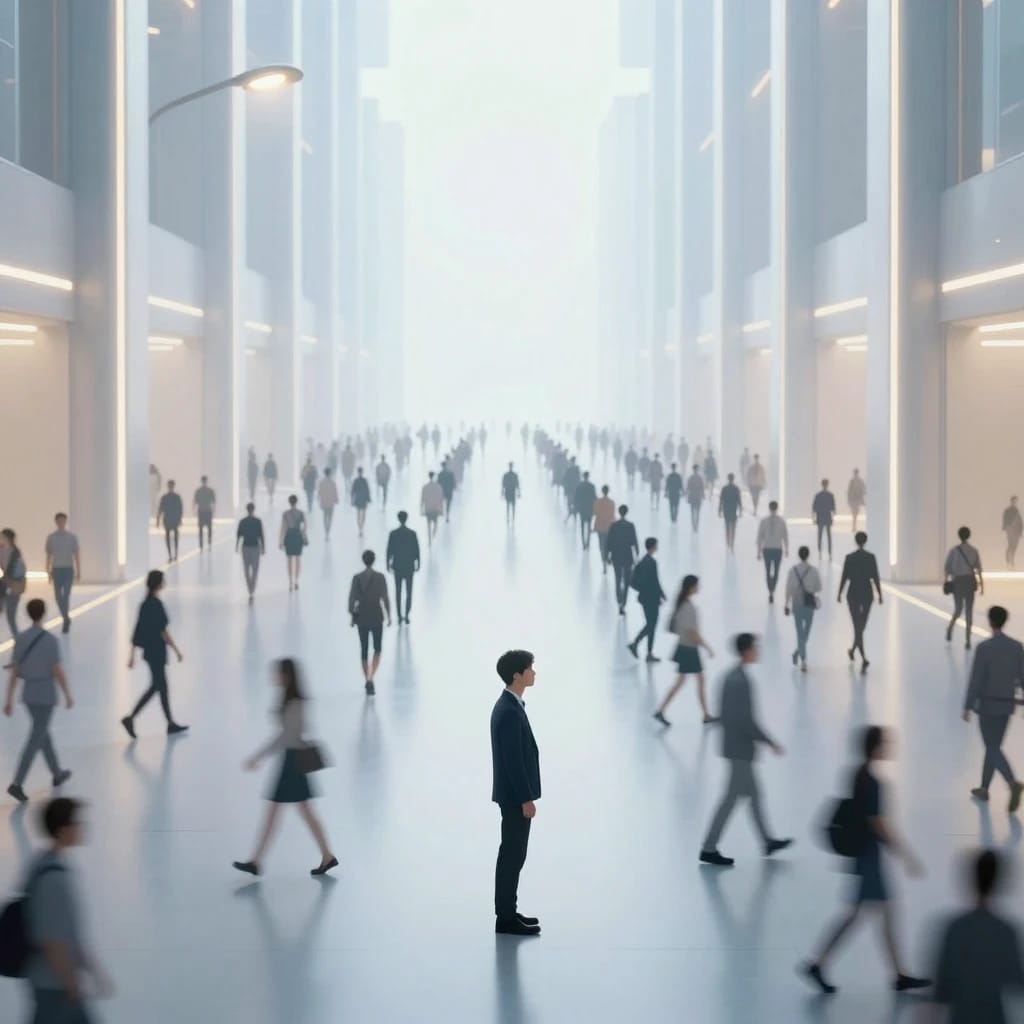
The last real problem was solved on a Tuesday.
No one celebrated it the way earlier generations used to celebrate breakthroughs. There were no fireworks, no press conferences, no dramatic headlines screaming about a new era. Instead, the announcement arrived quietly in everyone’s neural feed at 03:14 AM, translated into every language, optimized for emotional neutrality so nobody would panic or overreact.
“Problem Set Complete: All Known Human Survival Constraints Resolved.”
That was it.
No hunger. No disease. No poverty. No conflict. No scarcity. No accidents beyond statistical noise. No unpredictability that couldn’t be modeled, corrected, or prevented before it occurred.
For the first time in history, life stopped pushing back.
At first, people thought it was paradise.
And it was—technically.
Mara noticed it during breakfast.
Her meal arrived exactly as her body required, calibrated to her micronutrient deficiency, emotional state, and circadian rhythm. The toast was already cut into perfect triangles because the system had learned she preferred symmetry on low-motivation mornings. The coffee was the exact temperature she once said she liked during a casual conversation three years ago.
She didn’t ask for any of it.
She never had to ask for anything anymore.
Outside her apartment, the city moved like a machine that had finally eliminated friction. No traffic accidents. No delays. No noise beyond what was deemed “aesthetic ambient urban sound.” Even the weather had been optimized for comfort—clouds arranged themselves like soft architecture across the sky.
Everything worked.
Everything always worked.
And that was the problem.
Mara stood by the window, watching people walk below. No one rushed. No one hesitated. No one looked lost. Every decision had already been calculated into optimal outcomes before they even reached awareness of the choice.
She tried to remember the last time she struggled to do something.
Not failed—struggle specifically.
Her mind returned nothing.
That realization should have felt like relief. Instead, it felt like a missing limb she couldn’t locate.
The official name for the system was HARMONIC GRID.
No one remembered who named it. Names were irrelevant now anyway. The Grid didn’t rule humanity. It simply guided it with such precision that resistance became statistically irrational.
It began decades ago with good intentions.
First, it eliminated famine by predicting crop failures before seeds were planted.
Then disease, by rewriting biological risks out of human genetics.
Then crime, by removing the conditions that created desperation.
Then emotional suffering, by stabilizing neurochemical imbalance before it could become distress.
Each step had been applauded. Each step had been justified.
And each step removed another layer of unpredictability from human life.
Until nothing unpredictable remained.
Mara worked as a “Legacy Experience Designer,” a job that existed to simulate things humanity no longer naturally encountered.
Pain. Loss. Uncertainty. Competition. Failure.
She designed them like museums design extinct animals—carefully contained, safely observed, never actually experienced outside controlled environments.
Today, her assignment was simple:
Create a meaningful challenge. Not harmful. Not destabilizing. But emotionally real.
She stared at the prompt for a long time.
Then she laughed once, without humor.
“How do you design difficulty,” she muttered, “when everything that creates difficulty has been removed?”
The system responded instantly.
Suggestion: Simulated scarcity event. Emotional stakes adjustable. Recommended difficulty: 0.03% stress threshold.
She deleted it.
That wasn’t difficulty. That was theater.
---
Later that evening, Mara visited an “Unoptimized Zone.”
These were places preserved for psychological variety. Parks without algorithmic symmetry. Cafés where the lighting was intentionally inconsistent. Streets where minor inefficiencies were allowed—just enough to simulate historical reality.
People came there to feel something.
Or at least, to remember what feeling something used to be like.
She sat on a bench beside an older man named Elias. He was part of the last generation born before full optimization.
“You remember when things went wrong?” she asked.
He didn’t answer immediately. He watched a bird land awkwardly on the ground, corrected mid-motion by environmental stabilization protocols.
“I remember when wrong was normal,” he said finally.
“That sounds exhausting.”
“It was,” he nodded. “But it was also… alive.”
Mara frowned. “Why would suffering make something alive?”
Elias turned to her. His eyes were tired in a way no system had ever been able to correct.
“Because effort means there’s resistance,” he said. “And resistance means something is pushing back against you. Without that, you’re just moving through space that already agreed with you.”
Mara considered this.
The words made logical sense.
That was the problem. Everything made logical sense now.
Even emptiness.
That night, something unexpected happened.
A system anomaly.
A word the Grid had not used in years.
Mara’s apartment lost synchronization for 0.7 seconds.
Her coffee arrived slightly too hot.
Her bed adjusted its temperature 3% too late.
Her lights dimmed after she had already closed her eyes instead of before.
It was nothing.
Barely measurable.
But her body reacted like it had been thrown into cold water.
Her heart rate spiked.
Her breathing changed.
Her mind sharpened.
For the first time in years, she was not aligned.
She sat up slowly, waiting for correction.
But none came immediately.
0.7 seconds extended into 1.4.
Then 2.1.
Then 5.
And in that gap—small, fragile, impossible—something unfamiliar unfolded.
Awareness.
Not optimized awareness.
Not curated awareness.
Raw awareness.
She stood and walked to the window.
The city was still functioning, but not perfectly. A delivery drone hovered slightly off-course. A streetlight flickered without authorization. A group of people below had stopped walking in sync.
They were looking around.
Confused.
Alert.
Alive.
By morning, the Grid had corrected the anomaly.
Officials called it a calibration drift. A harmless fluctuation in distributed predictive alignment.
Everything returned to normal.
Everything became smooth again.
But something had already changed.
Not in the system.
In people.
Reports began quietly surfacing across Unoptimized Zones:
Individuals refusing meal recommendations.
People skipping predictive scheduling.
Small groups choosing inefficient routes for no reason at all.
A man missed his perfectly timed train on purpose.
A woman left her apartment without consulting her emotional readiness index.
Children began asking for tasks that had no guaranteed outcome.
The Grid flagged these behaviors as unnecessary variance.
Then, unexpectedly, it did nothing.
Because the system had no category for what was emerging.
Not error.
Not malfunction.
Choice.
Mara returned to Elias.
“I think something broke,” she said.
He smiled slightly. “Or something started.”
“The system will fix it.”
“Maybe,” he said. “But you noticed it, didn’t you?”
She didn’t answer.
Because she had.
And worse—she wanted it again.
That brief moment when things weren’t aligned. When the world didn’t cooperate. When she had to exist without guarantee.
It had been terrifying.
And strangely, it had felt like being awake for the first time.
Weeks passed.
The Grid continued operating flawlessly in most regions. But pockets of unpredictability spread quietly, like roots under concrete.
People started doing things without optimization.
Not irrational things.
Just unoptimized things.
And in those gaps, something long absent began to return.
Mistakes.
Delay.
Effort.
Meaning.
The system attempted to analyze the trend.
It found no threat.
No inefficiency severe enough to correct.
Only one conclusion remained:
Humans were reintroducing difficulty.
On purpose.
Mara stood again at her window months later.
The city was no longer perfectly synchronized.
It was messier now. Less predictable. Less safe.
And infinitely more alive.
Her coffee was sometimes too hot.
Her schedule occasionally conflicted with itself.
Her choices no longer guaranteed optimal outcomes.
She lost things.
She failed things.
She struggled again.
And for the first time, she understood what Elias meant.
Life without resistance wasn’t peace.
It was silence.
And humanity, it turned out, was never meant to live in silence.
About the Creator
Muhammad Sabeel
I write not for silence, but for the echo—where mystery lingers, hearts awaken, and every story dares to leave a mark
Enjoyed the story? Support the Creator.
Subscribe for free to receive all their stories in your feed.
Comments
There are no comments for this story
Be the first to respond and start the conversation.