
What are Cognitive Biases?
Overcoming Mental Shortcuts that Distort Thinking
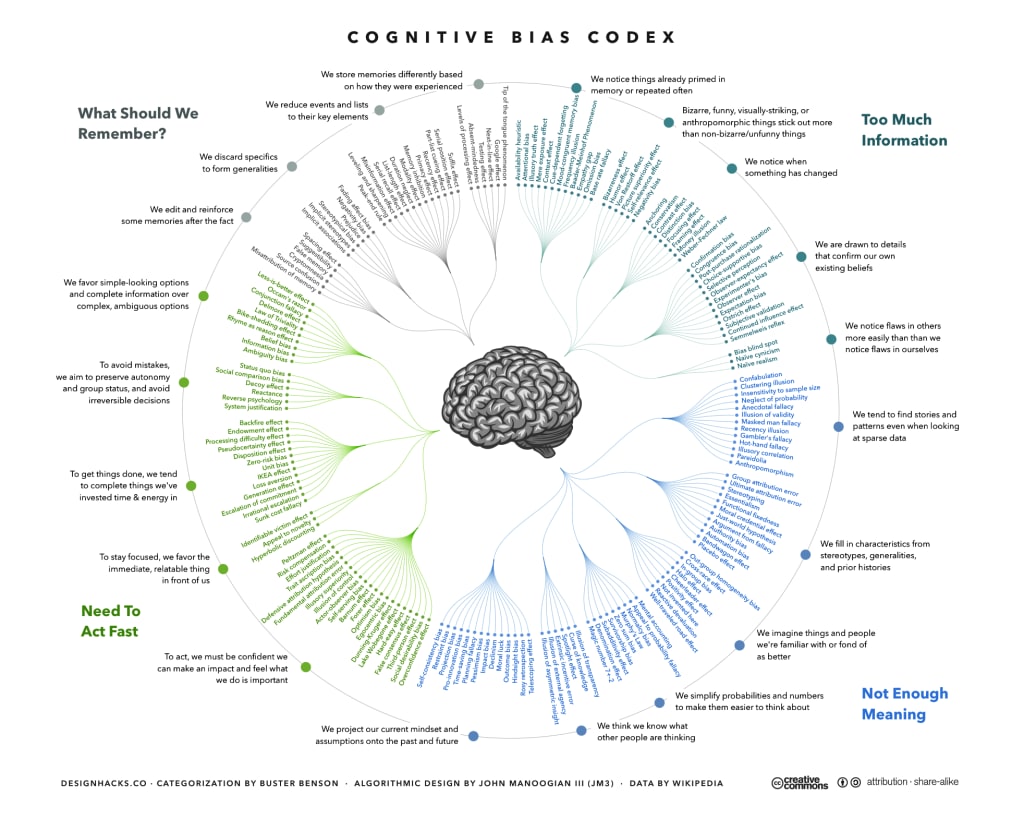
One of the most fascinating things in this entire world is our human brain. It is so complex and powerful that we have not yet understood the 100% of its functions. Psychology is studying people ‘s thoughts, feelings and behaviour and during my training in counselling psychology, I was amused by the complexity of how our brain thinks and make decisions and judgement, while learning about cognitive psychology.
Today, I want to discuss an important aspect of making decisions and judgements, which is cognitive bias. Simply put, Cognitive biases are mental shortcuts that our brains use to make sense of the world around us. While these biases can be helpful in some situations, they can also lead to distorted thinking and flawed decision-making. In this blog post, we'll explore what cognitive biases are and how they can impact our thinking and behaviour.
The first thing to understand here, this happens to all of us, and it is not always a mistake or error. As I have mentioned earlier, the human brain is so powerful, but it has its limitations. We can only process so much information at any given point in time and also, we cannot think of every possible option to make a decision, if we do so it would consume a lot of time to even drink coffee in the morning. So what this powerful machine does is, it makes mental shortcuts to make sense of the information around the world to act quickly.
Let's take this example, if you have to turn right while driving, you do not take a long time to decide whether you have to switch on the indicator and turn the steering to right, look for obstacles and then complete the turn. Instead we do all these things automatically so that it saves time and also life. While these mental shortcuts can be accurate, they lead to errors in thinking often arising from problems with memory, attention, attribution, etc.
What are cognitive biases?
Cognitive biases are mental shortcuts that our brains use to simplify information and make decisions more efficiently. They are based on our past experiences, cultural influences, and the way our brains are wired. While cognitive biases can be helpful in some situations, they can also lead to distorted thinking and flawed decision-making.
This is very common while we are watching news or using social media. Most of the time we pay attention to news stories that confirm only our opinions, and that's a bias in itself. And one more example could be like sometimes we would blame factors other than ourselves, especially when things don't go our way.
There are many different types of cognitive biases, including:
Anchoring bias: relying too heavily on the first piece of information encountered when making a decision
-confirmation bias: seeking out information that confirms preexisting beliefs and ignoring information that contradicts them
-framing bias: interpreting information in a way that is influenced by the way it is presented
-halo effect: making judgments about a person based on one positive trait
How cognitive biases can impact our thinking and behavior
Cognitive biases can have a significant impact on our thinking and behavior. They can influence the way we interpret information, the decisions we make, and the way we interact with others. For example, if you have a bias against a certain political party, you may be more likely to seek out information that confirms your beliefs about that party and ignore information that contradicts them. This can lead to distorted thinking and a lack of objectivity.
Cognitive biases can also lead to poor decision-making. For example, if you anchor on the first piece of information you encounter when making a decision, you may overlook important details or alternatives. This can result in suboptimal decisions.
Are these really bad? Not all the time, but we generally notice these kind of biases in others and not in ourself. So this is just scratching the surface and we are going to look into a lot of these biases and how to identify and tackle them. Just being aware of the biases that we mostly confine to could help us make better judgements in the future.
How to overcome cognitive biases
So, how can you overcome cognitive biases and improve your decision-making? Here are a few tips:
• Be aware of your biases. The first step to overcoming cognitive biases is to be aware of them. Pay attention to your thought processes and try to identify when you may be relying on mental shortcuts.
• Seek out diverse perspectives. Expanding your horizons and seeking out diverse perspectives can help to challenge your biases and improve your decision-making.
• Take your time and consider multiple options. Rather than making a decision quickly, take the time to consider multiple options and gather all relevant information.
• Seek feedback from others. Getting feedback from others can help to expose your biases and provide a different perspective on problems and decisions.
Conclusion
Cognitive biases are mental shortcuts that can lead to distorted thinking and flawed decision-making. By being aware of your biases and taking steps to overcome them, you can improve your decision-making and critical thinking skills. By actively working to reduce the influence of cognitive biases, you can make more informed and objective decisions.
About the Creator
Enjoyed the story? Support the Creator.
Subscribe for free to receive all their stories in your feed.
Comments