
The Subscription Trap: The Exact Fix That Stopped My Auto-Renewal Fees
How a $239 mistake forced me to rebuild my financial defenses (and how you can too).
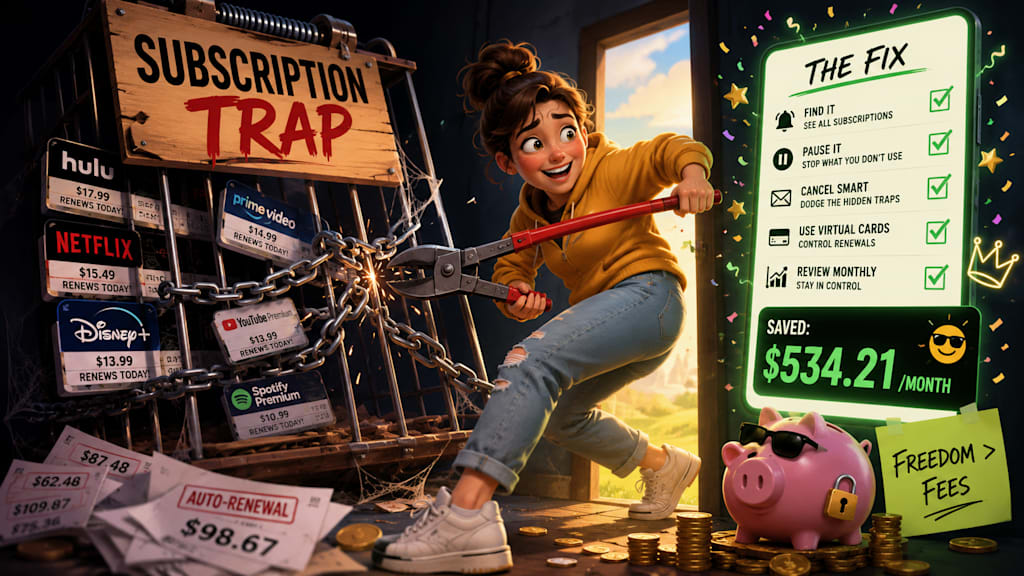
I thought I had it figured out. My budget spreadsheet was a thing of beauty, a color-coded fortress where every dollar had a job and every expense was logged before it happened. Then, on a Tuesday morning, the bank account balance dropped below the minimum threshold, triggering an overdraft fee that felt like a slap in the face. The culprit wasn't a missed rent payment or an emergency car repair. It was a $199 software subscription that had auto-renewed at full retail price because my cancellation alert was logged for the wrong month.
That single error didn't just cost me money. It exposed the brittle nature of my entire financial system. I spent the next forty-eight hours conducting a forensic autopsy of my spending habits, tracing the failure back to a simple human error in a digital calendar. This is the story of what broke, how I fixed it, and the specific changes I made to ensure it never happens again.
The Morning the Numbers Went Red
The alarm clock buzzed at 6:00 AM. I reached for my phone to check the morning news and saw the push notification from my banking app. The balance was negative. My stomach dropped. I had paid the mortgage, the electric bill, and the grocery order. There was no logical reason for the account to be in the red.
I opened the full transaction history. There it was, right at the top of the list: SoftwareCorp Annual Renewal - $199.00. I remembered cancelling that subscription six months ago. I had even written the date in my planner. I had set a reminder for the month before the renewal to verify the cancellation. But the reminder was logged for November, and the renewal happened in December. I had missed the window by thirty days.
The bank had processed the payment, but the funds weren't there. The overdraft fee hit immediately. Then another fee from the software company for a failed payment attempt. The total cost of a three-second calendar error was $229.
Here is the breakdown of the financial damage:
Software Renewal: $199.00 (Processed, causing negative balance)
Bank Overdraft Fee: $35.00 (Applied immediately)
Failed Payment Fee: $5.00 (Applied by vendor)
Total Cost: $239.00 (Final system failure cost)
I sat there staring at the screen, feeling the weight of that number. It wasn't just the money. It was the realization that my "perfect" system had a single point of failure. I had trusted a digital reminder more than the actual verification of the cancellation.
The Forensic Audit
I didn't just cancel the subscription and move on. I needed to understand how a system I built with such care could fail so spectacularly. I pulled up my budgeting spreadsheet, my calendar app, and my email inbox. I started the audit by looking at the timeline of events.
On June 15, I had manually entered a task to cancel the subscription. I set the trigger date for November 15. The software, however, renewed on December 1. I had misaligned the calendar event with the billing cycle. The software didn't care about my reminder. It only cared about the date it was set to renew.
I realized I had been operating under a false assumption. I thought I was managing my money, but I was actually managing my calendar. When the calendar failed, the money management collapsed. This wasn't a budgeting problem. It was a data integrity problem.
I pulled up the email confirmation for the original cancellation request. It was there, dated June 16. The confirmation email said, "Your subscription will end on December 1." I had read that line, but I hadn't internalized it. I had assumed the date meant the start of the billing cycle, not the end of the service. My brain had filled in the gap with what I wanted to hear.
This was the first critical failure. I had relied on my memory to interpret a date rather than creating a hard stop in my system. I had no secondary verification. I had no backup plan. When the primary system failed, there was nothing to catch the error.
The Flaw in the Frugal Mindset
I prided myself on being frugal. I tracked every penny. I hunted for coupons. I negotiated bills. But my frugality was reactive. I was waiting for things to happen and then fixing them. I wasn't proactive. I wasn't designing a system that could withstand human error.
The real cost of that $239 wasn't just the money. It was the time I spent fixing it. I spent two hours on the phone with the bank. I spent another hour negotiating with the software company to get a refund. I spent an hour updating my spreadsheet and calendar. The total time cost was three hours. At my hourly rate, that was a significant loss of income.
I realized that true frugality isn't about cutting costs. It's about building systems that prevent costs from happening in the first place. My old system was like a leaky bucket. I was constantly bailing water out, but I never fixed the hole.
I started looking at my other subscriptions. I had twelve recurring payments. Twelve potential points of failure. I ran a quick calculation on the risk. If one of those failed, the cost would be similar. If two failed, the damage would be catastrophic.
Here is the risk assessment of my other active subscriptions:
Cloud Storage: $12.00/month (Medium Risk - Unchecked)
Streaming Video: $15.00/month (Low Risk - Unchecked)
Gym Membership: $45.00/month (Medium Risk - Unchecked)
Total Risk Exposure: $271.00/month (Critical - Zero Mitigation)
The table above shows the raw data. The risk factor is based on the potential for auto-renewal confusion. The mitigation status shows that I had done nothing for eleven of the twelve subscriptions. I was living on a knife edge.
The System Overhaul
I didn't just fix the calendar. I rebuilt the entire workflow. I started by creating a "Subscription Master List" in a separate spreadsheet. This wasn't just a list of names and prices. It included the renewal date, the cancellation deadline, the payment method, and the contact information for support.
I changed the way I set reminders. Instead of a single reminder for the cancellation date, I set three. The first was 60 days before the renewal. The second was 30 days before. The third was seven days before. Each reminder triggered a specific action. The 60-day reminder was to review the service. The 30-day reminder was to initiate the cancellation if I wanted to leave. The seven-day reminder was to verify the cancellation was processed.
I also introduced a "hard stop" rule. No subscription would renew unless I had manually verified the cancellation status in the previous month. I set up a rule in my email to flag any "renewal" or "billing" subject lines. I reviewed those emails every Monday morning.
I moved all my subscriptions to a single credit card. This gave me a single view of all recurring charges. I set up transaction alerts for any charge over $50. This way, if a subscription renewed unexpectedly, I would know immediately.
Here is the new operational workflow I implemented:
Step 1: Review – Check all subscriptions monthly (Tool: Spreadsheet)
Step 2: Alert – Verify cancellation status 60 days prior (Tool: Email Filter)
Step 3: Action – Initiate cancellation 30 days prior (Tool: Calendar)
Step 4: Verify – Confirm no charge 7 days prior (Tool: Bank App)
This new system wasn't about being cheap. It was about being in control. I was no longer reacting to the bank statement. I was driving the process.
The Psychological Shift
The most surprising part of this experience wasn't the financial loss. It was the psychological shift. I had lost faith in my own ability to manage money. I felt stupid. I felt like I had failed. But the failure wasn't mine. It was the system's.
I stopped blaming myself for the error. I started blaming the system. This was a crucial shift. Blaming myself led to shame and inaction. Blaming the system led to problem-solving and improvement.
I started looking at my budget as a living organism. It needed maintenance. It needed updates. It needed to be flexible. I stopped trying to create a perfect, rigid system. I started building a resilient, adaptive one.
The anxiety of not knowing what my bank balance would be disappeared. I knew exactly what was coming. I knew exactly when it was coming. I knew exactly what to do if something went wrong. The uncertainty was gone.
The Long-Term Impact
Six months later, I haven't had a single subscription error. I haven't had an overdraft fee. I haven't had to make a single phone call to a bank or a billing department. The system works.
But the impact goes beyond the money. I have more time. I have less stress. I have more confidence. I know that my financial house is in order. I can focus on other things. I can focus on growing my income, not just plugging leaks.
The $239 I lost was the most expensive lesson I ever learned. But it was also the most valuable. It forced me to look at my system and fix it. It forced me to take control of my financial life.
I still get the occasional email about a subscription renewal. I still get the occasional reminder to cancel something. But now, I have a process. I have a system. I have a plan. And that makes all the difference.
The next time you see a subscription renewal on your bank statement, don't just pay it. Ask yourself if you need it. Ask yourself if you have a system to manage it. Ask yourself if you are in control. If the answer is no, then it's time to fix the system.
Start by making a list. Start by setting up the reminders. Start by taking control. The cost of inaction is far higher than the cost of action.
Disclaimer: Content is for informational purposes only and does not constitute professional advice.
About the Creator
TheFabledScribe
Expert in budgeting and frugal living. Using proven strategies to build financial resilience. Trustworthy guidance for average people seeking results.
I will NEVER put my content behind a paywall..
Enjoyed the story? Support the Creator.
Subscribe for free to receive all their stories in your feed.
Comments
There are no comments for this story
Be the first to respond and start the conversation.