
The Quiet Luxury of Starting Over
There’s a strange kind of silence that appears after a major life change.

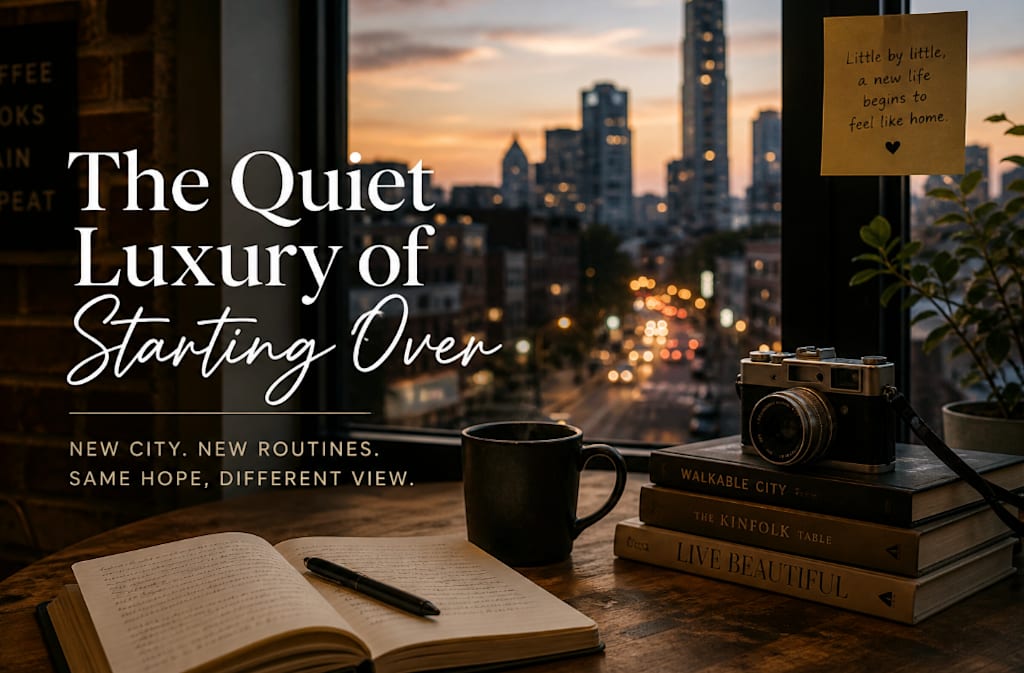
Not the dramatic kind you see in movies. Real silence is smaller than that. It’s sitting in an apartment that still smells like cardboard boxes. It’s realizing nobody in your new city knows your usual coffee order. It’s walking through a grocery store and suddenly feeling exhausted because you can’t find the brand of pasta sauce you used to buy without thinking.
A few years ago, I moved to a different city with two suitcases and a laptop that barely held a charge for more than an hour. I thought the whole experience would feel exciting all the time. New city, new routines, new version of myself. That’s how people talk about starting over, anyway.
What nobody mentions is how awkward it feels at first.
For a while, I got lost constantly. Dinner usually meant takeout containers balanced on moving boxes because I still hadn’t bought a table. Weekends were the worst. I’d walk around random neighborhoods pretending I was exploring the city, but honestly, I just didn’t want to spend another Saturday sitting alone in my apartment.
I remember spending nearly twenty minutes in a grocery store once looking for the coffee brand I used to buy back home. When I finally realized they didn’t carry it, I almost laughed at myself. It seemed ridiculous to care that much about coffee. But that was the strange thing about moving somewhere new — tiny inconveniences suddenly felt emotional.
People love talking about reinvention as if it arrives all at once. One big decision, one dramatic turning point, and suddenly your life changes direction.
In reality, most transitions are painfully ordinary.
You still need to do laundry. You still forget passwords. You still have awkward conversations and stand in line at pharmacies wondering if you filled out the form correctly. Life doesn’t suddenly become cinematic just because you moved somewhere unfamiliar.
And honestly, that turned out to be comforting.
The city slowly became less intimidating. The cashier at the convenience store started recognizing me. I found a small bookstore hidden between two apartment buildings and ended up going there almost every weekend. Eventually I learned which streets stayed quiet at night and which café played terrible jazz music every morning.
None of these things were important individually. Together, though, they made the place start feeling familiar.
I think that’s what people misunderstand about starting over. It usually doesn’t happen through one giant breakthrough moment. Most of the time, it happens through repetition. You go somewhere enough times that it stops feeling foreign. You talk to people long enough that conversations become easier. You keep showing up to your own life until it finally begins to feel like yours again.
That process is slower than most people expect.
Modern culture likes dramatic transformations. Social media especially loves before-and-after stories. Someone quits their job, moves across the country, starts waking up at 5 a.m., and suddenly they’ve become a completely different person.
Real life is less organized than that.
Some mornings during my first year in the city, I felt optimistic and productive. Other mornings I seriously considered packing everything up and leaving. There wasn’t a clean emotional arc to any of it. Mostly, it was just adjustment happening in small pieces.
Looking back now, I think the hardest part wasn’t loneliness. It was uncertainty.
When you leave behind familiar routines, even small decisions suddenly require energy. Which train should you take? Which neighborhoods are safe? Which grocery store is overpriced? Where do people go when they want to be alone without looking lonely?
You spend months collecting answers to questions nobody thinks about until they have to start over somewhere unfamiliar.
But there’s something strangely valuable about becoming a beginner again.
As adults, we spend so much time trying to appear established. We want competence. Stability. Predictability. Starting over removes all of that for a while. You become noticeably inexperienced again, even in situations that seem simple.
At first, I hated that feeling.
Later, I realized it made me more observant.
I paid attention to things I normally would’ve ignored. The pace of conversations. The way strangers interacted with each other. Which parks filled up at sunset. Which cafés people stayed in for hours without feeling rushed out the door.
The city itself moved differently from the one I’d left behind.
Back home, everyone always seemed busy. Conversations revolved around deadlines, work stress, productivity. Slowing down felt irresponsible somehow. In the new city, people lingered. They sat outside bookstores reading for hours. Coffee shops stayed crowded late into the evening, not because people were working remotely, but because nobody seemed in a hurry to leave.
Without really planning to, I changed too.
I started walking more. Cooking more. Reading before bed instead of staring at my phone for an hour. Not because I suddenly became disciplined, but because the environment around me quietly encouraged different habits.
That realization stuck with me.
Sometimes personal growth has less to do with forcing yourself to improve and more to do with finding environments that allow different parts of you to exist.
Of course, not every fresh start comes from something positive. Sometimes people begin again because they have no choice. A breakup. A layoff. A loss they didn’t see coming. Those kinds of transitions carry a different weight entirely.
At the time, uncertainty usually just feels exhausting. The “growth” part only becomes obvious later.
Still, I think there’s value in realizing you can survive unfamiliar versions of your own life. Once you’ve rebuilt routines from scratch, future uncertainty becomes slightly less frightening. You know from experience that eventually the unfamiliar becomes ordinary.
A new coffee shop becomes your regular spot.
A stranger becomes a friend.
A city stops feeling temporary.
And one day, usually without noticing when it happened, your life no longer feels like something you’re adjusting to. It just feels like your life.
About the Creator
Florence Rossetti
Known for elegant prose and reflective storytelling, work explores themes of identity, human connection, and personal transformation through a calm and emotionally grounded narrative style.
Enjoyed the story? Support the Creator.
Subscribe for free to receive all their stories in your feed.
Comments
There are no comments for this story
Be the first to respond and start the conversation.