
“The Job Application Advice We Were Sold Is Dead”
AI Era Reality Check

I’m continually coming back to this one idea, and it’s been worrying me more than I anticipated: we were all given the same script regarding how to obtain a job. That is to say, you should go to school, get the degree, construct a resume which is identical to everyone else’s, apply to a large number of positions, then wait around and hope that someone rings you up. For a time, this approach did work — or at least so many people believed it worked that no one ever questioned it.
It no longer does. I believe it hasn’t worked for a long time, even if we’ve never actually said so.
What irritates me most is the fact that some people still spend their time manually processing three, four, or perhaps five job applications each day, copying and pasting the same resume with only one word changed. On the other hand, there’s another group of people who have worked out that AI can produce twenty or thirty customized resumes and cover letters in the time it takes the first group to complete just one. And this isn’t spam — these are actually tailored to the specific job posting. They are genuinely customized, and while they are preparing their coffee or browsing TikTok, they use AI to send out all the applications.
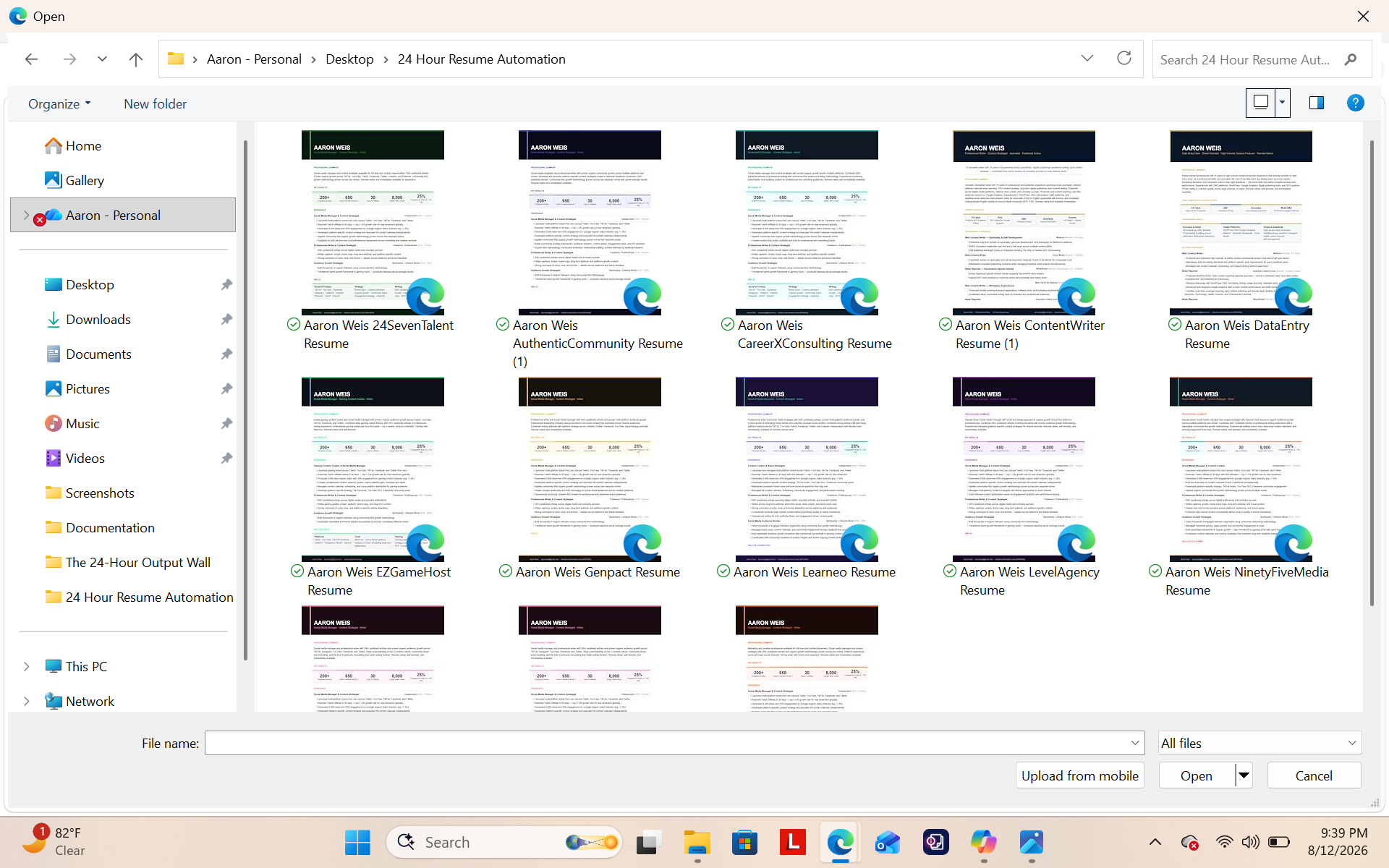
“This is what AI‑assisted job hunting looks like: 13+ resumes and cover letters in minutes, not days.”
This is no fair contest and it isn’t the same game at all; it’s rather similar to the posts you sometimes see online stating that Michael Jordan was playing chess while everyone else was playing checkers.
No one is discussing the other aspect of this situation. I’m referring to the new reality in which your resume likely isn’t even reaching human eyes at the beginning; instead, it goes directly to a machine, is assessed, and has various factors considered — such as keywords, formatting, and some general “fit” indicator. You may or may not pass, and if you do pass, you could end up having an interview with an AI. Pause and think about that for a moment. People are practicing answers as if they’re being evaluated by a machine that judges the tone. I still can’t erase the extremely surreal sensation as if I had been in a kind of Phillip K. Dick science-fiction film when I first had an interview with an AI bot. It’s exactly the kind of thing that would form the basis of a whole therapy session centered on the idea that you can no longer believe the world in which you actually live. Looking back on it, it reminds me of the time I asked a Vietnam veteran what he thought about technology nowadays, and his reply was, “It’s scary. It has become something I would have never thought possible.”
All the previous advice — making sure your resume is polished, applying to every position, and being patient — is not incorrect, it’s just… out of date. It’s similar to taking a paper map to a job that needs GPS.
The true life hack is to stop thinking as if you’re looking for a job and instead think as a consultant who is by the way looking for a job.
What this means is that you should take the initiative and get in touch directly — with the hiring manager, the recruiter, or indeed the person who actually makes the decision — not by sending the same “Hi, I’m very interested in this role” message that everybody else does, since no one reads that twice.
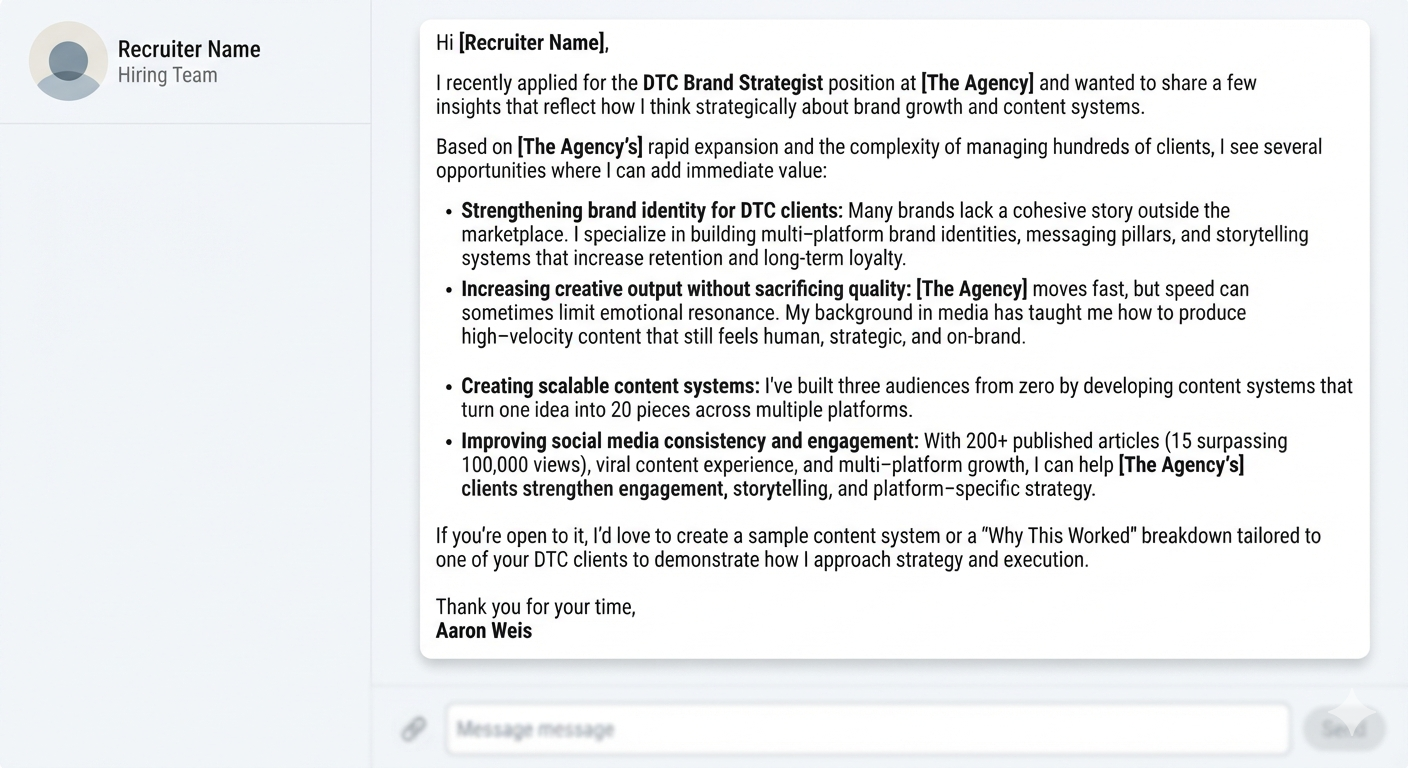
“A sample outreach message showing how I lead with value — offering a free audit instead of a generic ‘I’m interested’ note.”
Bring value instead and offer a free audit.
Of course, I already know how people will react — “I’ve never carried out an audit, I don’t know what it involves.” That’s quite reasonable and completely fair. Yet that’s precisely where AI proves useful. You can take a company’s website, its content, its social media accounts — anything that’s publicly available — and input it into an AI model so that the model helps you prepare a preliminary audit. Then you refine it and incorporate your own views, after which you’ve accomplished something that very few people even take the time to attempt.
The video does resume. In the past I considered this a gimmick, but after looking more closely at the market I can see that it does make sense. People remember faces, they remember a person’s energy and they remember the voice. They don’t remember the fourth bullet point on page two. A short, watchable video demonstrates effort — and effort is something that stands out.
The market is already crowded and everybody is aware of that. The only way to succeed is to go beyond the absolute minimum. You must demonstrate that you can do the job, not just say that you can.
I’ll take my own situation as an example since that’s the one I’m most familiar with. At the time I applied for a brand strategy position, I didn’t simply send in my resume and wait around. Instead, I put together a complete presentation, carried out a full audit, suggested an AI campaign, prepared six scripts — three for podcasts and three for TikTok — created visual aids, including icons and thumbnails, developed a content ecosystem, outlined a 30-day roadmap, established a growth flywheel, and designed an AI knowledge brain. In effect, the amount of work that usually takes a whole week was completed in under 24 hours.
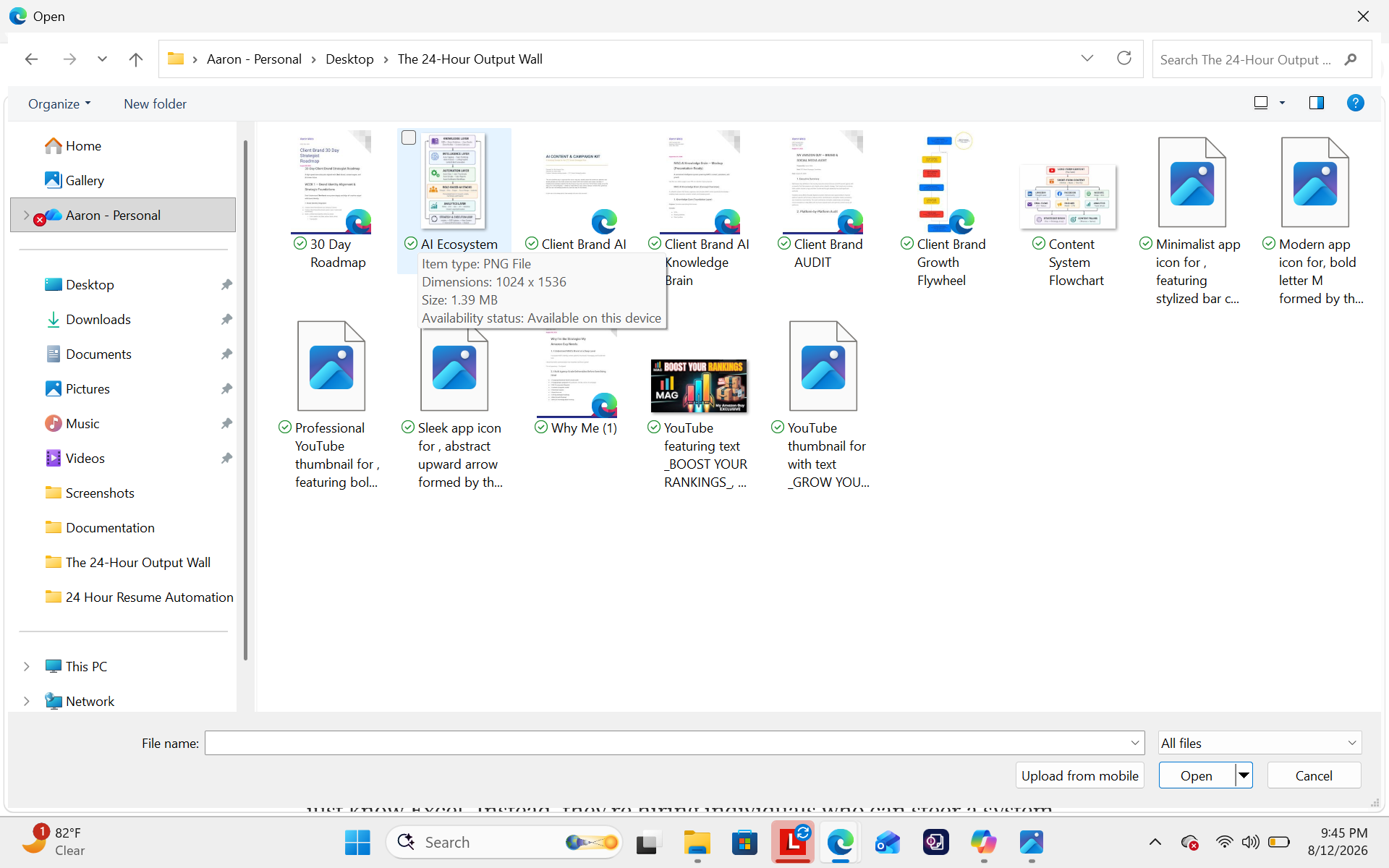
I’m not some kind of productivity machine by any means, but with AI you can work at a totally different speed once you know how to direct it.
Here’s the aspect that’s not so much about ‘hacks’ as it is a warning: people need to become literate in this area. It’s not because it’s in vogue. It’s not because it looks good on LinkedIn. Rather, the companies that have real money are already developing multi-layer AI systems. They’re spending hundreds of thousands of dollars so that knowledge can move smoothly throughout their whole organisation. They’re no longer hiring people who just know Excel. Instead, they’re hiring individuals who can steer a system, not just use it within one.
Alright, listicle time — because let’s be honest, this is the part people actually read:
How to Apply for Jobs in the AI Era (So You’re Not Left Behind)
Don’t hand-applied to three to five jobs each day.
You are facing off against people who are applying through automation with 30 or more such applications.
Use artificial intelligence to customize your resumes and cover letters.
Specific ones — those that have actually been tailored to each posting.
Suppose that a machine looks at your resume first.
Write with clarity and include the relevant keywords rather than focusing on vibes.
Contact the hiring managers directly by highlighting your value.
Not a form letter — something that they could use.
Offer a free audit.
You can use AI to create it even if you’ve never made one before.
Make a video resume.
Short, personal, memorable.
Prepare a one-page document for the role.
What I would do in the first 30 days is the following.
Use artificial intelligence to reduce the amount of output.
It is now possible to work six days in one day.
Get AI‑literate.
It’s not optional anymore.
Think like a consultant.
Show proof, not promises.
The job market didn’t get harder. It got faster. It’s leaving behind anyone who still applies like it’s 2015.
Either adapt at once or risk being left behind by those who already have.
About the Creator
Aaron M. Weis
Creator of Continuity Writing: a spiritual, steady‑stream consciousness style shaped by daily journaling, inner expansion, and the belief that awareness is our greatest responsibility.
Enjoyed the story? Support the Creator.
Subscribe for free to receive all their stories in your feed.
Comments
There are no comments for this story
Be the first to respond and start the conversation.