
The Invisible Rucksack
Tactical Resilience for the Next Generation

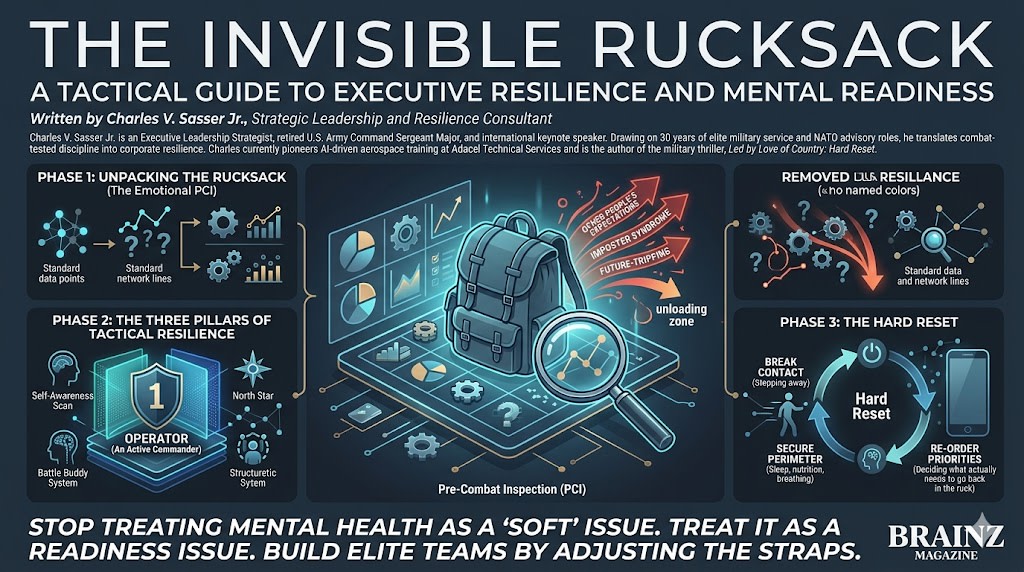
In the Army, we have a saying: "Ounces equal pounds, and pounds equal pain." Every Soldier knows that if you don't pack your rucksack with discipline, the weight will eventually break your back on a long movement. But after thirty years serving and ten years defense contracting training our allies and service members, from the hardwoods of Georgia to the streets of Al Dora and the mountains of Afghanistan, I’ve learned that the heaviest loads aren't the ones strapped to our shoulders—they’re the ones we carry inside. Whether you’re a Command Sergeant Major leading a battalion or a middle-schooler navigating a fractured home life, we all humped an "invisible rucksack" filled with anxiety, expectations, and the "weird" dysfunction that life throws our way. Resilience isn't about being a statue that never feels the weight; it’s about the tactical discipline of unpacking that ruck before it pins you to the ground.
I. The Weight We Carry
The year 1990 didn’t end with a celebration; it ended with a test of sheer, frozen will.
December at Fort Campbell is rarely kind, but that morning, the air didn’t just bite—it hunted. The thermometer bottomed out at 5 degrees, and the wind-chill coming off the Sabalauski Air Assault School’s tarmac felt like a physical blow. We stood there, 133 of us, shadows in the pre-dawn dark, adjusting the straps of our ALICE packs for the final 12-mile ruck march. We were the "101st Airborne," the "Screaming Eagles," but at 0400 in sub-zero gusts, we were just men trying to keep our lungs from searing.
"Go."
The first few miles were a rhythmic crunch of boots on frozen earth. Your body heat starts to rise, and that’s when the real danger begins. In 5-degree weather, sweat isn’t just moisture; it’s a liability. As the salt and water rolled off my forehead, the wind caught it.
I remember the first time it happened. I blinked, and my eyelashes didn't part. They were fused. The moisture had turned to ice instantly, sealing my eyes shut. I had to reach up with my freezing gloved hand, cupping my eyes to let the heat of my palms melt the bond just so I could see the heels of the man in front of me. This happened again. And again. Every blink was a gamble.
By mile six, the attrition began.
You could hear it—not just the wind, but the sound of men stopping. The cold doesn’t just hurt your muscles; it attacks your spirit. It tells you that a warm truck and a heater are just a "quit" away. One by one, the formation thinned. The instructors’ trucks cruised the line, picking up the fallen, the frostbitten, and those whose bodies simply revolted against the pace.
I focused on the "Invisible Rucksack." I told myself that the ice on my face was just extra gear I hadn't cleared during PCI. I wasn't Charles Sasser, a man in pain; I was a machine designed to move 12 miles in under three hours.
When I finally crossed that finish line, the world was a blur of grey and white. I looked around, expecting the usual crowd of successful candidates. Instead, there was a ghost crew.
Out of the 133 who stepped off into the dark, only 13 of us remained.
I didn't feel like a champion in that moment. I felt like a block of ice. Once the movement stopped, the adrenaline evaporated, and the cold claimed its due. I stood waiting for my items to be inspected, and the shaking started—a deep, violent, bone-rattling tremor that lasted for hours. My nervous system was rebooting after a Hard Reset it never asked for.
But as I sat there, teeth chattering and eyes finally thawed, I thought about the "Air Assault Wings" waiting for me. I realized that the 120 men who fell out weren't necessarily weaker; they just hadn't found the gear to override the instinct to survive.
I had learned an important lesson, one of many in my career: When the wind-chill hits 5 degrees and your eyes freeze shut, you don't need a miracle. You just need to take the next step.
II. Unpacking the Rucksack: The Emotional PCI
In the light of day, a rucksack is just nylon and straps. But at mile 12 or 18 of a foot march in the dark, every ounce feels like a boulder. Mental health is no different. For a kid dealing with family dysfunction or a veteran transitioning to civilian life, the "weight" often goes unnamed. We call it "stress" or "being tired," but that’s lazy leadership. To manage the load, you have to dump the ruck on the floor and account for every single item.
Identifying the "Dead Weight"
When I was a young Soldier, I saw guys pack extra gear they didn't need "just in case." In our emotional lives, we do the same. We carry:
• Other People’s Expectations: Packing a load that belongs to a parent, a spouse, or a boss.
• The "Weirdness" Factor: The shame of family dysfunction or personal anxiety that we think we have to hide.
• Future-Tripping: Carrying the weight of a "what if" scenario that hasn't even happened yet.
The Tactical Inventory
You cannot maneuver if you are pinned down by unnecessary weight. Unpacking the rucksack means asking: Is this item helping me reach the objective, or is it just making me bleed? If it’s "dead weight"—like the shame of a situation you didn't create—you have to have the tactical discipline to leave it on the drop zone.
III. The Three Pillars of Tactical Resilience
Once the ruck is empty, you don't just leave it that way. You repack it with purpose. In the Infantry, we didn't just survive because we were "tough"; we survived because we had a system. To build a resilient life—especially for a young person facing the "weirdness" of a fractured world—you need three structural pillars to hold the weight.
1. Inventory: The Self-Awareness Scan
You can't manage a leak in your camelback if you don't know it’s dripping. Resilience starts with a constant, honest scan of your internal "equipment."
• The Drill: Ask, "What am I feeling, and is it a fact or a 'ghost'?" Anxiety is often just a ghost in the perimeter. Shine a light on it, call it by its name, and it loses its power to pin you down.
2. Weight Distribution: The Battle Buddy System
No soldier humps a 80-pound ruck across a mountain range alone. If a guy is flagging, someone else takes a few magazines or a base plate to lighten the load.
• The Lesson: For a kid or a veteran, "toughing it out" in isolation is a tactical error. Resilience is a team sport. You need a "Squad" of mentors, friends, or Family who know exactly what’s in your ruck and are ready to help you shift the weight when the terrain gets steep.
3. Pace and Purpose: The North Star
When the pain sets in, you stop looking at the horizon and start looking at your boots. You focus on the next step. But you only keep stepping if you know where you’re going.
• The Strategy: Define your "Objective." Whether it’s graduating high school, finishing a task, or just making it through a difficult Tuesday, having a clear 'Why' provides the friction-reduction needed to keep moving.
IV. The "Hard Reset" for the Modern Soul
Sometimes, despite your best packing, the mission goes sideways. The weather turns, the gear breaks, and the weight becomes unbearable. In my writing, I call this the Hard Reset. It’s the moment you stop, drop the ruck, and recalibrate your entire approach.
For someone struggling with mental health, a Hard Reset isn't a failure—it’s a tactical regrouping. It means:
• Breaking Contact: Stepping away from the "noise" (social media, toxic environments, or circular thoughts) to regain clarity.
• Securing the Perimeter: Focusing on the basics—sleep, nutrition, and breathing. You can’t win a battle if your base is compromised.
• Re-Ordering Priorities: Deciding what actually needs to go back in the ruck for the next leg of the journey.
V. Conclusion: Leadership is Service
At the end of the day, a leader’s primary job isn’t just to accomplish the mission—it’s to ensure their people are capable of completing it. Whether you are a Command Sergeant Major or a parent, you are the "Platoon Leader" of a small, vital unit. If someone in your charge is flagging under the weight of an invisible rucksack, you don’t tell them to "suck it up" and keep walking. You teach them how to adjust the straps.
Don’t treat mental health as a "soft" issue, start treating it as a readiness issue. Resilience isn't a destination; it’s a tactical proficiency that requires constant training.
By sharing our own "weirdness," by admitting when our own rucks are heavy, and by providing a clear map for a Hard Reset, we give the next generation the permission to be human—and the tools to be elite. The mission continues, the terrain remains tough, but with the right tactical approach, there isn't a rucksack in the world that can keep us from the objective.
About the Creator
Charles V Sasser Jr
Retired U.S. Army CSM, SOFREP defense analyst, and author of the thriller Led by Love of Country. I translate military doctrine into strategic insights on global conflicts, defense technology, and executive leadership.
Enjoyed the story? Support the Creator.
Subscribe for free to receive all their stories in your feed. You could also become a paid subscriber, letting them know you appreciate their work.
Comments
There are no comments for this story
Be the first to respond and start the conversation.