
The Everyday Online Tools That Quietly Changed How We Work
Smarter Digital Workflows

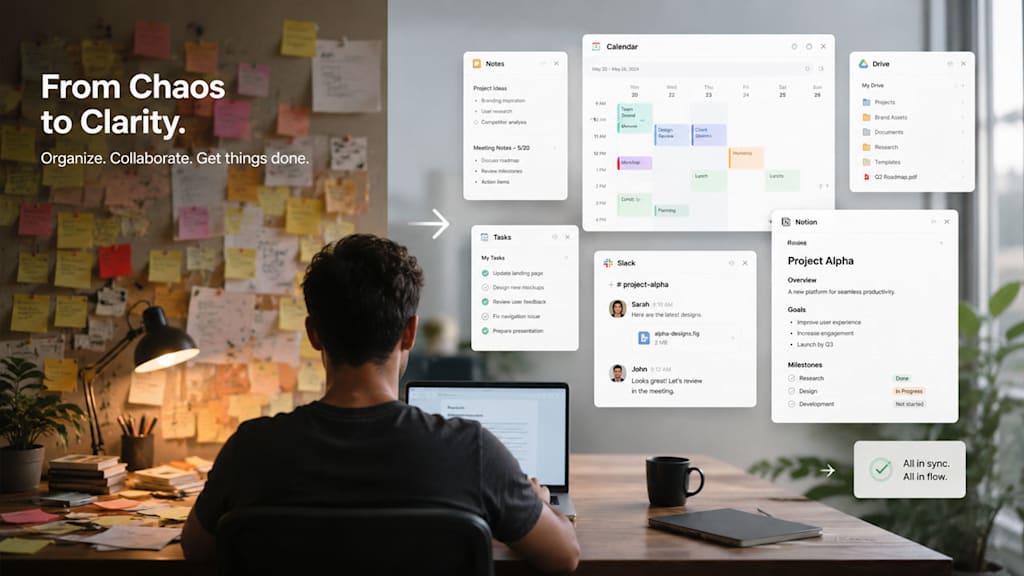
There was a time when my workday began with chaos.
A notebook filled with half-finished ideas sat beside my keyboard. Important files were scattered across folders with names like "Final_v2_ReallyFinal." Deadlines lived inside my memory, which, unsurprisingly, wasn't always reliable. Collaboration often meant sending endless email attachments and hoping everyone was editing the same version.
It wasn't dramatic. It was simply the way many of us worked.
And then, almost quietly, things changed.
Not because of one revolutionary app or a groundbreaking piece of technology. Instead, it happened through a collection of everyday online tools that slowly became part of daily life. They weren't flashy. They didn't promise to transform everything overnight. Yet, together, they completely reshaped how we organize, create, collaborate, and manage our time.
Looking back, it's difficult to imagine working without them.
Before: The Friction Hidden in Everyday Work
The old workflow had invisible costs.
Finding a file could take longer than creating it. Coordinating with teammates required multiple emails and endless back-and-forth messages. Notes lived in one place, tasks in another, and calendars somewhere else entirely.
The problem wasn't a lack of effort.
It was friction.
Small interruptions repeated dozens of times every day:
- Searching for documents.
- Copying information between devices.
- Waiting for feedback.
- Rewriting lost notes.
- Forgetting deadlines.
- Switching between disconnected systems.
Individually, these moments seemed insignificant. Collectively, they consumed hours.
Many professionals accepted this as normal because there wasn't an easier alternative—or at least one they knew about.
The Discovery of Simpler Ways to Work
The first noticeable improvement came from browser-based solutions.
Instead of installing bulky software, it became possible to open a browser and immediately start working.
Documents could be edited online.
Notes synced automatically.
Tasks updated in real time.
Files became accessible from anywhere.
Suddenly, the location of work mattered less. Whether at home, in a café, or during travel, the tools remained available.
This flexibility wasn't just convenient—it changed expectations.
People began valuing accessibility, simplicity, and speed over complicated setups. Slowly, browser-based utilities became part of many people's daily routines.
And the change was remarkably natural.
How Digital Workflows Became Easier
The beauty of modern digital tools is that they reduce mental clutter.
Instead of remembering everything, people can rely on systems that organize information automatically.
A few examples illustrate the shift:
- Notes That Never Get Lost
- Ideas often appear unexpectedly.
- In the past, they disappeared just as quickly.
Today, cloud-based note-taking solutions allow thoughts to be captured instantly from any device. A note written on a phone appears moments later on a laptop.
No more searching through old notebooks.
No more forgotten ideas.
Collaboration Without Endless Email Chains
Teamwork used to involve countless attachments.
Someone edited a file.
Another downloaded it.
A third accidentally modified an older version.
The cycle repeated endlessly.
Modern collaboration platforms changed this entirely.
Multiple people can now work on the same document simultaneously, leave comments, and track changes instantly. Communication becomes faster and projects move forward with fewer obstacles.
This shift has quietly become one of the most valuable aspects of today's workplace.
The Rise of Smarter Productivity Habits
Perhaps the biggest transformation isn't technological.
It's behavioral.
Many people have adopted simpler systems for planning their days.
Tasks are organized visually.
Reminders appear automatically.
Calendars sync across devices.
Small routines become easier to maintain because the tools remove unnecessary effort.
This is where modern productivity tools shine.
They don't replace discipline.
They support it.
A simple checklist, a reminder for important deadlines, or an automated workflow can reduce decision fatigue and create space for deeper, more meaningful work.
Remote Work Changed Expectations Forever
When remote and hybrid work became widespread, online platforms moved from being helpful to being essential.
Meetings shifted online.
Shared workspaces replaced office whiteboards.
Cloud storage became a necessity rather than a convenience.
The experience revealed something important:
- Work isn't defined by location.
- It's defined by access.
The ability to collaborate, share files, communicate instantly, and maintain organized workflows has become central to modern professional life.
As a result, many people now build entire systems around online services that support flexibility and efficiency.
The Quiet Power of Automation
One of the most underrated developments has been automation.
Simple actions that once required repeated manual effort can now happen automatically.
Files are backed up instantly.
Appointments generate reminders.
Emails are filtered intelligently.
Information flows between different services without constant intervention.
These small improvements may seem insignificant individually.
But over weeks, months, and years, they save countless hours.
More importantly, they allow people to focus on creative work instead of repetitive tasks.
Why Simplicity Often Wins
An interesting lesson emerged during this shift.
The most useful tools are rarely the most complicated.
People tend to stick with platforms that are:
- Easy to learn.
- Accessible on multiple devices.
- Fast and reliable.
- Intuitive to navigate.
Flexible enough to adapt to changing needs.
In many cases, the best technology fades into the background.
You stop noticing it because it simply works.
And that's exactly what makes it valuable.
The New Normal of Everyday Work
Today's workflows often look very different from those of a decade ago.
Files live in the cloud.
Teams collaborate in real time.
Projects are managed digitally.
Schedules synchronize automatically.
Information is available almost instantly.
What once required multiple programs, physical documents, and complicated processes can now be accomplished through a collection of lightweight online services working together seamlessly.
This evolution wasn't loud.
There wasn't a single moment when everything changed.
Instead, these everyday online solutions quietly entered our routines and gradually reshaped the way we work.
Looking Back
When I think about how work used to feel—constant searching, scattered notes, missed updates, and unnecessary complexity—I realize the biggest improvement wasn't speed.
It was clarity.
The best online tools didn't just make tasks faster.
They reduced friction.
They simplified decisions.
They helped create workflows that feel calmer, more organized, and more sustainable.
And perhaps that's why their impact is so remarkable.
The transformation happened quietly.
But it changed everything.
About the Creator
Enjoyed the story? Support the Creator.
Subscribe for free to receive all their stories in your feed.
Comments
There are no comments for this story
Be the first to respond and start the conversation.