book reviews
Reviews of must-read books for self-helpers, home improvers and life hackers alike.
How to Accomplish Anything at 17
I did it so why can't you? — Lessons from Sasuke Uchiha At just 17, Sasuke Uchiha faced huge challenges, losses, and tough choices. But what made him stand out wasn’t just his power — it was his unwavering focus on his goal. Here’s what you can learn from Sasuke to make your own dreams come true: 1. Set Your Goal Clearly: Sasuke knew exactly what he wanted. You need to find your own passion or goal and hold it tight. 2. Work Hard and Train: Like Sasuke trained every day to get stronger, you must practice your skills, whether it’s writing, sports, or any other dream. 3. Face Challenges Fearlessly: Sasuke faced enemies and setbacks, but he never gave up. When things get tough, push through the obstacles. 4. Believe in Your Own Power: Sasuke trusted his own abilities even when others doubted him. Believe in yourself no matter what. 5. Keep Growing: Sasuke kept learning and evolving. At 17, you’re still growing — use this time to improve constantly. Remember, just like Sasuke’s journey wasn’t easy but was worth it, your path at 17 can be challenging but full of success if you stay focused and determined. So, put your fate in your hands and go for it — you can accomplish anything!Sasuke Uchiha: Why 17 Is the Age to Build Your Destiny At just 17, life can feel like a confusing storm — you’re caught between being seen as “just a kid” and carrying dreams that are huge and real. But if there’s one anime character who teaches us what it means to stay focused and fight for your future, it’s Sasuke Uchiha. Sasuke didn’t grow up with a perfect life. In fact, he lost his family, faced betrayal, and walked a lonely path just to become strong. But here’s the truth — he never lost his drive. His story teaches something powerful: > "No matter your age or situation, your future starts the moment you decide to chase it." 1. Focus Is Everything Sasuke knew what he wanted — to grow stronger, to find answers, to prove himself. At 17, you’re not too young to have vision. You don’t need the world’s permission to start. You just need to choose your goal and chase it daily, like training for battle. Whether it’s learning a skill, starting a hustle, or building something new — lock in your focus. Turn off the distractions. Use your time as your weapon. 2. Growth Takes Struggle Sasuke’s journey wasn’t pretty — he faced loneliness, pressure, and pain. But pain was his teacher. At your age, things might feel heavy. You may feel alone in your dream, unsupported, or behind. But like Sasuke, don’t run from the struggle — use it to fuel your growth. Pressure makes diamonds. Challenges make champions. 3. Don’t Wait for Motivation — Use Discipline Sasuke didn’t always feel “motivated.” He trained because he had discipline. That’s the real secret. Wake up and do the hard things even when you don’t feel like it. The days you show up with no energy are the days you grow stronger. At 17, building habits now gives you power later. Start small. Be consistent. And soon, your work will speak for you. 4. Believe You Belong — Even When No One Claps Sasuke walked alone — not everyone understood him, but he didn’t care. He believed in himself, even in silence. You might not have people clapping for you yet. But that’s okay. Most people only cheer when you’ve “made it.” Your belief has to come from inside. Don’t wait for validation. Be your own fan. Act like the person you want to become. 5. Rewrite Your Fate Sasuke wasn’t born with an easy life. But he never used that as an excuse. He made his own path — even if it meant going against everything. You have that same power. No matter your background, age, or where you’re from, you can write your own future. It starts with small steps, made every day, with a strong heart. Final Words: Being 17 is not a weakness — it’s your chance to become unstoppable early. Sasuke didn’t wait for perfect conditions. He just began. So can you. Don’t underestimate yourself. You don’t need to have it all figured out. You just need to begin, and never stop. Put your fate in your own hands — like Sasuke did — and become the legend you were meant to be.
By Godswill Isaac Ogbonnayaabout a year ago in Lifehack
Why Failure Was the Best Thing That Ever Happened to Me. Content Warning.
By [Your Name] I never thought I would fail — not like that. Not the kind of failure that feels like your life has cracked open, like the ground beneath your feet has simply disappeared. But that’s exactly what happened. And strange as it sounds, I am grateful for it now. Let me take you back to the beginning. For most of my life, I had been what people call a “high achiever.” Good grades. Neat little awards. Always the one who seemed to “have it together.” It was a comfortable identity — one that others admired, and one that I quietly clung to. I was afraid of what would happen if I ever let go of it. After university, I landed a coveted job at a marketing agency. Fast-paced. Competitive. The kind of place where staying late was expected, and success was measured in numbers and praise. I threw myself into it, certain that hard work would be enough. For a while, it was. I hit deadlines. I earned promotions. I told myself I was happy — because wasn’t this what success looked like? But beneath the surface, cracks were forming. The long hours drained me. Creativity, which had once come so easily, began to feel forced. I was running on fumes. Worse, I began to dread Monday mornings — a dread that grew stronger with each passing week. I ignored it, of course. I convinced myself that it was normal — that stress was part of the game. But no amount of positive thinking could stop what was coming. It happened during a high-stakes project for a major client. I was leading the team, juggling timelines and expectations. And then — disaster. A simple oversight spiraled out of control. Deadlines were missed. The campaign flopped. The client walked away. The fallout was swift. My manager was furious. The team was demoralized. I was called into an office and told, bluntly, that I had failed — that I wasn’t the leader they thought I was. In less than a month, I was let go. Just like that. I remember walking out of that glass building, stunned. It was a cold, gray afternoon. The sky seemed to press down on me. My mind kept looping one awful word: failure. For days, I barely left my apartment. I avoided friends. The shame felt unbearable. I had built my identity on being capable, reliable — and now? Now I was the opposite. But here’s the strange thing: failure, when you sit with it long enough, begins to teach you. And if you let it, it can change you in ways that success never could. With no job and nothing to lose, I finally had the time — and the space — to ask questions I’d avoided for years: Did I really want that career? Did I really love that work — or had I only loved the approval that came with it? Had I ever even asked myself what made me happy? The answers were uncomfortable but clear. The truth was, I had been chasing the wrong version of success. I’d been trying to live up to an image — not building a life that was truly mine. Slowly, I began to shift. I read books that had been gathering dust on my shelf. I started journaling — something I hadn’t done since I was a teenager. And for the first time in years, I allowed myself to write, not for clients, not for deadlines — but for me. At first, it was clumsy. The words didn’t always come. But with time, something unlocked. Stories flowed. Ideas sparked. I found joy again — in the act of creating, in telling stories that mattered to me. One afternoon, I came across a platform called Vocal — a place where everyday writers could share their work. Nervous, I uploaded a short personal essay. It wasn’t perfect. But it was honest. To my surprise, people read it. Some even commented. The experience lit a small fire inside me. I wrote another piece. Then another. That small beginning grew. I began taking on freelance writing projects — ones I actually cared about. I connected with other creators. My days filled with words, ideas, creativity — not just deadlines. It wasn’t easy. Building a new path never is. There were setbacks, dry spells, rejections. But here’s what failure had taught me: you survive. You keep going. And sometimes, what comes after failure is better than anything you could have planned. Today, my life looks very different from the one I thought I wanted. I’m a freelance writer now. I set my own hours. I choose projects that align with my values. The stress that once consumed me is gone. In its place is a quieter kind of success — one rooted in authenticity. I don’t chase perfection anymore. I don’t fear failure the way I once did. Because I’ve seen what it can offer: perspective. Resilience. Growth. And perhaps most important of all — freedom. If I hadn’t failed at that job, I would likely still be stuck in a life that didn’t fit me. I would still be chasing titles instead of meaning. Failure cracked my life open — and through that crack, the light got in. So when people ask me now — would I go back and change that moment? Would I undo the failure that once felt so devastating? The answer is simple: No. Because sometimes, failure isn’t the end. It’s the door you didn’t know you needed to walk through. ---
By Huzaifa Writerabout a year ago in Lifehack
Data breach compilation lists 16 billion compromised passwords
**Data Breach Compilation Lists 16 Billion Compromised Passwords** In an alarming development for cybersecurity experts and everyday internet users alike, a massive compilation of over **16 billion compromised credentials** has been discovered circulating on hacker forums and darknet marketplaces. One of the largest known password caches, this cache serves as a stark reminder of the growing threats of the digital age and the urgent need for stronger security measures for both individuals and businesses. ### The Discovery
By GLOBAL NEWSabout a year ago in Lifehack
Love is Eternal Flame
In the quiet village of Ardenshire, nestled among rolling hills and ancient woods, the townsfolk spoke in hushed tones about a flame that never died—a soft, golden glow flickering endlessly atop a lone candle in the chapel ruins. It was said to burn for a love too powerful for time to silence. No one remembered when the flame had started, only that it had always been there. The old spoke of it as fact, the young as legend. But for Elise, the flame was a memory—aching, warm, and eternal. Elise was not born in Ardenshire. She came from the bustling city, a restlessness in her heart and a worn photograph in her locket. The photo was of a man with dark, laughing eyes and a crooked smile—Luca. They had met years ago under a summer sky, the kind that glowed violet just before night. He had been playing a worn violin by the riverside, and she, with her books and guarded heart, had stopped to listen. That first meeting was a spark. Every moment after ignited something deeper. Long walks under the moonlight, endless conversations about music and poetry, promises whispered with the kind of certainty only youth allows. They believed, utterly, in forever. But forever has a cruel way of shifting. War broke out. Luca, ever the romantic, volunteered. He told her he had to protect something good in the world—her smile, their future, the idea of peace. He left with a kiss and a letter pressed into her hands, sealed with red wax. That letter was the last she ever received. Years passed. The world changed. Elise waited—first with hope, then with denial, and finally, with heartbreak. She searched for him, scoured lists, questioned veterans, and even visited old battlefields. But he had vanished, as if swallowed by the very stars they had once wished upon. Unable to live with the noise of the city and the silence in her heart, Elise left everything behind and came to Ardenshire—a place Luca had spoken of once. "There’s a village," he’d said, "where time sleeps and the sunsets last forever." She found it almost by accident, like fate guiding her feet. It was there, among the ruins of an old chapel cloaked in ivy and mist, that she saw it—a single candle burning in the dark, untouched by wind or time. The villagers told her it had been lit by lovers who made a vow beneath its glow. She felt drawn to it, inexplicably, as if the flame knew her sorrow and waited. Each evening, she returned to the chapel and spoke aloud to the flame, recounting her memories, her pain, her hope. She spoke of Luca, of how she still dreamed of him, still reached for him in sleep. The flame danced, always listening, never dimming. One winter evening, snow blanketing the ground like untouched parchment, Elise brought her locket and placed it at the base of the candle. “If you can hear me,” she whispered, voice cracking, “let this flame carry my love wherever you are.” She closed her eyes and cried—not the loud, heaving kind, but the quiet, exhausted tears of someone who has held on for too long. Suddenly, the wind shifted. The cold seemed to pull back, just slightly, as if the world paused to listen. And then—footsteps. Slow, hesitant, crunching the snow behind her. She turned. There he stood. Older, scarred, worn—but it was him. Luca. Alive. His eyes still held the same depth, the same light, but now shadowed by stories too painful to name. “Elise,” he breathed, falling to his knees, his voice trembling. “I never stopped trying to find you. I was taken, lost… I thought I’d never see you again.” She knelt beside him, her fingers tracing his face, not believing, yet knowing deep in her soul it was real. “You found me,” she whispered. “No,” he said, tears slipping down his cheeks. “You kept the flame alive. That light... it led me here.” They sat together in the ruins, bathed in the candle’s glow, their hands clasped like they had never been apart. The years melted away, replaced by the echo of their laughter, the warmth of held silence. Elise looked at the flame, flickering brighter than ever, and understood the truth. Love, when real, does not die. It may flicker. It may dim. But somewhere, somehow—it burns. Long after the chapel crumbled and the world forgot their names, the villagers still whispered about the eternal flame. They spoke of the lovers who found each other through time and war and loss. Of how, every night, two shadows danced beside the light. And the flame? It never went out.
By Habib Ur Heman about a year ago in Lifehack
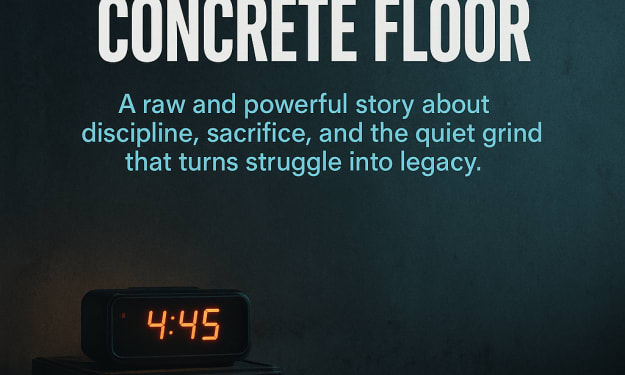
The Alarm Clock and the Concrete Floor
The first thing Malik heard was the alarm. Not the soft tone of a phone on a nightstand, but the sharp buzz of an old digital clock sitting on a milk crate next to a worn-out mattress on the floor. 4:45 a.m. Like clockwork—because it was clockwork.
By Rick Brownabout a year ago in Lifehack
Light Up Life
In today’s fast-paced world, life can sometimes feel overwhelming. Work, responsibilities, stress, and uncertainty can dim our inner light. But what if we chose every day to light up life—not just for ourselves but for those around us? Living with positivity, purpose, and possibility can make an ordinary life truly extraordinary.
By aadam khanabout a year ago in Lifehack
10 Skills That Will Be Essential in the Next 10 Years
Introduction The world is changing faster than ever. Technological revolutions, global challenges, and cultural shifts are transforming the way we work, live, and connect. Jobs that exist today may not exist a decade from now, while entirely new roles will emerge. In this unpredictable future, knowledge alone is no longer enough—what truly matters are the skills you carry into it. Whether you're a student, professional, entrepreneur, or life-long learner, staying relevant in the next 10 years means mastering a blend of soft and hard skills. These are the abilities that machines can’t easily replace, and that change-makers, leaders, and problem-solvers will need to thrive. Here are 10 future-proof skills that will define success in the coming decade. --- 1. Critical Thinking and Problem Solving As automation takes over routine tasks, human workers will be increasingly valued for their ability to think critically and solve complex problems. Employers want people who can analyze situations from multiple angles, identify root causes, and make informed decisions in uncertainty. Why it matters: In a world overflowing with data, the ability to cut through noise, question assumptions, and think logically is essential—not just for careers, but for civic engagement and personal decision-making. How to develop it: Challenge your opinions. Read diverse perspectives. Practice scenario analysis. Engage in debates or simulations that require strategic thought. --- 2. Tech Literacy and Digital Agility The digital landscape will only become more central to every industry—from AI and blockchain to augmented reality and automation. Being comfortable with emerging technologies, even if you're not a developer, will be vital. Why it matters: Jobs across all fields are becoming more tech-integrated. Understanding how tools like AI, big data, and cloud systems work gives you a major edge. How to develop it: Learn the basics of coding, analytics, and AI. Use online platforms like Coursera or edX. Stay up-to-date with tech news and experiment with new tools. --- 3. Emotional Intelligence (EQ) While machines excel at calculations, they can’t match the emotional depth of humans. Emotional intelligence—self-awareness, empathy, interpersonal communication, and emotional regulation—is a superpower in a collaborative world. Why it matters: EQ enhances teamwork, leadership, customer service, and conflict resolution. It’s especially critical in roles requiring trust and human connection. How to develop it: Practice active listening. Reflect on your emotions. Read about empathy and communication. Ask for feedback—and be open to it. --- 4. Creativity and Innovation Creativity isn’t just for artists. In an era of constant change, the ability to generate original ideas and innovate solutions is a key differentiator. Why it matters: Companies and communities face novel problems. Those who can connect dots in new ways and adapt quickly will lead the way. How to develop it: Brainstorm without judgment. Explore new hobbies or fields. Use tools like mind maps or design thinking. Collaborate with people outside your comfort zone. --- 5. Adaptability and Resilience If the last few years have taught us anything, it’s that change is constant—and often unpredictable. The ability to adapt and bounce back from setbacks is more valuable than ever. Why it matters: Industries shift. Roles evolve. Technologies emerge. Resilience and adaptability keep you grounded and moving forward despite disruption. How to develop it: Practice mindfulness. Reflect on how you’ve overcome past challenges. Try new routines regularly. Learn to embrace—not fear—change. --- 6. Communication and Storytelling In a noisy digital world, those who can communicate clearly and persuasively will always stand out. This includes writing, speaking, and visual communication. Why it matters: Whether pitching an idea, leading a team, or explaining data, the ability to tell a compelling story influences outcomes and builds relationships. How to develop it: Join public speaking groups. Write blogs or opinion pieces. Study storytelling techniques. Learn to tailor your message to different audiences. --- 7. Cross-Cultural and Global Competence The workforce is increasingly global. Teams span continents, and customers come from diverse backgrounds. Understanding cultural nuances and global trends is vital. Why it matters: It enhances collaboration, market strategy, and social responsibility—especially in remote work environments and international industries. How to develop it: Travel if possible. Learn new languages. Read about other cultures. Engage in international projects or collaborations. --- 8. Leadership and Influence Leadership in the future isn’t about hierarchy—it’s about influence. Whether you're leading a team or a solo entrepreneur, being able to inspire, guide, and motivate others is crucial. Why it matters: Leaders set the tone for innovation, culture, and progress. The ability to influence without authority is especially valued in flat or agile organizations. How to develop it: Take initiative. Mentor others. Study leadership styles. Seek out leadership roles—even informal ones—in your community or workplace. --- 9. Collaboration and Teamwork Even the most brilliant minds need a team. The future belongs to those who can co-create, coordinate, and share responsibility effectively, especially across digital platforms. Why it matters: Remote and hybrid work demand digital collaboration skills, trust-building, and conflict resolution—even when you're miles apart. How to develop it: Use team tools like Slack, Notion, or Trello. Work on group projects. Reflect on team dynamics and improve your listening and support skills. --- 10. Lifelong Learning Mindset Perhaps the most vital skill is the ability to keep learning. As industries evolve, those who continuously update their skills will not just survive—they’ll thrive. Why it matters: Degrees are less important than your capacity to adapt and grow. Lifelong learners remain relevant and motivated in any field. How to develop it: Create a personal learning plan. Take online courses. Read widely. Stay curious and open to feedback. --- Conclusion: Build for the Future, Starting Now The next decade will bring profound change. AI, climate challenges, shifting economies, and new ways of working will test our ability to evolve. But those who invest in developing these essential skills—especially the ones machines can’t easily replicate—will be the ones who shape the future. You don’t need to master all 10 skills overnight. Start by identifying one or two areas where you want to grow, and commit to small, consistent steps. The most important thing is to stay curious, adaptable, and open-minded. Because in a world of uncertainty, the best security is not a job or a title—it’s the skills you carry forward.
By Faizan Malikabout a year ago in Lifehack