
"Stop Chasing #1"
The Secret to Real Success”

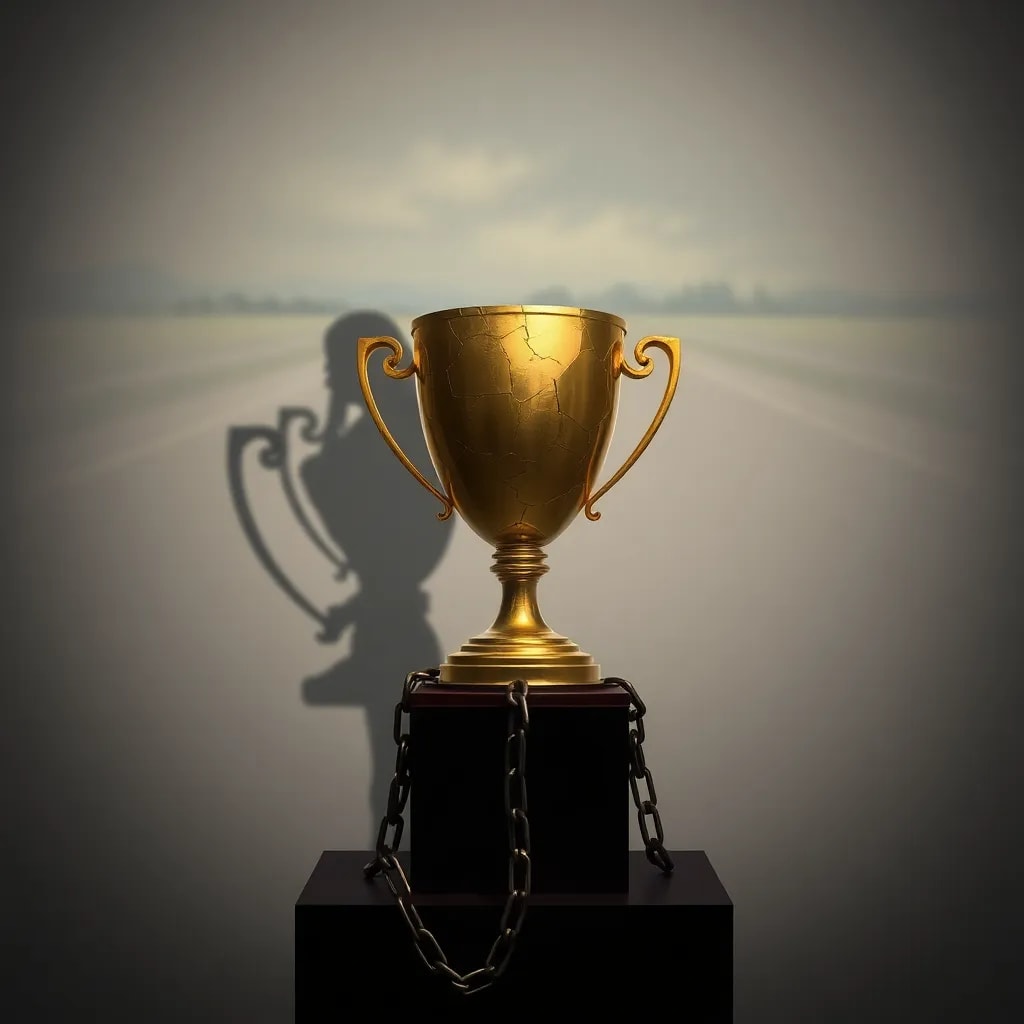
The sun was a merciless spectator that afternoon, glaring down as I crouched at the starting line, my knees trembling against the baked rubber of the track. I was nine years old, convinced that winning the 100-meter dash at our school’s field day would cement my status as the fastest kid in the fourth grade—a title I’d worn like a crown in my imagination for weeks. My neon-green sneakers felt like rockets, my sweatband like a warrior’s headdress. When the whistle blew, I shot forward, legs churning, arms pumping, heart slamming against my ribs. And then, halfway down the lane, my foot caught a crack in the asphalt. I skidded, stumbled, and watched as three other kids blurred past me. By the time I crossed the finish line, my knee was scraped raw, my pride bloodier than the wound. I hadn’t just lost the race; I’d failed to be number one. Back then, that felt like the only thing that mattered.
Years later, I still think about that race—not because the loss haunted me, but because it taught me how deeply we’re conditioned to equate “first” with “best.” From the moment we’re old enough to compete for gold stars on classroom charts, we’re steeped in the mythology of being the fastest, the smartest, the most recognized. It’s a narrative woven into everything: sports, academics, careers, even social media. We applaud the pioneers, the record-breakers, the trailblazers who plant their flags where no one else has ventured. But what happens when the obsession with being number one becomes less about achievement and more about validation? What do we lose when we fixate on the podium instead of the path that led us there?
History is littered with stories of firsts that changed the world. Neil Armstrong’s footprint on the moon, Rosa Parks’ refusal to surrender her seat, the Wright brothers’ wobbly flight over Kitty Hawk—these moments are etched into our collective memory because they represent leaps of courage, innovation, and defiance. Being first, in these cases, wasn’t just a title; it was a catalyst. It shifted paradigms, cracked open doors, and forced society to reckon with new possibilities. Yet for every iconic “first” that deserves celebration, there are countless others that go unnoticed, their contributors erased by time or overshadowed by those who came after. We remember Edison for the lightbulb, but rarely Nikola Tesla for his revolutionary work on alternating current. We celebrate Steve Jobs for the iPhone, but how many of us could name the engineers who designed its first prototype? The allure of number one often obscures the truth: progress is rarely the work of a single person, but a chorus of voices, failures, and incremental steps.
The pressure to be first can also distort our sense of purpose. I once met a startup founder at a tech conference who proudly told me his company’s mission was to “disrupt the industry and dominate the market.” When I asked him what problem they were solving, he hesitated. “Does it matter?” he shrugged. “If we’re not first, we’re last.” His words reminded me of that childhood race—the tunnel vision, the desperation to outpace everyone else, even if it meant losing sight of why you’re running. In business, academia, and creative fields, the scramble to be the first to patent, publish, or premiere can lead to corner-cutting, burnout, and a culture of toxic individualism. Researchers rush studies to press, sacrificing rigor. Artists churn out work for clicks, not connection. The race to first becomes a race to the bottom, where the finish line keeps moving.
There’s a quieter, more insidious cost to this mindset, too. When we glorify number one, we inadvertently send a message that everything else is second-rate—or worse, worthless. I think of friends who’ve quit hobbies they loved because they couldn’t “master” them quickly enough, or students who opt for easier majors to protect their GPAs rather than pursuing subjects that challenge them. The fear of not being the best becomes a barrier to exploration, growth, and joy. I fell into this trap myself in college, avoiding creative writing workshops for years because I doubted I’d be the star student. It wasn’t until I enrolled in a class on a whim, wrote a painfully awkward short story, and received feedback that had nothing to do with rankings—“This line made me feel seen”—that I realized how much I’d missed by conflating value with virtuosity.
But what if we redefined what it means to be number one? Not as a fixed position, but as a mindset—one that prioritizes curiosity, resilience, and integrity over trophies or titles? I’m reminded of a story about Julia Child, who didn’t publish her first cookbook until she was 50. She wasn’t the first celebrity chef, nor the most technically skilled, but her unpretentious passion for food reshaped how Americans cooked and ate. Or consider the scientists behind the COVID-19 vaccines, who openly shared data and collaborated across borders to accelerate a breakthrough that saved millions. Their goal wasn’t to “win” the pandemic; it was to end it. Being first mattered less than being effective.
This isn’t to say ambition is inherently flawed. The drive to innovate, excel, and push boundaries is what propels us forward. But maybe there’s a difference between striving for excellence and clinging to supremacy. The former is about reaching toward something—an idea, a goal, a version of yourself you haven’t met yet. The latter is about fending off others, a defensive crouch that leaves little room for solidarity or shared success. The older I get, the more I’m drawn to stories of people who redefined winning on their own terms. The teacher who measures her impact not in test scores but in students who ask bold questions. The athlete who trains for personal bests, not podiums. The activist who builds movements rather than monuments.
On that long-ago field day, after I’d brushed the gravel from my knee and blinked back tears, my dad handed me a popsicle from the concession stand—a consolation prize dripping neon-blue down my wrist. “You looked like a cheetah out there,” he said, grinning. “Until the trip-up part,” I muttered. He paused, then shrugged. “Cheetahs trip sometimes. They also get back up.” I’ve carried that image with me: not the cheetah as an untouchable predator, but as a creature built for speed and stumble, capable of both. These days, when I find myself slipping into old habits—comparing achievements, fixating on rankings—I try to remember the popsicle, the scraped knee, the dad who reframed the story. Being first isn’t the only way to matter. Sometimes, it’s enough to run the race, taste the sweetness of the effort, and keep showing up, even when the track is uneven.
About the Creator
Terrence Webster
Stories of real life, self-discovery, and amazing adventures. Friendship, feeling, and surprising journeys. My stories stick with you.
Enjoyed the story? Support the Creator.
Subscribe for free to receive all their stories in your feed.
Comments
There are no comments for this story
Be the first to respond and start the conversation.