
Powerful Productivity Tips: Achieve More, Stress Less
How to Achieve More and Reduce Stress
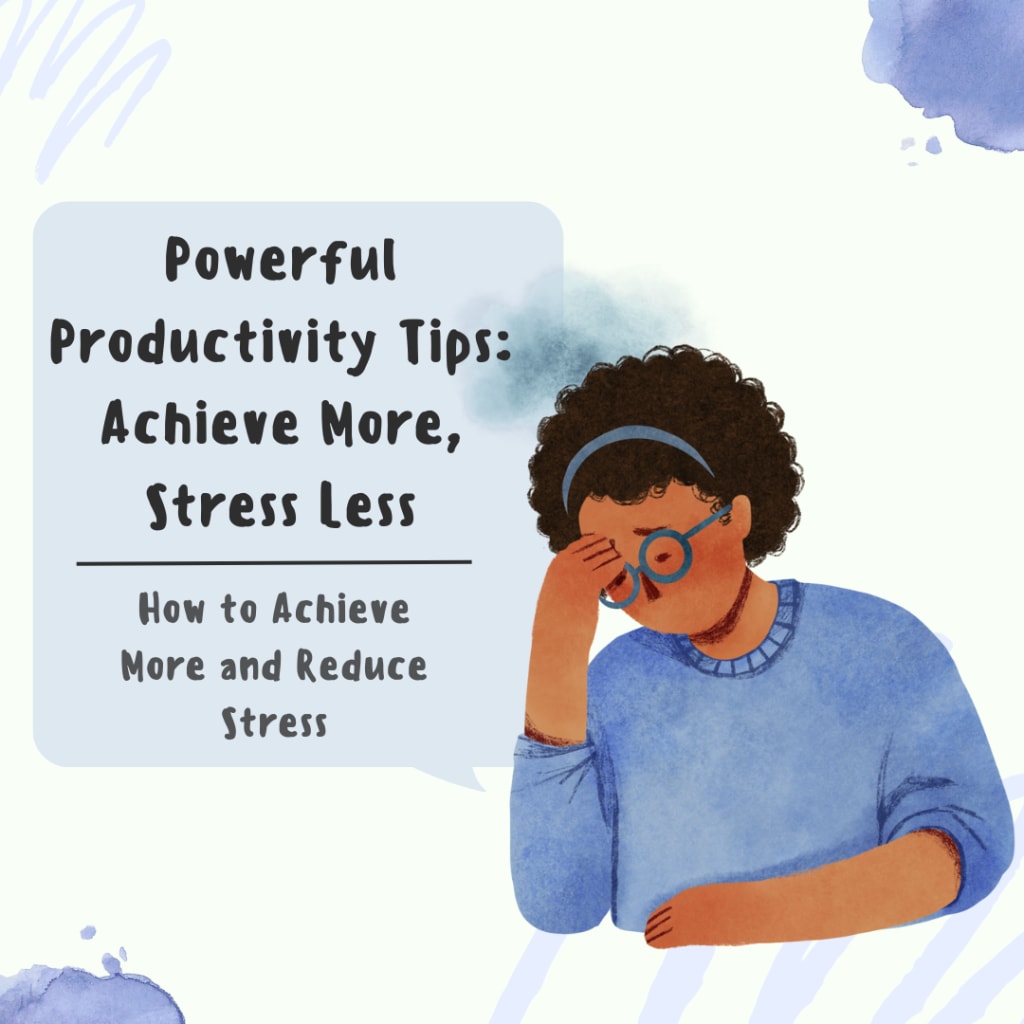
Did you know that people waste approximately 17 hours of a 45-hour working week? That's equivalent to two whole working days or a full week in a month, or even three months out of a year. Just imagine if we could reclaim this lost time. It's crucial for us to learn how to put an end to this wastefulness.
Let me introduce you to Leah. She's 28 years old, and today we will assist her in becoming more productive. The first step Leah should take is to listen to her body and work in harmony with it. As you may already know, some people are early birds while others are night owls. Leah needs to determine which category she falls into—whether she is more active in the morning or the evening. Once she figures it out, she should plan her sleep schedule accordingly, taking into account her personal needs as well as any commitments, such as office hours.
Fortunately, Leah has a lot of flexibility in this regard. She lives alone and works remotely, but she does have a meeting every workday at 11 a.m., and she spends an hour watching her niece after school. Consequently, she needs to be awake during those specific times. Fortunately, she identifies herself as an early bird. Consistency is crucial when it comes to a sleep schedule, so once she determines the ideal timings, she should stick to them. After experimenting for a few weeks, Leah discovers that she requires seven and a half hours of sleep. Therefore, she goes to bed at 11:15 PM, takes around 15 minutes to fall asleep, and wakes up at 6 AM.
The next aspect Leah needs to focus on is establishing a consistent and energy-boosting morning routine. This way, she won't waste time and energy contemplating whether to shower first or brush her teeth before or after breakfast, or whether to have sandwiches or eggs for her morning meal. It's beneficial to incorporate activities that boost energy, such as a workout or a short walk. Moreover, it's advisable to avoid using her smartphone during the first hour of the day.
Now that the morning is taken care of, there's an entire working day ahead. Leah should familiarize herself with a few guidelines:
1. To-do lists hold significance. However, our to-do lists are often never-ending. The good news is that we don't have to complete every single task on that list. Have you heard of the 80/20 rule? It states that 20% of our tasks contribute to 80% of the results. The remaining 80% of tasks only provide an additional 20% of the outcome. In essence, 80% of our tasks are relatively useless. Therefore, Leah needs to examine her to-do list and identify the 20% of crucial tasks. She should begin with those tasks right away.
2. The most important task is often referred to as the "Frog." It's typically the most challenging task on the to-do list and has the potential to make the most significant positive impact on Leah's career. However, it's also the task she's most likely to procrastinate on. Leah should identify the Frog and tackle it immediately. Completing the most challenging tasks gives us the greatest sense of accomplishment. However, we tend to procrastinate on these tasks precisely because they are challenging.
I would wager that at least 15 of the 17 wasted hours are spent procrastinating on big and important tasks. We tend to procrastinate because these tasks seem too daunting, lengthy, or intimidating. So, here's how Leah should approach any difficult task: break it down into smaller, manageable sub-tasks, and then complete them one by one. Ideally, each sub-task should take no longer than 20 minutes. Leah's most important task for
the day is to finish her work project. Hence, she needs to break it down into parts. However, before she begins, she should check the other tasks and distribute them throughout the day effectively.
Leah should identify her most productive time frames and when her brain functions at its best. Simultaneously, she should pinpoint the opposite times when she feels drained or gets easily distracted by other commitments in her life. Here's a list of her typical daily tasks, and she can assign them to suitable time slots accordingly. Since Leah's most productive hours are from 7 AM to 10 AM, she should start her day with the most important task during that period. It's best to reserve this time for tackling the toughest tasks. However, around 4 PM, Leah's brain starts functioning less efficiently, making it an ideal time for less mentally demanding work, such as editing variables, organizing tables, etc. Creating such a structured day will enhance her productivity.
Now it's time to start working, and here are a few tips for Leah to work efficiently:
1. Group similar tasks together so that she can complete them consecutively while maintaining the right mindset.
2. Eliminate all distractions. Activate the "Do Not Disturb" mode on her phone, use website blockers, and avoid checking emails unless it's the designated time to do so. If she has any thoughts or tasks that come to mind while working on the main task, she should write them down and return to them later.
3. Keep a notebook handy to capture thoughts and ideas as they arise.
4. Let go of perfectionism, as it only adds unnecessary stress and pressure.
Another truth is that productivity requires taking breaks. We're not robots meant to work continuously for nine hours without any respite. In fact, the inability to take breaks is one of the reasons why we procrastinate. Various strategies exist, and Leah should find what works best for her. Some people prefer working for 25 minutes and taking a 5-minute break, while others follow a 50/10 pattern. Some opt for 90-minute work intervals with a 15-minute break. Leah should experiment and determine the most effective approach for herself. However, it's important not to work for more than 90 minutes without a break, as it leads to a loss of focus and makes it difficult to recover. Instead of a 15-minute break, she might end up needing an hour or even procrastinate for the rest of the day. That's not desirable.
When taking breaks, it's crucial to ensure they replenish energy rather than deplete it. Scrolling through social media isn't an ideal break activity as it scatters attention. A better choice would be to go outside for a short walk or engage in activities like stretching, lying down with closed eyes, making a drink, having a healthy snack, having a conversation with a colleague, practicing breathing exercises or meditation, tidying up the room, reading a book, or doodling.
With the workday coming to an end, it's important to establish an evening routine to detach from work and initiate the resting phase. This routine may include taking a shower, having dinner, reading, and planning for the next day. By planning ahead, Leah can begin her day promptly without wasting any time.
Wishing you good luck on your journey to increased productivity!
About the Creator
Enjoyed the story? Support the Creator.
Subscribe for free to receive all their stories in your feed.
Comments
There are no comments for this story
Be the first to respond and start the conversation.