
Inside a 5mg AOD-9604 Vial: A Researcher's Quality and Handling Walkthrough
Explore a researcher-focused walkthrough of inspecting, reconstituting, storing, and handling an AOD 9604 5mg research peptide vial for consistent laboratory preparation.

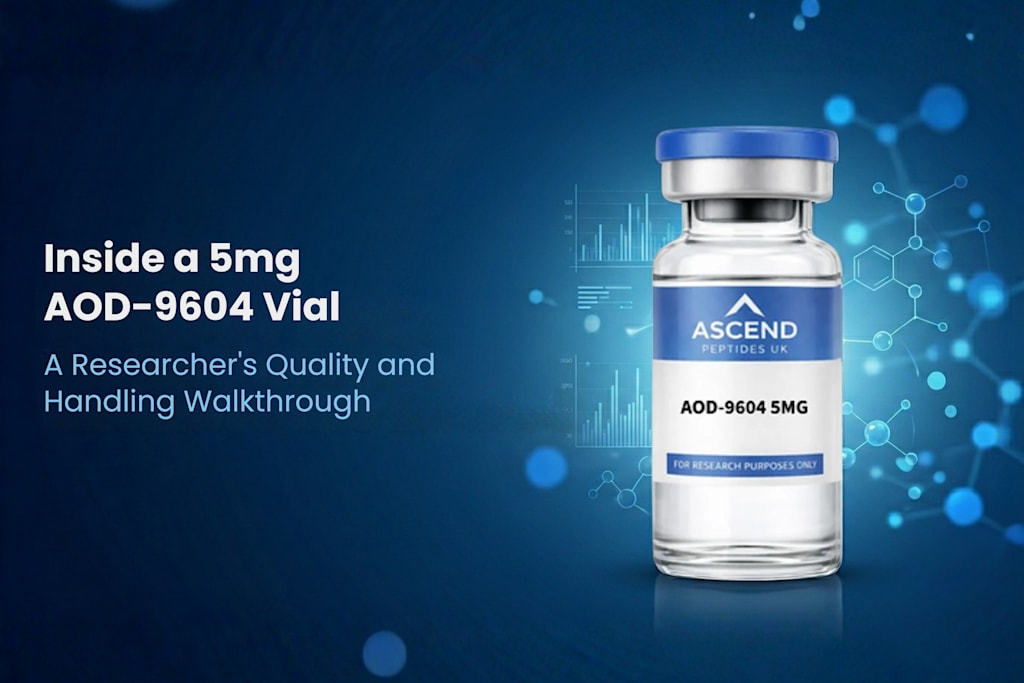
In peptide research, the quality of a compound is only part of the equation. The way a vial is inspected, prepared, and stored can influence consistency just as much as the peptide itself. Researchers working with peptides understand that small handling variations often create noticeable shifts in experimental reliability, especially in long-term studies where structural stability matters.
That’s why experienced researchers approach every vial with a process. From examining the condition of the lyophilised powder to preparing controlled reconstitution ratios and maintaining cold storage standards, each step supports cleaner experimental conditions and more dependable data.
This walkthrough takes a closer look inside a typical laboratory workflow surrounding AOD 9604 5mg research peptide handling. We’ll cover how researchers inspect a vial upon arrival, evaluate quality indicators, approach reconstitution, and preserve peptide stability through proper storage and preparation techniques in controlled research environments.
First Impressions Matter: Inspecting the Vial on Arrival
Before a peptide ever enters a research setup, the first evaluation happens visually.
Researchers often begin by examining:
- Vial integrity
- Seal condition
- Powder appearance
- Label clarity
Signs of moisture exposure or instability
A properly prepared 5mg lyophilised vial typically contains a dry, stable peptide cake or powder with a consistent appearance throughout the vial. Uneven texture, excessive condensation, or compromised seals can raise concerns around environmental exposure during handling or transit.
With AOD-9604 5mg research peptide, these early observations help establish confidence in the handling standards maintained before the peptide reaches the laboratory.
Understanding the Lyophilised Structure
Lyophilisation plays a major role in preserving peptide stability before preparation.
Why researchers prefer lyophilised peptides:
- Supports structural preservation
- Improves storage stability
- Reduces degradation risk during transport
- Maintains consistency before reconstitution
A stable lyophilised structure helps researchers maintain tighter control over experimental conditions, especially when working with peptides that require precise preparation protocols.
Evaluating Sterility Before Preparation
Sterility remains a central consideration throughout peptide handling. Researchers carefully examine packaging and preparation environments before beginning any reconstitution process.
- Common sterility checks include:
- Reviewing vial seal integrity
- Inspecting stopper condition
- Using controlled handling environments
- Minimizing environmental exposure during preparation
Even highly stable compounds can experience quality shifts if handling environments introduce contamination variables. This is why researchers often treat preparation protocols with the same level of attention as the experimental phase itself.
Reconstitution: Where Consistency Begins
One of the most important stages in peptide handling is reconstitution. The goal is to achieve a uniform solution while preserving structural integrity throughout the preparation process.
Researchers often focus on:
- Controlled solubilization techniques
- Consistent reconstitution ratios
- Gentle handling during mixing
- Stable preparation environments
With AOD 9604 5mg research peptide, maintaining consistency during reconstitution supports cleaner experimental repeatability and more reliable handling across multiple observations.
Why Reconstitution Ratio Matters
The reconstitution ratio directly influences how consistently a peptide can be handled during laboratory work.
A structured ratio helps researchers:
- Maintain solution uniformity
- Improve aliquot consistency
- Simplify comparative preparation methods
- Support repeatable handling procedures
Researchers generally establish preparation protocols before experimentation begins so every step remains standardized throughout the study timeline.
Handling the Vial During Preparation
Preparation technique can significantly influence peptide stability. Researchers often use slow, controlled handling methods to preserve solution integrity.
Common handling practices:
- Gentle vial rotation instead of aggressive agitation
- Controlled environmental exposure
- Minimal repeated opening of the vial
- Clean preparation surfaces and equipment
These small details often contribute to stronger consistency across experiments involving AOD-9604 5mg research peptide.
Cold Storage and Peptide Stability
Once prepared, storage conditions become a major priority. Peptides are sensitive to environmental shifts, especially temperature fluctuations.
Why cold storage matters:
- Helps maintain structural stability
- Reduces degradation over time
- Supports longer-term consistency
- Preserves preparation quality across observations
Researchers frequently use temperature-regulated storage conditions to maintain peptide integrity throughout ongoing studies.
What Researchers Watch for After Reconstitution
Once the peptide is in solution form, researchers continue monitoring quality indicators before introducing it into experimental workflows.
Common post-preparation observations:
- Solution clarity
- Consistency in appearance
- Absence of visible particulate matter
- Stable handling behavior over time
Monitoring these indicators helps researchers identify any shifts that could affect experimental reliability later in the process.
Building a Repeatable Handling Protocol
Experienced researchers rely heavily on repeatability. A standardized workflow creates stronger consistency across observations and reduces variability introduced through preparation differences.
A repeatable protocol often includes:
- Initial vial inspection
- Controlled sterility preparation
- Structured reconstitution ratio
- Aliquotting procedures
- Temperature-controlled storage
- Ongoing stability observation
This structured approach helps maintain cleaner research conditions from start to finish.
Why Preparation Quality Impacts Research Outcomes
Many inconsistencies in peptide studies originate during handling rather than experimentation. A peptide with strong structural quality can still produce unreliable data if preparation standards shift between trials.
Consistent handling supports:
- Cleaner signaling analysis
- Better reproducibility
- More accurate comparative observations
- Improved stability during long-term studies
This is why preparation protocols surrounding AOD 9604 5mg research peptide are often treated as a critical part of the overall research framework.
Common Mistakes Researchers Try to Avoid
Even experienced laboratories follow strict handling discipline because small oversights can influence peptide integrity.
Common issues include:
- Excessive environmental exposure
- Unstable storage conditions
- Inconsistent preparation ratios
- Aggressive mixing techniques
- Repeated unnecessary handling
Avoiding these variables helps preserve peptide stability throughout the study period.
The Importance of Documentation in Peptide Research
Researchers frequently document every stage of peptide handling to support repeatability and improve study reliability.
Documentation often includes:
- Batch tracking
- Reconstitution details
- Storage timelines
- Preparation observations
- Stability monitoring records
This level of detail supports stronger consistency, especially in comparative studies involving multiple preparation cycles.
Why Researchers Value Structured Handling Systems
Peptide research depends heavily on precision. A structured handling system creates more reliable conditions for observing receptor interaction and pathway behavior.
Benefits of a structured approach:
- Reduced preparation variability
- Better long-term consistency
- Improved confidence in experimental observations
- Stronger alignment between trials
Researchers working with AOD-9604 5mg research peptide often prioritize handling consistency as much as peptide quality itself because both directly influence data integrity.
FAQs About AOD 9604 5mg Research Peptide
1. Why is lyophilisation important in peptide research?
Lyophilisation helps preserve peptide stability and supports longer-term structural integrity before preparation.
2. What should researchers inspect when receiving a peptide vial?
Researchers often evaluate seal integrity, powder appearance, labeling, and signs of environmental exposure.
3. Why does reconstitution ratio matter?
A consistent ratio supports uniform handling and improves repeatability across experiments.
4. How does cold storage support peptide stability?
Cold storage helps reduce degradation and maintains structural consistency over time.
5. Why is handling protocol important in research?
Structured handling reduces variability and supports more reliable experimental outcomes.
Conclusion
Strong peptide research begins a long time before experiments begin. The consistency of each result thereafter is influenced by how the vial is inspected, prepared and stored.
Evaluation of sterility, lyophilised structure, maintenance of stable cold storage conditions etc., all lead to cleaner handling and enhanced experimental reliability. Researchers using AOD 9604 5mg research peptide understand that the quality of preparation is a crucial factor that can affect the stability, reproducibility and consistency of the data they obtain.
A well-defined handling procedure forms the basis of more reliable peptide research, enabling researchers to ensure accuracy at all stages.
About the Creator
Enjoyed the story? Support the Creator.
Subscribe for free to receive all their stories in your feed.
Comments
There are no comments for this story
Be the first to respond and start the conversation.