
Cloud for AI: Why Hybrid and Sovereign Architectures Are the Only Way to Scale Without Leaking Your Data
Worse, your legal team just found out that customer data was moved across international borders to train

You just opened your monthly AWS or Azure bill, and your heart dropped. Your engineering team spun up a cluster of H100 GPUs last month to fine-tune a new large language model, and the compute costs completely wiped out your quarterly infrastructure budget. Worse, your legal team just found out that customer data was moved across international borders to train that model, putting you in direct violation of local privacy laws. Panic sets in.
This is the exact nightmare playing out in boardrooms everywhere right now. You cannot run modern AI on a basic, outdated cloud strategy.
Standard public clouds are fantastic for hosting websites or running basic SaaS applications. But AI changes the physics of enterprise computing. Artificial intelligence requires massive compute power, zero latency, and absolute control over where your proprietary data lives. If you just dump your AI workloads into a generic public cloud without a plan, you will bleed cash and expose your most valuable IP. To survive the AI arms race, you need to master the exact balance between hybrid cloud flexibility and sovereign cloud security.
The Hidden Crisis of Hosting AI Models
Let’s get one thing straight right out of the gate. AI is incredibly greedy. It consumes compute, memory, and storage at rates we have never seen before in traditional software development.
When you build a normal web application, the data just sits in a database until a user requests it. The server does a tiny bit of math, delivers the page, and goes back to sleep. AI does not sleep. During the training phase, machine learning models chew through terabytes of unstructured data, running billions of mathematical calculations per second. This requires specialized hardware like GPUs (Graphics Processing Units) or TPUs (Tensor Processing Units).
These chips are expensive to buy and even more expensive to rent. If you rely solely on a public cloud provider to rent these GPUs by the hour, your costs will spiral out of control the moment your model needs retraining.
Beyond the financial bleeding, there is a massive security crisis. You cannot hand over your company's crown jewels to a public server. If you are a hospital training an AI to detect tumors, or a bank building a fraud-detection algorithm, feeding highly sensitive, regulated data into a multi-tenant public cloud is a compliance disaster waiting to happen. You need a way to keep the data locked down while still getting the computational horsepower required to make the AI smart.
What Actually Makes "Cloud for AI" Different?
Before you can fix your architecture, you need to understand why AI breaks normal cloud setups. A cloud built for artificial intelligence looks fundamentally different from a cloud built for standard IT operations.
First, an AI cloud prioritizes high-bandwidth, low-latency networking. When thousands of GPUs are training a single model, they have to talk to each other constantly. If the network connecting them is slow, the GPUs sit idle waiting for data to arrive. You end up paying thousands of dollars an hour for incredibly fast chips that are doing absolutely nothing.
Second, AI requires a completely different approach to storage. Traditional object storage is often too slow to feed data into a hungry machine learning model. AI infrastructure requires high-performance parallel file systems that can blast millions of small files (like images, text logs, or audio clips) directly into the compute engines without bottlenecking.
Finally, an AI-optimized cloud must support dynamic scaling. You might need 500 GPUs for exactly three days to train a model, and then zero GPUs for the next two weeks. If your infrastructure cannot scale up and tear down instantly, you are burning cash. This unique set of demands is exactly what gave birth to the modern hybrid AI cloud strategy.
The Hybrid Cloud Strategy: Balancing Cost and Control
Think of a hybrid cloud as having the best of both worlds. You own a secure vault in your basement, but you also rent a massive factory across town.
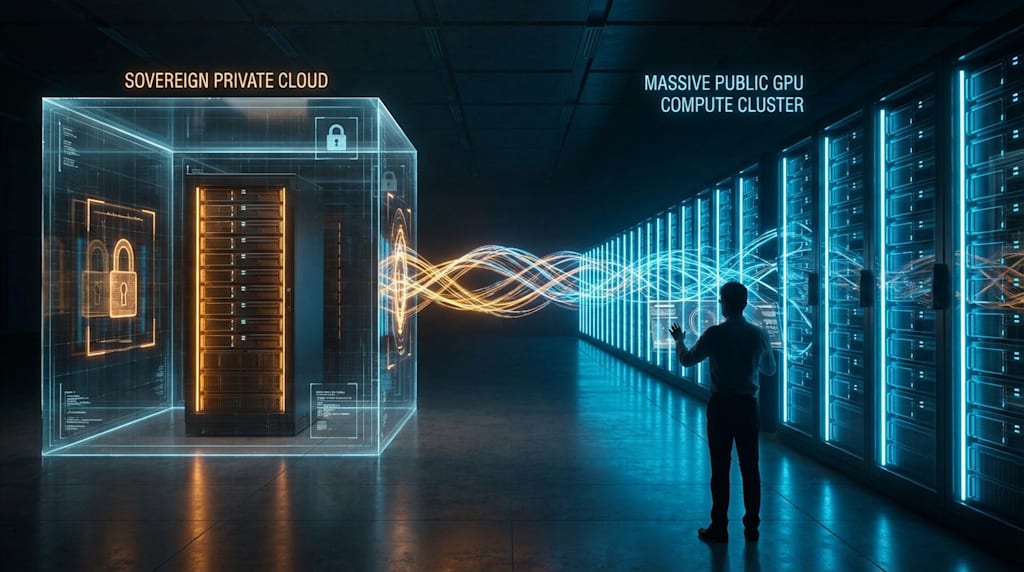
A hybrid cloud architecture for AI combines your own on-premises private servers with public cloud resources (like Google Cloud, AWS, or specialized GPU clouds). The two environments are connected by a highly secure, encrypted network. This is the ultimate playbook for cost-effective AI.
Here is how a smart team actually uses it. You keep your highly sensitive, proprietary data inside your private, on-premises data center. This satisfies your lawyers and compliance officers. You use your private servers to clean, anonymize, and prep the data. Then, when it is time to do the heavy, computationally expensive training, you push only the anonymized data to the public cloud.
The public cloud spins up hundreds of GPUs, crunches the numbers, trains the model, and sends the finished, compiled algorithm back to your private servers. Once the model is back home, you shut down the public cloud GPUs immediately. You get the infinite scale of the public cloud without permanently exposing your private data or committing to a massive, long-term hardware purchase.
What is a Sovereign Cloud? (And Why Governments Demand It)
Hybrid clouds solve the cost problem. Sovereign clouds solve the legal problem.
Over the last few years, governments around the world woke up to a frightening reality. If a country's healthcare records, financial data, and critical infrastructure AI models are entirely hosted on servers owned by foreign tech giants, that country has lost control of its own digital borders. If a foreign government issues a subpoena, that data could be extracted.
A sovereign cloud is a specialized cloud computing environment designed to guarantee that all data, including the metadata, remains within a specific geographic border and is strictly subject to local laws. It is built to ensure total data independence.
If you are building an AI tool for a government agency in Germany, you cannot legally process that data in a US-based data center. A sovereign cloud ensures that the physical servers, the support staff managing those servers, and the legal entity operating the business are all firmly rooted inside Germany. No foreign entity can access it, and no data ever crosses the border.
Public vs. Private vs. Sovereign vs. Hybrid: The Ultimate Breakdown
With all these terms flying around, it is easy to get confused. Let’s break down exactly what each architecture does so you can choose the right one for your specific AI workload.
Public Cloud: Owned by tech giants (AWS, Azure, GCP). You share hardware with other companies. It offers massive, instant scale and access to the newest GPUs. It is perfect for training non-sensitive AI models, but terrible for data privacy and long-term cost control.
Private Cloud: Servers you own and operate, completely dedicated to your company. It offers maximum security and predictable costs. However, buying your own H100 GPUs takes months, and if you need more power instantly, you are out of luck.
Sovereign Cloud: A cloud physically and legally ring-fenced within a specific country. It guarantees compliance with local data residency laws. It is non-negotiable for defense contractors, healthcare networks, and government AI projects.
Hybrid Cloud: The strategic combination of private and public environments. It gives you the security of private storage with the elastic, on-demand compute power of the public cloud.
If you are building an enterprise AI strategy today, a hybrid approach operating within sovereign boundaries is the gold standard.
How to Build a Hybrid AI Infrastructure That Doesn't Break
You cannot just plug a cable from your office into a public cloud and call it a hybrid infrastructure. Building a system that actually handles AI workloads without breaking requires precise engineering.
First, you must embrace containerization. Docker and Kubernetes are not optional in the AI era. When you build an AI model, it relies on specific software libraries, drivers, and frameworks. If you build it on your private servers and try to move it to the public cloud, it will crash if the environments do not match perfectly. Containers package your AI code and all its dependencies into one clean box that runs flawlessly anywhere.
Second, you need a smart data fabric. Moving terabytes of data between your private servers and the public cloud takes time and costs money. You need intelligent software that only moves the exact data required for training, caches it locally near the GPUs, and deletes it the second the training is done.
Third, implement strict identity and access management (IAM). When your systems span across multiple environments, your attack surface doubles. You must enforce zero-trust security. Just because an AI training script originates from your private server does not mean the public cloud should blindly trust it. Authenticate every single request.
The Role of Data Gravity in AI Cloud Decisions
There is a concept in software architecture called "Data Gravity," and it will dictate your entire AI cloud strategy.
Imagine your data is a planet. As the amount of data grows from gigabytes to petabytes, its gravitational pull becomes massive. It becomes incredibly difficult, slow, and expensive to move that data around. Data has mass, and compute is light.
If you have a 50-petabyte archive of customer transaction history sitting in your private data center, you cannot just upload that to the public cloud every time you want to train an AI model. The bandwidth costs alone would ruin you, and the upload would take weeks.
Instead of moving the heavy data to the compute, you must move the light compute to the data. This is why localized hybrid clouds are winning. Smart companies deploy small clusters of AI inference servers directly next to their massive databases. You process the data right where it lives. You only use the distant public cloud for lightweight tasks or when working with small, highly compressed datasets.
Why AI Compliance is Forcing the Shift to Sovereign Clouds
You might think sovereign clouds are only for government spies or defense contractors. You are wrong. The regulatory landscape in 2026 is aggressively pushing standard enterprise companies into sovereign architectures.
Look at the European Union’s AI Act or the stringent data localization laws in the Middle East. These regulations mandate that if you are training an AI model on citizen data, you must be able to prove exactly where that data was processed and who had administrative access to the server rack.
If you use a generic global cloud, your data might dynamically shift from a server in Paris to a server in Virginia during a routine load-balancing operation. The moment that happens, you have violated a data sovereignty law, and the fines are absolutely devastating.
To protect yourself, you must ask your cloud provider hard questions. Do they employ foreign nationals who can access your servers remotely for "maintenance"? Does their parent company fall under foreign jurisdictions like the US CLOUD Act? If the answer is yes, that cloud is not truly sovereign, and your AI project is carrying massive legal risk.
Cost Optimization: Stop Burning Cash on Idle GPUs
Even with the perfect architecture, AI will drain your bank account if you do not actively manage your cloud economics. The phrase "FinOps for AI" is critical here.
Never pay full price for training compute. Public cloud providers offer "Spot Instances," which are unused GPUs they rent out at massive discounts (often up to 80% off). The catch is that the cloud provider can pull the plug on your server with only a two-minute warning if a paying customer needs it.
To survive this, you must build "fault-tolerant" AI training pipelines. Your code must automatically save its progress (checkpointing) every few minutes. If the cloud provider kills your cheap spot instance, your system simply waits for another cheap GPU to become available, reloads the last checkpoint, and continues training without losing days of work.
Also, watch out for egress fees. Cloud providers let you upload data to their servers for free, but they charge you a fortune to take it back out. If your hybrid AI model constantly pushes and pulls data across the network, those hidden egress fees will destroy your budget. Keep the chatter between the public and private clouds to an absolute minimum.
The Future of AI Cloud Architecture in 2026 and Beyond
The era of defaulting to a single, massive public cloud vendor is officially over. The future of AI infrastructure is incredibly decentralized.
We are already seeing the rise of "micro-clouds" and Edge AI. Instead of sending data back to a massive centralized server, companies are putting small, highly efficient AI servers directly inside retail stores, factory floors, and hospital basements. The AI makes decisions locally in milliseconds. It only connects back to the main sovereign or hybrid cloud once a day to share high-level insights or receive an updated algorithm.
You cannot build tomorrow's AI on yesterday's cloud. If you want to scale your artificial intelligence initiatives safely, you must take ownership of your infrastructure. Blend the security of your private servers, the raw power of the public cloud, and the legal protection of sovereign boundaries. The companies that master this architectural puzzle will move faster, spend less, and sleep better at night.
Frequently Asked Questions (FAQ)
What is the main difference between a hybrid cloud and a sovereign cloud?
A hybrid cloud is an architectural strategy that combines private, on-premises servers with public cloud resources to balance cost and performance. A sovereign cloud is a legal and geographic strategy. It guarantees that all cloud infrastructure and data processing remain strictly within a single country's borders, immune to foreign laws or subpoenas.
Why is public cloud so expensive for AI workloads?
AI workloads require highly specialized hardware, primarily GPUs. Unlike traditional CPUs which are cheap and abundant, GPUs are expensive to acquire and maintain. Public cloud providers charge massive premiums for hourly GPU rentals. Furthermore, AI requires transferring massive amounts of data, leading to hidden network and data egress fees that drive up the monthly bill.
Can I run large language models (LLMs) on a private cloud?
Yes, but it requires significant capital investment. To train a large language model from scratch, you need hundreds or thousands of high-end GPUs, specialized cooling infrastructure, and massive power supplies. However, running inference (using an already trained model) is much easier. Many companies download open-source models and run them privately on smaller, more affordable on-premises servers to keep their data secure.
What is "Data Egress" and why does it matter for AI?
Data egress refers to the cost of transferring data out of a public cloud provider's network back to your private servers or to the public internet. Because AI models require massive datasets, constantly moving data out of the cloud can trigger astronomical egress fees. Smart hybrid architectures avoid this by computing the data where it lives.
How do containers help with hybrid AI deployments?
Containers, like Docker, package your AI code, dependencies, libraries, and frameworks into one standardized unit. This allows developers to build and test an AI model on a private server, and then deploy that exact same container to a public cloud without rewriting code or worrying about system incompatibilities. It makes your AI workloads entirely portable.
Is a sovereign cloud necessary for all businesses?
No. If you run a basic e-commerce store or a non-regulated SaaS product, a standard public or hybrid cloud is usually fine. Sovereign clouds are strictly necessary for highly regulated industries such as healthcare, finance, defense, government agencies, and critical infrastructure, where leaking data across national borders could result in massive fines or national security threats.
How do Spot Instances save money in AI training?
Spot Instances are excess compute capacity that cloud providers sell at steep discounts (up to 80%). Because AI training can often be paused and resumed without breaking the algorithm, smart engineering teams use these discounted GPUs to train their models. If the instance is interrupted, the system saves its state and resumes when capacity is available again, drastically reducing the total cost of training.
About the Creator
John Arthor
seasoned researcher and AI specialist with a proven track record of success in natural language processing & machine learning. With a deep understanding of cutting-edge AI technologies.
Enjoyed the story? Support the Creator.
Subscribe for free to receive all their stories in your feed.
Comments
There are no comments for this story
Be the first to respond and start the conversation.