
YouTube Doubled Its Monetization Threshold. Here’s What It Looks Like at 3 A.M.
One creator. 978 subscribers. 4,200 watch hours. A door that just got narrower.
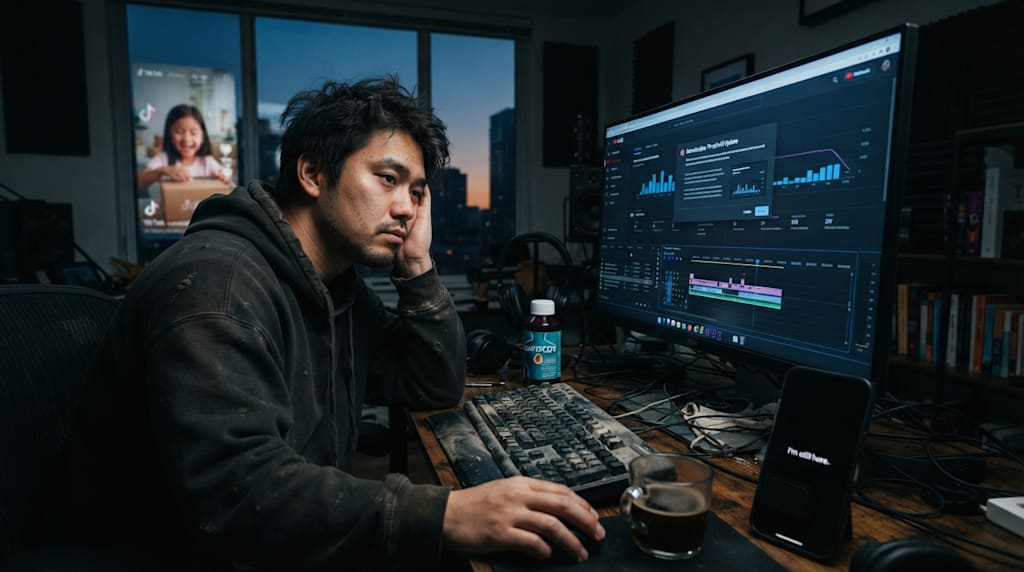
Chen Mo closed his editing software at 2:17 a.m. The YouTube Studio notification sat in the lower right corner of the screen, a small red dot. He clicked it.
One line: Starting February 1, 2027, new YPP applicants must meet 8,000 valid watch hours in the past year, or 20 million valid Shorts views in the past 90 days.
He did the math. His channel had 4,200 hours in the past year. The old threshold was 4,000. He had just crossed it. The new threshold was 8,000. He was 3,800 hours short. He opened the fridge, took out his stomach medicine, and dry-swallowed two pills. There was a layer of dust on the keyboard cover. He wiped it with his sleeve.
This wasn’t the first time a rule change had hit him. Three years ago, he quit his job at an ad agency to make long-form videos full-time. Film history, camera movement, the venetian blinds in film noir. Ten minutes per episode, forty hours of editing. Subscriber count stuck at 978. For the past year, he’d covered rent with memberships and Super Thanks. Ad revenue sharing hadn’t started yet. He’d planned to apply for YPP next month. Now the plan would have to be pushed back. How long? He didn’t know. Average watch time per video was shrinking. Completion rate used to be 42 percent; now 31 percent. Viewers left at the eighth minute. He’d tried moving the climax earlier, adding subtitles, saying at the start, “There’s useful stuff in three minutes.” The numbers still slid.
He opened the traffic sources in the backend. Views from “Ask YouTube” accounted for 7 percent. Last month that number was 3 percent. He clicked into a video and saw Google’s AI summary: the video’s core argument, three key shots, conclusion. Below it, a small line: “Jump to relevant segment.” He dragged the progress bar and jumped to the segment the AI had marked. The entire middle of the video had been folded away. He closed the page. The stomach medicine left a bitter taste at the root of his tongue.
YouTube offered a choice. The Shorts entrance was becoming more prominent on the home page. He’d tried posting Shorts. Take a segment from a long video, add subtitles, vertical, nine seconds. Views: three thousand, four thousand, ten thousand. Followers up by two hundred. Ad revenue? He’d checked. Shorts RPM was about $0.05. TikTok RPM was between $0.40 and $1.00. A friend he knew on TikTok made a twenty-second shopping-cart video, and the commission covered a month of electricity. He opened the TikTok backend, then closed it. He didn’t want to learn another algorithm.
But YouTube was pushing him. He saw a test: open the app, go straight into Shorts. He updated the version. Sure enough, after the splash screen, a vertical video played automatically. He swiped through five. The sixth was a movie recap, cutting Taxi Driver into thirty seconds. He swiped away. He went back to his own channel. The latest video: four thousand views. Seventeen comments. He replied to every one. At the tenth reply, he stopped. A viewer said, “You talk too slowly. I watch everything at 2x.” He stared at the sentence. Then he closed the comments and opened his editing software.
There was another line in the new rules: creators already in YPP were unaffected. But he wasn’t in yet. He was stuck at the door. The door had gotten narrower. He remembered the day he quit three years ago, when his wife asked, “Can you make money from this?” He said, “Yes. YouTube shares revenue with creators.” Now he sat in the same spot, screen light on his face. He opened the calculator. If he posted twice a week, average watch time four minutes per video, how many views would he need? He got halfway through the calculation and closed the calculator. He opened his phone and saw someone on TikTok post: “YouTube long-form is dead.” He clicked in. It was a creator in his early twenties, teaching people how to use Shorts to sell products. He watched for three minutes. Then he went back to YouTube and cut one of his long videos into three Shorts. At the second one, he stopped. The cursor blinked. He closed the project.
The next afternoon, he went to see a friend who ran an MCN. The friend opened a laptop in the coffee shop and showed him data: TikTok users spend 95 minutes a day, YouTube 85. The friend said, “You can make short videos. You just don’t want to admit the long-form ad model is collapsing.” Chen Mo said nothing. He stirred his coffee. The friend added, “YouTube has raised the Shorts targeted-ad split to 45 percent, only for five channels or fewer. It’s an opportunity.” Chen Mo asked, “What about long-form?” The friend said, “Long-form builds the brand. Shorts make the money. Do both.” Chen Mo said, “I’m only one person.” The friend closed the laptop: “Then choose one.”
On the subway home, Chen Mo opened YouTube Studio. He saw a notification: one of his old videos had been recommended by Ask YouTube, and views were up. He clicked in. The AI summary read: “The core argument of this video is…” He scrolled down. In the comments, someone asked, “Which film is the shot at the eighth minute from?” He replied. Then he opened his Shorts page. The three Shorts he’d posted yesterday had 800, 1,200, and 900 views. Followers up by forty. He turned off the screen. The subway passed through a tunnel. His face and a car ad overlapped on the window. The ad was for TikTok: a girl unboxing a package on camera.
That night, he sat in front of the computer. YouTube Studio’s terms update page popped up. He scrolled. The terms said: Starting February 1, 2027, new applicants must meet the new thresholds. He clicked “Accept.” The page jumped. He returned to the channel backend. Subscribers: 978. Past year’s watch hours: 4,200. He opened the project file for his new video. On the timeline, a ten-minute segment he’d spent forty hours editing. He pressed play. On screen, he said to the camera, “Today we’re talking about Venetian blinds in film noir.” He watched for a while. Then he opened the Shorts editing page. Dragged the same footage in. Vertical. Nine seconds. Added subtitles. He stopped. The cursor hovered over the “Publish” button. He checked the time. 3:04 a.m. He closed the Shorts page. Opened the long-form project. Kept editing. Stomach medicine on the desk. Pothos on the windowsill. Another scratch on the keyboard cover.
Three days later, he got an email. YouTube Creator Insider: Shorts monetization threshold adjusted; new applicants need 20 million valid Shorts views in the past 90 days. He did the math. His Shorts had fewer than fifty thousand total views in the past 90 days. He closed the email. Opened TikTok. Created a new account. Username: Chen Mo Watches Movies. He uploaded his first video. Nine seconds. Black screen. Subtitles: “I’m still here.” Then he turned off his phone. Went to wash a cup. The faucet ran. The cup rinsed clean. He put it on the drying rack. Outside the window, dawn broke.
About the Creator
Jin
Writer of reamstories
https://reamstories.com/jin
Enjoyed the story? Support the Creator.
Subscribe for free to receive all their stories in your feed. You could also become a paid subscriber, letting them know you appreciate their work.
Comments
There are no comments for this story
Be the first to respond and start the conversation.