
Why Good Jobs Never Show Up on Job Boards
A can of dace in black bean sauce explains the hidden market that decides who gets the good seats.
I
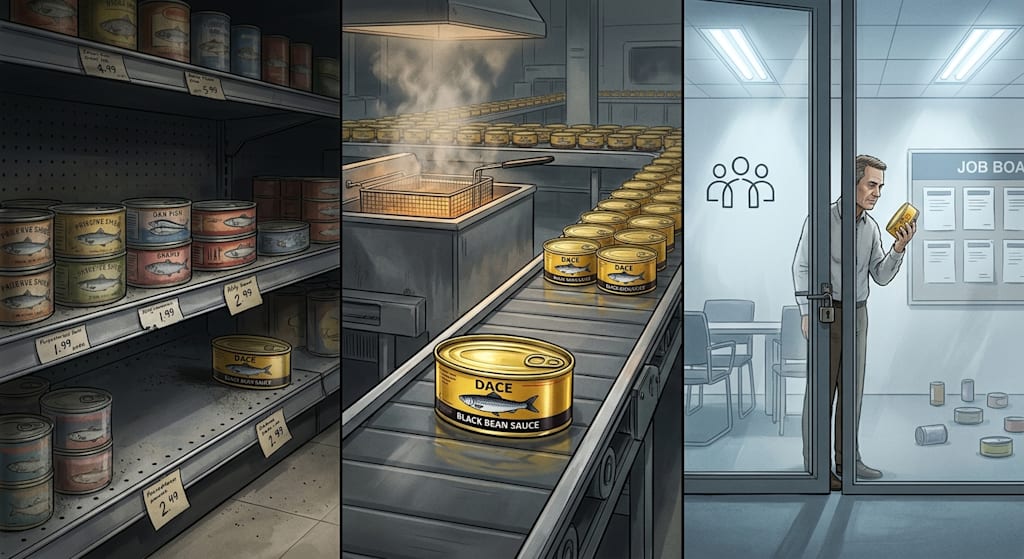
On the bottom shelf of the supermarket, Gan Zhu and Eagle Coin sat side by side. The 184-gram Gan Zhu was 12.8 yuan. The 227-gram gold-can Eagle Coin was 19.9. Between them were Yuehua, Gulong, Pearl River Bridge, and a few brands whose names I could not remember. Their cans said “fresh-fried,” “spicy,” and “preserved vegetable.” A thin layer of dust sat on the lids.
I squatted there and looked for ten minutes. A stock clerk came over with a cart, moved the 184-gram Gan Zhu two slots forward, pushed the can of olive-seed dace at the far edge back a little, and left. The olive-seed dace was never moved forward again.
This has something to do with good jobs. Start with the dace.
Dace is farmed almost only in the Pearl River Delta. Fresh dace has other preparations in Cantonese cooking: stuffed dace, dace balls, steamed dace with black bean sauce. They all sound fine. If you have ordered them a few times in Shunde or Guangzhou, you notice something. Compared with the canned dace in black bean sauce, they are always a breath short.
The gap comes from two problems. Dace has an absurd number of fine bones. It also has a heavy muddy taste. When steamed, if the black bean sauce is not thick enough and the heat not precise enough, the fishiness covers the freshness whole. Cantonese people love fish, but few are willing to deal with dace every day. Too many bones. Too much work to eat.
The canned dace in black bean sauce is the only solution that holds both problems down at once.
Step one: deep-fry at 180 degrees Celsius. The fish goes in and fries through. The muddy-tasting compounds leave with the moisture. The meat tightens. The Maillard reaction pushes the aroma up. After this step, the aroma begins to press down the fishiness.
Step two: Yangjiang black beans plus a heavy oil soak. The beans are salty and aromatic enough to pin down what fishiness remains. High salt and high oil push water activity very low. No preservative is needed. The can keeps itself. While it keeps, the black beans continue to ferment, and the flavor seeps into the fish.
Step three: sterilize at 121 degrees Celsius. Other fish would fall apart into crumbs. Dace has been fried once, so the meat has tightened and holds. The bones and fine spines soften under heat and pressure. You can chew through bone and spine together. The many-bones problem becomes texture.
In 1958, the Guangzhou Canned Food Factory began making this at scale. It was exported to Southeast Asia, and overseas Chinese recognized the taste. Later Gan Zhu and Yuehua built production lines by the same standard. The technical route had converged. Not that nobody tried anything else: fresh-fried dace, dace with preserved vegetable, spicy dace in black bean sauce, dace with olive seeds. Sales are crumbs next to the black-bean dace. The can of olive-seed dace on the bottom shelf is the evidence.
When a category runs long enough, it converges into a few optimal solutions. Dace in black bean sauce is that solution. It is not high-end. It does not belong on a banquet table. Process, raw material, and history have bitten into one another. Others cannot pry it open.
II
Good jobs follow the same logic.
You join a company. The boss gives you 30,000 yuan a month and ten dace. He says: within one year, develop a category that beats dace in black bean sauce; within three years, take down Eagle Coin and Gan Zhu. Your likely move is to try fresh-fried dace first and find the taste too thin. Then dace with preserved vegetable, and find the vegetable cannot hold down the fishiness. Then spicy dace in black bean sauce, and find the chili fights the black beans. A year passes. Your proposal is rejected three times. The boss says think again. You start working overtime. You start to juan, to grind yourself against everyone else.
By the third year, you notice the people at Gan Zhu and Eagle Coin have not moved. Their employees are keeping the line that has run for sixty years. The black beans are still from Yangjiang. The oil temperature is still 180. The sterilization is still 121. They even have the spare mood to come out and watch you grind.
That is what it means for good jobs not to circulate.
Good jobs exist. Every industry has its Eagle Coin and its Gan Zhu. The core positions at those companies, in product, supply chain, channel, and finance, are the black-bean dace line. The optimal solution has been sitting there for decades. The people on the line do not leave, so the positions do not open. Even when one opens, insiders hear first, acquaintances recommend first, headhunters call directly. It does not go up on a job board for you to submit a resume.
Most of what you scroll through on a job board is fresh-fried dace and olive-seed dace. High turnover, easy to replace, or urgently short of people. The good seats are digested internally, passed around at dinner, and allocated in a boss’s sentence: “Do you know anyone suitable?”
This is the hidden market. It is not written in the JD. It does not go through HR. It does not even follow an interview process. It runs on trust radius: who sits close to the core business, who has appeared on the key project, who the decision-makers remember. An outsider may be capable, but bringing an outsider into a core position carries high trust and adjustment costs. An insider is known, has a track record that can be checked, and has a working network ready. If you were the boss, you would choose the insider too.
So when someone jumps ship after thirty-five, it looks bright. From Company A to Company B, a bigger title, a raise. Look closer. He has moved from tomato-sauce dace to sweet-and-sour dace. Still circling in the edge categories. He has not entered the core line.
III
I once saw a scene at a small-appliance company in Shunde.
In the meeting room, the boss put a 184-gram can of Gan Zhu on the table and asked the man across from him: Can we make our own black-bean dace? The man was a category director just poached from another company. There he had run an “innovation business unit” for three years, launched seven new products, kept two alive, and one of those was still losing money. The director said yes. The boss said, one year. The director said okay.
After the meeting, the director stood in the corridor for a while, took out his phone, and searched “dace can supply chain.” The first result was Eagle Coin’s official site. The second was Gan Zhu’s JD flagship store. He put the phone back in his pocket and went to the pantry to make tea. The tea bag was Lipton. When he tore it open, his hand shook and tea dust spilled on the counter. He wiped it with a tissue and threw the tissue into the trash. The trash can had no liner. The tissue stuck to the bottom.
No line in this scene says good jobs are hard to find. By the end you know where he stands. He is the man sent to develop a new dace can. The boss gives him money, time, and ten dace. What the boss does not give him: the supplier relationship for Yangjiang black beans, the oil-temperature curve accumulated over sixty years, and shelf space at Gan Zhu and Eagle Coin.
These things are not on job boards. They are on someone else’s line.
IV
One more thing.
I know a man who worked at Eagle Coin for eleven years. He went from quality inspection to line management. His day: arrive at the factory at 7:30, check the dace delivery, pull a can and test water activity, walk through the sterilization workshop in the afternoon, finish the records before four. The rest of the time he drinks tea, looks at his phone, waits to clock out.
I asked him if the work was interesting. He said the first three years were interesting. After that it was guarding. As long as you guard it, you are fine. I asked if he had thought about leaving. He said, leave for where? Gan Zhu’s line is identical to mine. If I go there, I am still guarding. Yuehua is in Shunde; my wife and child are in Guangzhou. Gulong is in Xiamen; too far. Other brands? Other brands do not last three years.
He said, for this position, there are two people in all of Guangzhou who can do it. One is me. The other is my apprentice. When I retire, he takes over. If I leave, Eagle Coin has to poach from Gan Zhu. A Gan Zhu man would still need half a year to learn the line. So I do not leave.
He picked up his tea and took a sip. The cup was enamel, printed with “Advanced Worker,” half the red paint worn off. He put it down on the glass table. The bottom clinked. Then he said: You people outside think our kind of job is comfortable. We are welded to the line. Welded on, so we do not circulate.
I remembered that sentence for a long time.
V
Good jobs are hard to find because good jobs are not found. They are welded shut.
An industry converges on an optimal solution. The optimal solution occupies the profit pool. The core positions around the profit pool are held by insiders. Positions do not open. The market does not circulate. What you see on job boards is edge categories trying things out. Trial-and-error positions are naturally tiring and hard to turn into results, because resources are thin, tolerance is low, and nobody knows which direction will work. You grind inside. If you win, it is innovation. If you lose, it is cost.
That does not mean there is no way through.
Start by seeing where the profit pool is in your industry. Is it black-bean dace or fresh-fried dace? What is the core business, and who decides where resources go? How far is your current position from that line?
If you are already on the core line, do not jump to an edge category for a short-term raise. Being welded on has its benefits: stability, predictability, and accumulation. What you need to do is widen your trust radius, moving from the line toward the decision layer.
If you are in an edge category, do not spend all your time on a new can that is doomed to fail. Build transferable capabilities: how to set up a supply chain, how to lay out a channel, how to calculate cost. These things work in another category. Before you jump ship at thirty-five, ask yourself whether this is entering the core profit pool or moving from one edge SKU to another.
Most practical of all: if you cannot get onto the core line, make yourself capable of writing a new formula. Black-bean dace did not fall from the sky. Before 1958 it was a folk recipe. Someone industrialized it, standardized it, scaled it, and it became the optimal solution. Every time an industry reshuffles, good jobs are reallocated. Cold chain, prepared food, and snack channels are all moving. When they move, old lines loosen and new lines are built. Your task is to be standing next to the new line when it is built.
VI
Back to the supermarket shelf.
In the end I bought a 184-gram can of Gan Zhu. At home I opened it. Plenty of black beans, the fish a little soft, salty and aromatic enough. I finished the fish and did not throw away the beans. I mixed them into a bowl of rice. The rice was leftover, reheated for two minutes in the microwave, a little dry. The oil from the black beans seeped in. It was just right.
After eating, I threw the empty can into the trash. It hit the bottom and made a sound.
The next day I went back to the supermarket. The can of olive-seed dace was still on the bottom shelf. The dust was a little thicker than the day before.
I did not buy it.
About the Creator
Jin
Writer of reamstories
https://reamstories.com/jin
Enjoyed the story? Support the Creator.
Subscribe for free to receive all their stories in your feed. You could also become a paid subscriber, letting them know you appreciate their work.
Comments
There are no comments for this story
Be the first to respond and start the conversation.