
When HR Starts Watching the Clock, Start Watching the Exit Signs
A company doesn't go downhill because of attendance. It starts watching attendance after it's already sliding. Here's how to read the signal and protect yourself.
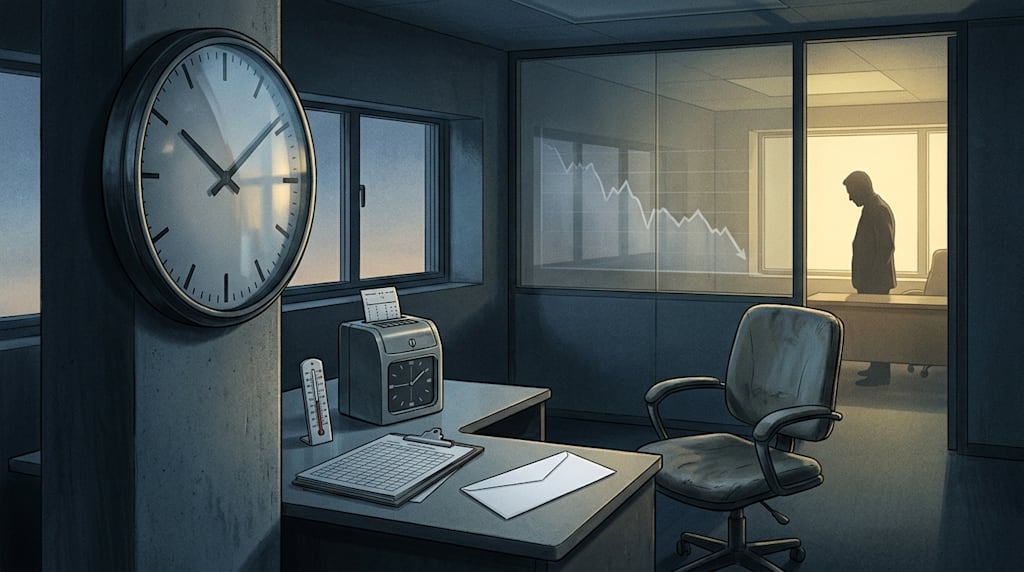
When HR Starts Watching the Clock, Start Watching the Exit Signs
A company doesn't go downhill because of attendance. It starts watching attendance after it's already sliding. Here's how to read the signal and protect yourself.
A friend told me his company recently started enforcing attendance like it was a matter of life and death.
Before, arriving at 9:30 raised no eyebrows. Now, clock in at 9:01 and HR names you in the group chat. Before, you could ask for a day off verbally. Now you need the system, documents, and three approvals. Before, overtime turned into comp time. Now you must request overtime in advance. If no one approves it, it doesn't count.
He said the strangest part isn't the stricter rules. HR, Finance, and the boss all began paying attention at the same time. People are whispering about layoffs.
That whisper usually has a reason.
Attendance crackdowns don't push a company downhill. A company starts sliding, then it cracks down on attendance.
Attendance is a thermometer. It doesn't cause the fever. It shows one.
Why managers reach for attendance first
Attendance is the easiest thing to control, measure, and display. A falling business is a complicated problem. Maybe the market shifted. Maybe the product aged. Maybe the strategy was wrong. Maybe the organization grew fat. Maybe the boss made a bad call. Fixing those things takes analysis, reallocation, hard conversations, and time. None of it is guaranteed.
Attendance is different. Send a notice. Change a policy. Put HR by the door for a week. Link attendance to payroll. You get visible movement. Who was late. Who left early. Who took too much leave. Management feels action. The feeling may be the point.
Behavioral economics has a name for this: action bias. When pressure rises, people want to do something. The something doesn't have to solve the problem. Attendance is a placebo. It calms the person taking it. It doesn't treat the disease.
Four things an attendance crackdown can mean
1. Discipline covers for strategy
Performance rarely collapses overnight. Customers change. Competitors change. Costs change. Products lose their edge. The signals arrive early. Management either misses them, avoids them, or refuses to act.
Then the numbers fall. Someone has to be responsible. Attendance becomes the explanation. The message: the company isn't failing because the direction is wrong or the product is weak. People just aren't working hard enough.
That moves a strategic problem down to the floor. It turns a lost map into a late employee. The execution layer works harder to cover the decision layer's silence.
2. The startup habit never died
Many companies grew from small teams. In the early days, the boss worked nights. Everyone did. Effort produced growth. Execution decided survival.
Then the company grew. Market, product, organization, capital, and talent became more important than who arrived at 9. Some managers never updated their mental model. When trouble comes, they reach for the old lever: people aren't trying hard enough.
That habit shows up beyond attendance. Sales growth becomes the only metric. R&D waits. Talent is hired ready-made, never trained. Processes stay informal. Responsibilities blur. Special cases multiply. Those problems hide in good times. They surface in bad ones.
Attendance is the visible edge of that habit.
3. Small controls replace big ones
When performance drops, even correct moves take time. A new product may fail. A new market may stall. Reorganization may take quarters. Decision-makers feel the delay. They want something they can hold.
Attendance is holdable. It can be checked today. It produces numbers by Friday. It creates the look of a company tightening its belt. The boss starts reading attendance reports. He never read payroll before. That change matters more than the policy itself.
4. Paper trails for layoffs
This is the fear many employees have, and sometimes it is correct.
Direct layoffs cost money. They can trigger disputes. Strict attendance creates records. Late arrivals. Early departures. Irregular leave. Insubordination. Missed targets. Later, those records can support a negotiated exit or a termination.
HR suddenly asks everyone to sign six months of attendance confirmations. That request is worth more attention than the rulebook.
Not every crackdown leads to layoffs. But watch for the cluster: hiring freezes, tighter reimbursements, forced ranking, position audits, handover documents, and no backfill when people quit.
How to tell the difference
Attendance rules alone don't tell you much. The surrounding moves do.
A company trying to survive will focus on growth. The boss visits clients. R&D spending continues. Sales incentives rise. Core roles stay open. Reorganization has a clear target. Attendance may be part of a wartime posture.
A company preparing to cut will focus on discipline. Attendance tightens. Daily reports lengthen. Meetings multiply. Reimbursements slow. Hiring freezes. Core people leave and aren't replaced. No one explains the business direction.
A company trying to save itself chases revenue. A company preparing to retreat polices the clock.
What companies should do instead
If management wants to turn things around, it should spend its energy in three places.
First, diagnose the business. Is the market shrinking? Is the product behind? Are costs out of control? Was the strategy wrong? Is the organization bloated? Each cause needs a different cure. Attendance cannot fix a market problem or a product problem.
Second, manage output, not hours. Watching arrival and departure times is crude. Output matters. Shorten decision chains. Clarify roles. Simplify processes. Adjust the org chart. Those moves are harder than checking attendance and far more useful.
Third, reward before you punish. Assessments stop mistakes. Incentives create wins. Set clear goals. Pay on time. Let people see that effort produces something. Handle individual discipline cases. Don't treat a company-wide problem as a discipline problem.
What employees should do
You cannot change company decisions. You can read signals and prepare.
Do not quit in anger. A voluntary resignation usually costs you severance. If you want to leave, wait for a negotiated exit or a written plan.
Show up normally. Don't hand them a reason. Lateness, early departures, absenteeism, and skipped leave procedures can all be magnified. You don't need to perform overtime. You do need your work to be provable.
Keep records. Save your contract, pay stubs, attendance records, performance reviews, work outputs, emails, and chats. Confirm important conversations by email. If you get called into a meeting, listen. Don't sign on the spot. Never sign "resignation for personal reasons."
Know your severance baseline. Negotiated exits often follow N or N+1. Illegal terminations may lead to 2N. Local law and your situation matter. Ask a labor arbitration office or a lawyer if you need to.
Prepare on two tracks. Update your resume. Take interviews. Maintain clients and contacts. Build three to six months of cash. Do this so you aren't trapped when tomorrow changes.
The signal in the clock
No company dies because it checked attendance. It dies because the strategy was wrong, the product got old, the market moved, the organization stiffened, and nobody wanted to name the problem.
Attendance is often the first domino. It doesn't kill the company by itself. It tells you the floor is moving.
For the company, the focus should be where the business is going, not who clocked in at 9:01.
For you, the focus should be what you can control next.
You can't control the company's fate. You can control your resume, your clients, and your savings.
About the Creator
Jin
Writer of reamstories
https://reamstories.com/jin
Enjoyed the story? Support the Creator.
Subscribe for free to receive all their stories in your feed. You could also become a paid subscriber, letting them know you appreciate their work.
Comments
There are no comments for this story
Be the first to respond and start the conversation.