
When A Prompt Finds Something Already There.
A Writer's Journal — Entry Three.

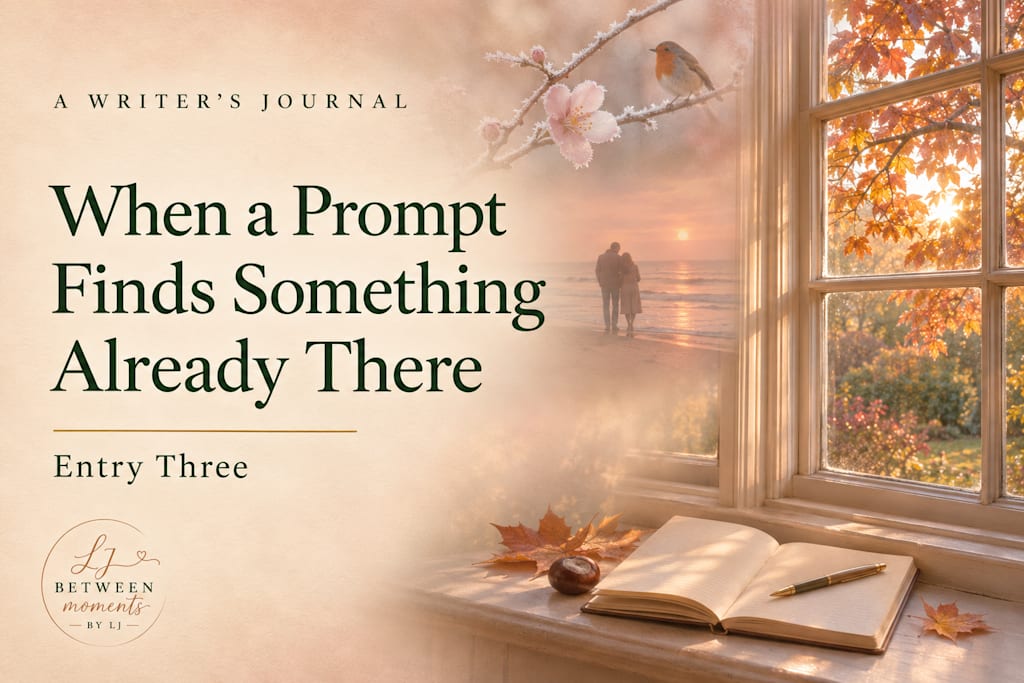
An autumn writing challenge was always likely to get my attention.
It is my favourite season. I could hardly spend so much time admiring it and then decline an invitation to give it a poem. That would feel a little ungrateful.
There is a spot by the window at home where I will find almost any excuse to sit: to work, to read, or simply to stay a while. There is something about the quiet presence of the trees that settles my mind, whatever the weather. I can lose myself in the view and find it a little easier to gather my thoughts.
In autumn, when the low sun catches them, I have another reason to look up. Early or late in the day, familiar trees seem to glow.
I will happily stop to look again. And again.
If I stay long enough, it almost feels as though that glow comes inside too.
That feeling was familiar before the challenge arrived. I had already paused there, already loved the view, already taken photographs because I wanted to keep something of it.
The invitation to write about autumn gave me somewhere to begin with that feeling.
And, eventually, a title: October, Come Inside.
The view before the poem
In my last journal, Collecting Stories Without Realising It, I wrote about photographs, fragments and ordinary moments kept before I understood what they might become.
Since then, I have been thinking about what happens when something gives one of those moments a direction.
A writing challenge can arrive with a theme, a limit and a deadline. It can look quite separate from the life I have been living. Then I carry it into the day: swirl it around with the dishes, stretch it out along a walk, bring it back to the window. Somewhere along the way, something familiar begins asking whether there might be room for it here.
With autumn, the connection was easy to recognise. I wanted to bring the season in with us. The warmth of that window mattered as much as the view beyond it: the small pleasure of being there, of looking up, of allowing myself those few minutes.
The poem gave me a way to spend longer with that feeling.
I could think about the colours, the scents, the sounds and the little comforts I associate with the season. I could choose which ones belonged together, and try to offer someone else the warmth I find there. The kind that makes you want to stay a little longer, even as the days grow colder.
It became a pleasure to write, and a favourite to return to.
It sounds fairly peaceful when I put it like that.
A single branch still managed to keep me occupied for quite a while.
Somewhere to begin
I am finding that I rather like having a prompt to consider.
There is plenty I want to write. A prompt gives me a particular brief to work with, then leaves me to discover how I want to answer it. Sometimes that means drawing on something familiar. Sometimes it asks me to learn a way of writing I have barely tried.
The regular challenges have begun to give my writing week a little shape. I do not enter every one, but I appreciate having something specific to try, with a deadline to work towards.
A theme gives my attention somewhere to settle, even if the ideas gathering around it do not immediately form an orderly queue.
Of course, I still have to find a connection that means something to me.
An autumn prompt offered a very comfortable beginning. Other challenges have taken longer to reveal where something of my own experience or feelings might fit.
Sometimes the first useful response seems to be a question: what does this make me think of?
Then another: why have I stayed with that thought?
I might begin with an image or a possible line. With a poem, it might be the feeling a theme brings, or a few words whose sound I want to follow. Sometimes the rhythm starts taking shape before I have much of the poem. Sometimes I have to play with the words for a while before I can hear where they want to go.
As I follow them, I can begin recognising a feeling I have carried for much longer than the challenge has existed.
That is becoming one of my favourite parts of the process. It is still surprising, and a little humbling, to discover how much there is to work with once I begin.
Love was always likely to find its way into my writing.
The surprise is where it keeps finding room.
The years inside an absence
Can We Have Forever? grew around the theme of negative space.
It is a phrase that gave me much more to think about than I first expected. I found myself considering the years my partner and I had known of one another without sharing the life we have now.
We knew each other at school, more than twenty years ago. We knew each other’s names without knowing what those names would one day mean to us.
There is joy in finding that love now. There is also a tenderness around the years we did not have together: all those ordinary mornings and conversations that never belonged to us.
They are strange things to miss, moments that never happened.
There was something there I wanted to write about. The happiness of what we have can sit alongside a little longing for what we missed. Neither feeling quite explains the other away.
I wonder how many other couples know that feeling: being grateful for the life they have found together, while still wishing they could have had a little more of it.
What might their story be?
Even that small question gives me something else to think about. A feeling close to home becomes a possible point of connection with someone whose life I know nothing about.
Some of that inspiration had begun to take shape during an earlier challenge. By the time I came to this poem, I was carrying more into the theme than I had realised.
One challenge can open into a whole labyrinth of things I want to explore. Finishing the entry does not seem to close it again.
The poem became a way to ask whether we could make up for the wait with forever.
I had not expected that particular question to be waiting inside negative space. Once I found it, it felt very close to home.
And being able to give it words, then share them, still brings a small pinch-me feeling.
I am only just getting started.
A blossom out of season
There was another kind of recognition in Between Blossom and Snow.
The challenge concerned something unseasonal. A blossom out of place gave the story an image to grow around, but the questions beneath it reached into more familiar territory: forgiveness, growth and the possibility of allowing someone close again.
Fiction gave those feelings people and circumstances through which to move. I could explore what an unexpected sign might mean to a character, how she might resist it, and what could happen as she began to allow herself to see things differently.
It also gave me room to change the circumstances around a feeling, to protect what belongs to my own life and imagine a version another person might recognise. I could explore something emotionally true through fictional people and events.
The blossom mattered. So did the life around it.
Writing the story meant finding a relationship between the challenge and the emotional questions I wanted to follow. The theme kept drawing me back to timing: what arrives when we do not expect it, and whether we are ready to welcome it.
I am still discovering how much a piece can hold beneath its first idea.
Sometimes I understand more of it while editing. Sometimes it is only when I try to explain the inspiration afterwards that I recognise how many familiar things have found their way in.
It makes the question “Where did this come from?” rather more interesting to answer.
And occasionally harder to explain in a sentence.
The words still have to work
Recognising the feeling is a lovely beginning. Then comes the work of finding words that can carry it.
The autumn challenge asked us to imagine October as a place we could enter. I wanted the poem to make that invitation something a reader could feel.
While working on October, Come Inside, I found myself questioning a line about a branch bending into a door. I liked the invitation it seemed to offer, but I was less certain what I was actually asking the reader to picture.
Was it a doorway through the branches? Was I thinking of the wood becoming a door? Had I become so fond of the sound, and the sense of stepping into October, that I had stopped checking where it led?
I was working with a particular prompt, and I wanted a poem people could step into. The image needed to help with both.
I considered “boughs” for a rhyme, too—a new word for a familiar part of the trees. I was glad to learn it, but in this poem I preferred language that felt closer to the way I knew the scene. I can keep the word for another day without having to find it a home in this one.
Those small choices are part of the work. A line can sound lovely when it first comes to me and still need a little attention. Sometimes I return to the original feeling and ask whether the wording helps someone else reach it.
With the autumn poem, I kept coming back to that window. To the light, the trees, and the wish to bring a little of their glow indoors.
That gave me something to check the words against.
My little girl is happy to help with bringing autumn indoors, too. Leaves, acorns, chestnuts—she rarely needs much persuading. There is something I want to keep of the joy and pride she takes in those small collections, and of this time when bringing a little of the season home is such a pleasure in itself.
Between her collections and an arborist in the family, I seem to have gathered a rather wonderful team of assistants and muses.
Payment is mostly in love and appreciation.
What I bring to the invitation
Looking at these pieces together, I can see how much I bring with me when I read a prompt.
My favourite season. A love found after years apart. Questions about timing, belonging and beginning again. The particular details I notice because of the life I have lived.
Another writer could meet the same theme and follow it somewhere entirely different. I rather like that thought. Even a shared starting point leaves room for all the things we cannot help arriving with.
I rather envy the judges getting to see all those different answers to the same invitation. I envy them less when they have to choose between them.
I do not expect every challenge to become a piece I want to write. Some may need longer. Some may interest me without leading anywhere I wish to follow. I would like to leave myself that choice, even while I am enjoying discovering how much a prompt can open up.
The challenges have been a blessing in getting me writing, trying things and learning as I go. They have encouraged me to practise, to question a line, to try a form or follow a connection I might otherwise have left alone.
Recognition from someone else would be lovely. I am also beginning to recognise something for myself: I can take a feeling, work with it and make a piece I am glad to share.
That belief follows me into the writing I begin without a prompt, too.
I can see it in the pieces already written and feel it in how much more I want to try. There is real pleasure in discovering what I can do, and in knowing there is still so much to learn.
For now, I am paying attention to the themes that keep returning to mind after I have read them. The ones that send me back to a photograph, a memory or a feeling I have not quite found words for yet.
With October, Come Inside, I can trace that connection back to a favourite place at home.
The trees were already there. So was the pleasure of stopping to watch the light move through them.
Then a challenge arrived, and I had a reason to ask what I wanted to share about it.
I began with a view I loved and found an invitation I wanted to pass on.
Come inside. Stay a little longer.
Look how the trees are glowing.
Be among the first to hear when I publish a new Writer's Jounral entry.
SubscribeAbout the Creator
Enjoyed the story? Support the Creator.
Subscribe for free to receive all their stories in your feed. You could also become a paid subscriber, letting them know you appreciate their work.
Comments
There are no comments for this story
Be the first to respond and start the conversation.