
What He Confirmed Without Ever Knowing
One man. One budget line. A lifetime of intelligence reduced to a handwritten receipt.
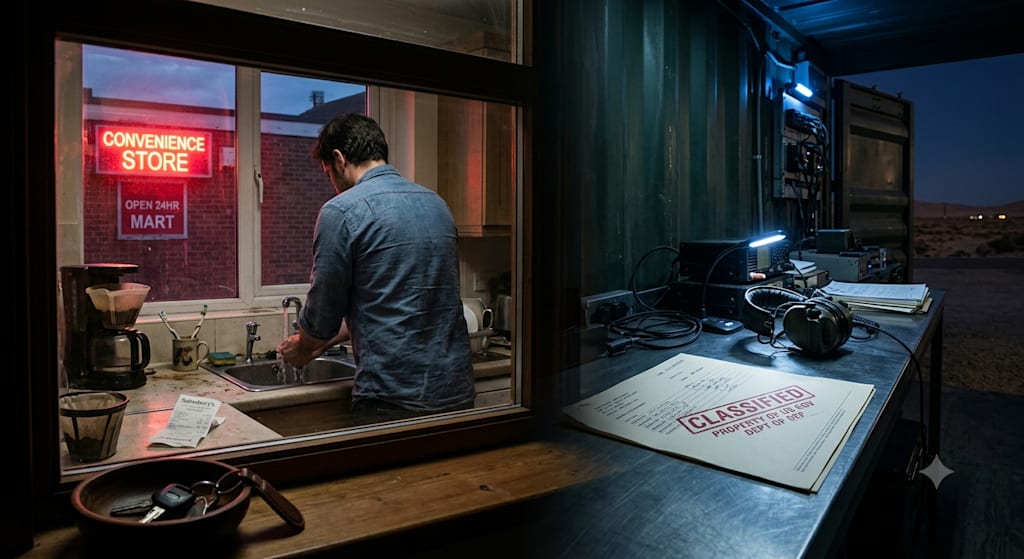
He came through the door and dropped his car keys into the wooden bowl on the shoe cabinet. The keys hit the bottom with a dull thud. The bowl was something his daughter had made in art class — lopsided, coated with a layer of glossy varnish, but the varnish had worn through, showing the gray-white wood underneath. He didn’t turn on the main light in the living room. The light strip under the kitchen cabinets came on by itself, triggered by motion. His daughter had installed it on her last visit. She’d stood on a chair while he held the backrest, and she’d said, This way you won’t have to fumble around in the dark when you want a glass of water at night. The chair was the one from IKEA. Its seat had come a little loose, and he’d tightened the screws himself once, afterward.
The filter basket of the coffee maker sat in the dish rack beside the sink, next to that old toothbrush. The bristles were splayed; a few were bent out of shape, past springing back. He glanced at it, didn’t pick it up. He reached into his pocket, found the supermarket receipt, crumpled it into a ball, and aimed for the trash can. The ball hit the rim, bounced, and landed on the floor. He left it there.
He turned on the tap, all the way to cold. The water ran over his wrist, cold enough to sting a little. He held his hand there, watching the column of water hit the stainless‑steel basin, splash up, and spiral down the drain. The sound of the water filled the kitchen. Behind him, the refrigerator hummed low; the compressor kicked in, vibrating through the floor tiles in small, irregular tremors.
The feel of cold water brought something back.
On his first overseas posting, when he was young, he’d been stationed at a listening post on the edge of a desert. Water was more expensive than oil there. You got three minutes of hot water for a shower each day, and the first stream from the showerhead was always ice‑cold, slapping against his collarbone, his shoulder blades — exactly this sensation. Back then he’d lived in a dormitory converted from a shipping container, corrugated‑iron walls that baked in the sun and turned cold and drafty at night. Above his bed he’d taped a photo of his newborn daughter with clear adhesive tape; all four corners had curled up. Every morning when he woke, that photo was the first thing he saw, even before the iron seams on the ceiling.
In those days they intercepted mountains of phone calls every day — recorded, packaged, encrypted, and sent back to headquarters. He handled the first pass of screening, wearing headphones for eight hours at a stretch. The headphones were the over‑ear kind; the leather cushions had worn through, exposing the sponge underneath. He heard all sorts of voices: a mother calling her son home for dinner, a wife asking her husband when he’d get paid, two businessmen cursing each other out as liars, a girl crying into the receiver for forty minutes without saying a word. He didn’t know where those recordings eventually went, what they became. All he knew was that every morning, a briefing would appear on his desk right on time, telling him, in clean, precise language, in that font he knew so well, what was happening in that country.
Once, the briefing said that in a neighborhood in the north of the capital, residents were secretly distributing anti‑government leaflets at night, demonstrating that grassroots mobilization had penetrated to the civilian level. He remembered that sheet of paper. A4 size, stamped “Classified” in the footer, punched holes on the left. The paper had still felt warm to the touch, fresh out of the printer; leaning close, you could smell the heated toner, a little acrid, a little sweet. He’d read that page three times, front and back, then written “Confirmed” in pencil in the margin, with a checkmark. How had he confirmed it? He couldn’t remember anymore. Probably he’d listened to a few calls — somebody had mentioned “tonight,” somebody had mentioned “that intersection up north,” somebody had mentioned “print a few more copies.” Enough. More than enough.
Years later, after he’d been transferred back to headquarters and given an office with a window — it faced north, onto the exhaust vent of another building — he no longer wore headphones. His job now was to look at intelligence synthesized by more people on bigger screens. One day, while reviewing a financial reimbursement file, he came across a line item. The document had the exact same format as the briefings he’d read when he was young: same font, same A4 paper, same punched holes. The line item read: “Leaflet printing costs — 500 copies, for nighttime operations in the northern neighborhood.” Attached was a scan of a handwritten receipt. The handwriting on the receipt was crooked; the ink was uneven, dark in some places, faint in others. The last character was unfinished, the stroke broken off halfway.
He pulled his hand back from the running water. The water stopped. The kitchen went quiet all at once, so quiet he could hear the liquid gurgling inside the refrigerator’s compressor, like a person who’d drunk his fill and was belching, or like the breath a strange woman had swallowed after crying into the phone for forty minutes without saying a word.
He turned off the tap. Wiped his hands on his pants. Bent down, picked up the crumpled receipt from beside the trash can, smoothed it out. It listed what he’d bought that afternoon: a carton of skim milk, a loaf of whole‑wheat sandwich bread, six tomatoes, a box of sugar cubes. Next to the sugar cubes was a tiny asterisk and the word “Promotion.” He folded the receipt in half, then in half again, and slipped it into his pocket.
He walked into the living room but didn’t sit down. The TV remote was on the armrest; he didn’t pick it up. Outside the window, the sky had begun to deepen, that blue‑gray when it’s about to turn dark but hasn’t yet. The convenience store across the street lit up its sign, red, casting half the bedroom wall in a warm red glow. Standing at the window, he saw a delivery driver parking an electric scooter right at the entrance to his apartment block. The insulated box on the back was plastered with reflective strips; caught in the headlights, each strip gleamed like a blade. The driver pulled out his phone, made a call, his mouth opening and closing — no sound through the glass. Half a minute later, the building door opened, and a woman in flip‑flops came out, took the plastic bag, and turned back inside. The door shut behind her with a soft, muffled thud. The driver got back on his scooter, twisted the throttle, and the scooter slid silently into the lane; its taillight blinked once at the corner and was gone.
He thought of that handwritten receipt.
He’d seen handwriting like that before. Not at the listening post when he was young — the timeline didn’t match; the neighborhood hadn’t appeared in the briefings until years after he’d returned to headquarters. But he’d seen that kind of handwriting. In a completely different setting, in a completely unrelated system, he’d seen that way of holding a pen: an adult sitting behind a greasy little counter, pressing a receipt pad against an uneven wooden surface, using a ballpoint to write, stroke by stroke, letters he didn’t recognize. That man probably had no idea what he was writing. He only knew he’d been told to write these characters, and if he wrote them right, he’d get paid. He wrote slowly, bearing down hard, the pen tip pocking the paper with little dimples. After the last stroke, he probably set the pen down, blew on the ink, and handed over the receipt in exchange for a few banknotes.
That cash. That money. Which account had it come from? Whose budget had it been allocated from? Through how many hands, bearing how many stamps, had it traveled before landing on that small counter? He didn’t know. All he knew was that some of that money had come from a budget request form he had signed off on. His signature. His name sat in the “Approving Officer” field at the very bottom of the form, written with the same pen he’d used to write “Confirmed” in the margin of the briefing all those years ago — his own fountain pen, its nib a little sprung, so that the horizontal strokes scraped the paper with a fine, sandy whisper.
And those five hundred leaflets — who had taken them? On which night had they been slipped under which doors, into which alleyways? Whose feet had stepped on them the next morning, whose broom had swept them into whose trash bin? No one knew. But one piece of information was certain: the leaflets had been distributed. The leaflets had been distributed, therefore grassroots mobilization was confirmed. Grassroots mobilization was confirmed, therefore the regime’s foundation was unstable. The regime’s foundation was unstable, therefore collapse was only a matter of time. The chain of deduction was seamless, link by link, every link resting on that crooked, painstaking handwriting.
It wasn’t that he didn’t know. Of course he knew. He’d spent his whole career in this line of work.
He’d just never put those two images side by side: on one side, the man sitting at that small counter writing out a receipt; on the other, the A4 paper — still warm — coming out of the printer. How many layers lay between them? He’d lost count. He’d known it existed, the way he’d known there was liquid moving inside the refrigerator compressor, but he’d never taken the back panel off to look. Now he saw it. On a Wednesday evening, in his own kitchen, in the second after he’d pulled his wrist out from under the cold water, he saw it.
He turned around. The coffee maker’s filter basket was still lying in the dish rack, the bristles of that old toothbrush still splayed. He walked over, picked up the toothbrush, and turned on the tap. This time he turned it all the way to hot. Steam rose, fogging the mirrored cabinet door. He worked the toothbrush into the crevices of the filter, sawing back and forth. Brown scale and white toothpaste foam ran down. The hot water scalded his hand red. He didn’t pull away. He scrubbed hard, until every seam let light through, until every tiny hole in that filter was perfectly clean, as if it had never been used.
He lifted the filter and held it up to the light. The light streamed through hundreds of neat little holes, casting a fine mesh of shadows across his face. Not a single hole was clogged.
He turned off the water, set the filter back in the rack. He wiped down the outside of the coffee maker with a cloth, untangled the power cord, and coiled it up neatly, loop after loop. He opened the cabinet, put the coffee maker inside, and pushed it all the way to the back. Before he closed the door, his hand brushed against the box of sugar cubes — bought that afternoon, on promotion. The corner of the box was already a little damp, going soft. He took out the box, tore it open, and pulled out one cube. He placed it on his tongue. The moment it touched the tip of his tongue, it began to dissolve, so sweet it was almost bitter.
With the sugar cube in his mouth, he walked back to the living room and sat down on the sofa. The remote was right beside his hand; he didn’t pick it up. Outside the window, the red sign of the convenience store across the street still glowed, lighting his living room half warm red, half gray‑blue. The sugar cube in his mouth had dissolved completely. All that remained was a faint graininess on the tip of his tongue — the last few grains that hadn’t quite melted. He licked them away, one grain at a time.
It was fully dark now. He didn’t turn on the light.
About the Creator
Jin
Writer of reamstories
https://reamstories.com/jin
Enjoyed the story? Support the Creator.
Subscribe for free to receive all their stories in your feed. You could also become a paid subscriber, letting them know you appreciate their work.
Comments
There are no comments for this story
Be the first to respond and start the conversation.