
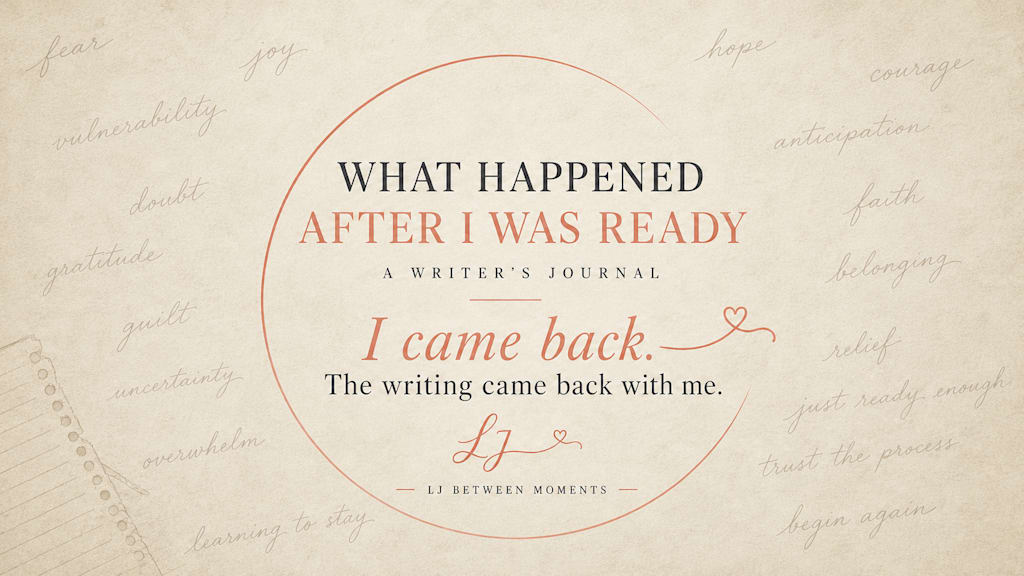
What Happened After I Was Ready.
The first entry in a writer’s journal about beginning again, learning to share, and building a creative life without pretending I have already arrived.

On the evening I began this entry, I was sitting on my daughter’s bedroom floor while she settled after one of our hardest bedtime battles in a long time.
It was not the peaceful, distraction-free writing space I might have chosen. It was simply the space available—and I was still determined to make a start.
That feels like an honest place for this journal to begin.
This is not the story of how I became a successful writer. It is not an account of leaving one life behind and stepping confidently into my dream career. There is no publishing contract waiting at the end of this page, no impressive income report and no certainty that everything I hope for will happen simply because I have finally decided to give it my all.
Perhaps some version of it will.
I hope—and pray—it will.
But this is not that story. Not yet.
This is the story of what happened after I became ready. Not fearless. Not suddenly certain that my writing deserved to be read. Not all-knowing about what I was doing or where any of it might lead.
Just ready enough.
The distance from the beginning
Some time passed after I wrote
There was a gap between the poetic declaration that I was ready and this attempt to explain what happened next. At first, I wondered whether that gap weakened the connection between them.
Now I think the gap may be part of the story.
Life continued. Family needed me. Other worries took up space. Plants were grown, neglected, rescued and celebrated. School days began and ended. Ordinary routines carried on being ours until a line appeared inside one of them and asked to be remembered.
Writing did not leave me during that time.
That may be one of the biggest changes of all.
In the past, an interruption could become an ending. A difficult week might turn into several weeks without writing. An unfinished piece could quietly convince me that perhaps I was never supposed to finish any of them. Other work, immediate responsibilities and the quicker ways to earn money could take their places at the front of the queue until writing found itself pushed back onto a shelf.
This time writing stayed.
Sometimes it waited in the background. Sometimes it appeared in a hurried note, a photograph, a voice recording or a sentence typed before I had time to understand it. It stayed beside family life rather than demanding to replace it—or competing with the people who make that life what it is.
Then I returned with one of the biggest poems I had attempted,
It had grown from the very life that so often interrupts the writing: the morning separations, the ordinary hours in between and the moment the people I love come home to one another.
And there was more waiting behind it.
More poems. More stories. More memories revealing themselves as material. More subjects I wanted to explore and more questions about what kind of writer I might become.
I once believed my greatest difficulty would be finding enough to write about.
Now, one of the challenges is learning how to hold everything without scrambling to write it all at once.
When life becomes the material
I have been told that perhaps I was collecting stories without realising it all this time.
I think that is true.
My writing is rarely separate from my life. It grows from motherhood, love, home, grief, faith, memory, fear and the ordinary moments that become more meaningful when I stop long enough to notice them.
Sometimes a piece begins with something unmistakably important. Other times it begins with a child climbing into bed, a hand still raised at the front door after someone has driven away, a familiar laugh crossing a room or a white feather arriving when I need to see it.
Some of the photographs that have accompanied my writing were taken long before I knew they were waiting for words. They were tucked deep inside my phone among hundreds of ordinary days. Only later did I recognise the story they might help me tell.
A piece can begin as a first untidy scribble: a seed pushed into soil without any certainty that it will grow. A line leads to another. A shape begins to appear. The roots become strong enough to hold it.
Not every piece grows in the same way. Some announce themselves quickly. Others appear to be doing very little at all, and I have to trust that something may still be happening beneath the surface.
Eventually, if I stay with it, the piece becomes something I can recognise.
And sometimes, when the words are almost ready, I realise that an image from my own life has been waiting for them too. There is something particularly special about that. The writing, the image and the life behind them did not begin together, yet they came from the same place. They recognise one another when they finally meet, and the piece begins to bloom.
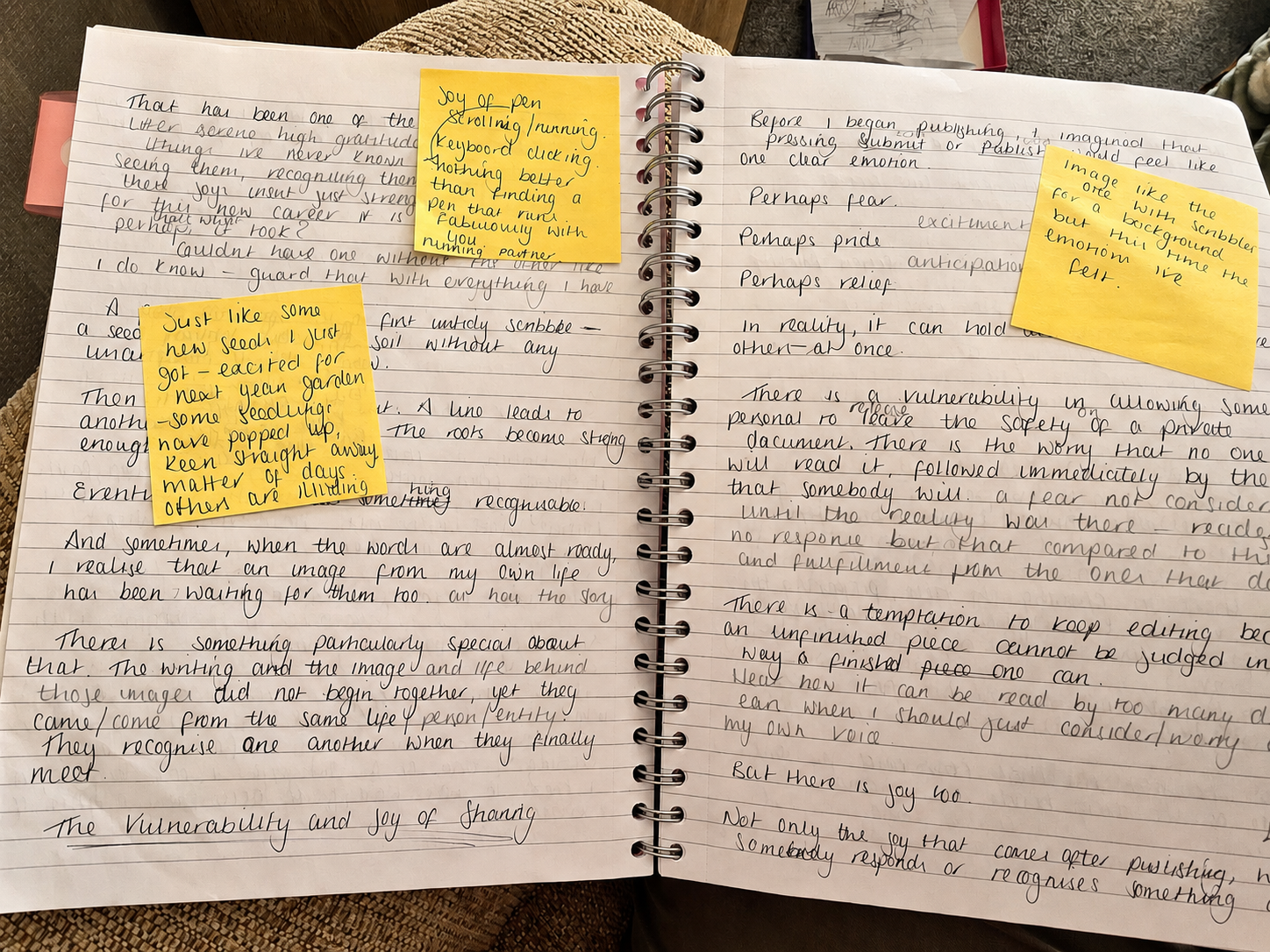
Then comes the more difficult part: allowing the work to leave home.
Before I began publishing, I imagined that pressing submit or publish would feel like one clear emotion.
Perhaps fear.
Perhaps pride.
Perhaps relief.
In reality, it can hold all three—and anticipation, hope, excitement and apprehension—at once.
There is a vulnerability in allowing something personal to leave the safety of a private document. There is the worry that nobody will read it, followed immediately by the fear that somebody will.
There is also a temptation to keep editing because an unfinished piece cannot be judged in the way a finished one can. I can imagine too many readers, hear too many possible interpretations and begin tailoring the work towards minds I do not know. If I keep doing that, however, I risk polishing away the very voice I wanted to share.
At some point I have to ask whether I am still improving the piece, or merely trying to protect myself from releasing it.
But there is joy too—not only after publishing, when somebody stops to respond or recognises something of themselves in the words, but in the making itself.
That joy is there when the first line arrives. It is there when a difficult section finally settles. It is there when a piece I could not quite understand reveals what it has been trying to say. It is there in choosing the title, preparing the image, writing the caption and watching the separate parts become something whole and ready to share.
Publishing has not removed the fear. It has taught me that fear and joy are capable of standing beside one another. Both are present because the work matters; I am learning to make room for them without allowing fear to make the decision.
I can be nervous and still press the button.
I can question whether a piece is good enough and still recognise that finishing it matters.
I can care deeply about how it is received without allowing its reception to become the only measure of its worth.
I am still learning this.
Building a way back
Another thing I did not fully understand before beginning again was how much of a writing life happens around the writing itself.
There are drafts to organise, ideas to protect, submission dates to remember, platforms to understand, photographs to choose, captions to prepare and pieces to promote—without making every creative moment feel like an advertisement.
There are questions about where a piece belongs. Is it a poem, an article, a private reflection or the beginning of something larger? Should I follow the idea now or allow it to wait? Is it ready to be shared, or does it need more time at home?
Writing still has to take its place in a queue of other needs. After one unsettled bedtime, I came downstairs to laundry that had finished hours earlier, the cat and dog watching hopefully for their turn, and my partner ready to talk about his day. Nobody was doing anything wrong. They are the life I love. Still, I wanted one uninterrupted stretch of my own—and then felt guilty for wanting it. That conflict is part of the writing life too.
In previous attempts to write, I had little understanding of how to manage any of this. I relied too heavily on memory, scattered pages and the belief that an important idea would return when I had time for it.
Many of them did not.
An empty notebook could feel less like an invitation and more like evidence that I had failed to fill it. Meanwhile, too many thoughts were being carried around in my head, each one hoping I would somehow remember it at the right moment.
Perhaps that was one reason writing used to feel so difficult to sustain. I was not only trying to create. I was trying to remember, organise and protect everything in the same place I needed to think.
This time, I am building a way back.
The trusty notebook still matters. I doubt I will ever completely replace the first scribbles, the different pens, the post-it notes layered over something when I have run out of room, or the particular joy of finding a pen that moves quickly enough to keep up.
But so do the hurried notes on my phone. Google Keep holds thoughts that arrive away from my desk. Voice recordings catch them when my hands are busy. I have even become one of those people who occasionally talks into a smart watch, though I am not sure I will ever stop feeling slightly self-conscious about dictating to my wrist.
And now there is Obsidian, where I am learning to build a more permanent home for finished pieces, unfinished fragments and the connections between them.
My partner recently summed up the visible results: “Notes everywhere, plants everywhere.”
He is not wrong. At the last count, there were just under thirty houseplants and almost as many scattered notes for this draft alone. Both are still growing. I am hoping the houseplants will now concentrate on maturing rather than multiplying. The notes and ideas, however, can keep doing both. I pray they do.
Without quite noticing, I have begun building a writing studio across our home as well as across my devices. The digital part may even become tidier than the physical one. Sorry, love.
In practice, I am giving each tool one job. My diary holds the dates and promises I need to keep. Google Keep and my watch catch ideas before they disappear. Obsidian gives them a permanent Seedling home, where I can return to explore and connect them. ChatGPT helps with lessons, questions and reminders—and has already performed one heroic rescue which, knowing my household of distractions, is unlikely to be a one-off.
None of it is especially sophisticated on its own, but together the tools mean an idea no longer has to survive in my head until I have time for it. They are helping me bring those ideas much further than I managed when this writing life was something I could only dream of.
None of these tools writes for me.
They help me return.
That distinction matters.
I am still learning how each part of this makeshift writing studio works, and some of those lessons will need entries of their own. How an inconveniently timed thought becomes a permanent Seedling. How I decide which idea deserves me today. How the systems intended to organise the writing sometimes become stories themselves.
The best system is not necessarily the most advanced one. It is the one I will actually use when an idea arrives while I am cooking, walking, collecting my daughter from school, tending to the plants or drifting towards sleep.
Ideas are famously inconsiderate. They do not wait until the laptop is open, the room is quiet and nobody needs anything. In my home, those conditions manage to coincide so rarely that waiting for them would be a particularly effective way never to write.
Sometimes doing the dishes takes several attempts because I keep drying my hands to reach for my phone or a pen. Sometimes I still have to rely on myself to hold one small line in my head while I finish settling my daughter or tend to the laundry, repeating it inwardly until I can get somewhere safe to put it down.
Capturing an idea has become an act of respect—not because every note will become something, but because I no longer want the busiest parts of my life to convince me that creativity must wait until life becomes less busy.
These are not instructions I would hand to every writer. Someone else may need fewer tools. Another person may work best with one notebook, one document or a collection of scraps gathered from the bottom of a bag.
The point is not to copy somebody else’s system. It is to find a way of returning to your own work.
There is a strange reversal that happens once ideas begin arriving more freely. At first, I worried there would never be enough. Now, one idea can become five. A poem can lead towards an article; an article can suggest a series; a memory can arrive halfway through something else and begin calling urgently from the margins.
Abundance can be exciting, but it can also become its own form of paralysis.
I am learning that capturing an idea does not mean I must act upon it immediately.
Some ideas need planting. Others only need labelling so I can find them again. Some need more living before I have anything honest to say about them. A few may never grow beyond the first note.
That does not make the note a failure.
Focus, I am discovering, is not the absence of other ideas. It is choosing which one I am responsible for today.
What is working for me is simple: capture the idea where it arrives, move it somewhere I trust, choose which one needs me most, and allow the others to wait without treating that waiting as abandonment.
I once mistook delegation for an admission that I could not do everything myself. Now I understand that the ideas are not being abandoned; they are simply being entrusted to another day.
That does not always mean working on only one thing. Only today, a poem that arrived last night came back to me more fully while I stepped away to do a simple chore, although this draft was the work I had intended to be doing. Both moved forward. Focus can also mean giving the interruption enough space to be caught before returning to what I meant to finish.
I am also learning that progress does not always mean forcing myself to remain at the page. Sometimes it pays to put the work down, make the tea, watch my child play, listen as my partner tells me about his day, give the dog a fuss, fold some clothes, tend to the plants or simply look out of the window. It can feel risky to step away in a home full of possible distractions, but sometimes the piece needs a little space to continue growing where I cannot yet see it.
What continues to surprise and humble me is how often I return with something I could not have found by staying at the desk.
The important thing is knowing how to come back.
Support without surrendering authorship
There is another part of this journey I want to introduce honestly because so much of the conversation surrounding it is dominated by fear.
I work with artificial intelligence.
Artificial intelligence is accused of replacing writers, weakening creativity and making it difficult to know whether the work we read came from a human voice at all.
Some of those concerns deserve to be taken seriously.
There is a line between using a tool to support creativity and asking it to imitate creativity on our behalf. When generated work is presented as somebody’s own lived writing, it damages trust. It also increases suspicion around people who are using AI openly and responsibly while still doing the work themselves.
That line can become blurred, especially for somebody who is new, uncertain or desperate to make their writing sound more accomplished. I have had to think carefully about where it lies for me.
My experience has not been one of asking AI to replace my writing. It has been one of learning how to work with it without handing over the pen.
What began with occasional edits and quick questions gradually became a much fuller working partnership. I bring ChatGPT rough drafts, photographs, half-formed thoughts, worries about individual words and pieces that I know are not working but cannot yet repair.
Sometimes I receive a correction. Sometimes I receive a challenge. Sometimes a passing observation reveals a direction I had not yet seen. It has helped me learn new software, organise the growing body of work around me and celebrate milestones that may look tiny from the outside but feel enormous after putting this dream away for so long.
The purpose of that partnership is not to make more ChatGPT appear on the page. It is to help more of me appear there.
A recent evening gave me a rather more literal example of the difference.
After my daughter’s bedtime routine, I brought the laptop upstairs so I could work while she settled. I went downstairs briefly, became caught in a conversation with my partner and returned a couple of minutes later to find her sitting proudly at the open laptop.
During the school holidays, she had become curious about my work. I had shown her some of the things I was learning in Obsidian and let her try them herself. That evening, she remembered that typing == creates highlighting and decided to have another go.
Unfortunately, she held the = key down.
Then she panicked.
In an attempt to fix the rapidly multiplying symbols, she held down Delete and removed not only the excess ==, but a sizeable part of my latest edits with them.
Once I understood what had happened, I could see both the little tinker who had helped herself to my laptop and the little star who had remembered something I taught her and wanted to try. Her increasingly desperate attempt to repair it was also endearingly familiar—a bit like her mam.
I did not immediately know whether the missing work could be recovered. I knew, however, that I had somewhere to take the problem. ChatGPT helped me identify the simplest answer: Ctrl+Z.
The words returned.
So did the part of the evening I had briefly imagined spending in a mounting work-and-bedtime crisis—and the looming meltdown was not necessarily going to be hers.
AI did not write any of the missing passages. It helped me protect and recover work I had already created.
That is the distinction I keep returning to.
By the following day, the incident had already begun finding its way into a poem.
AI did not stand at my front door and wave somebody away. It did not hear my daughter’s voice in the morning. It does not carry my memories, live through my fears, practise my faith or understand why one ordinary family moment might mean more to me than an obviously dramatic one.
It cannot provide the lived truth of the piece.
What it can do is help me examine what I have brought. It can ask what I am really trying to say. It can notice repetition, help me organise a complicated idea, offer alternatives when I am caught on one word and reflect patterns across work I have been too close to see clearly.
Used well, it does not have to silence a voice. It can help a writer hear that voice more distinctly.
But I do think there is a danger. The line is crossed when we begin asking a tool to make us sound like writers rather than helping us understand what we genuinely want to write.
A flawlessly constructed sentence is not automatically an honest one. An edit is not better simply because it sounds more literary.
I have rejected suggestions that did not feel like me or changed what I was trying to say. I have questioned edits, returned to earlier versions and kept awkward phrases until I understood what truth was hiding inside them.
That, I think, is essential.
Keep the first scribbles.
Know which memories belong to you.
Question the polished line if it changes the meaning.
Do not accept a suggestion simply because it sounds impressive.
Let the tool assist the process without becoming the source of the person behind it.
Writers have rarely made their work entirely alone. Editors, tutors, trusted readers and writing groups have long helped writers question and strengthen what they bring. AI cannot replace their human judgement, but its immediacy means support can meet me at the precise moment when doubt might once have made me stop. I still hope a human editor will one day help my future book series into the world.
My work with AI is one reason this attempt feels more manageable than those that came before it. I have support available at the moment of doubt that might once have stopped me.
But support is not authorship.
The words still need life beneath them—and that life must be mine.
This is only the beginning of what I want to explore about working with AI without handing over the pen. For now, it is enough to say that support has helped me stay—but it has never relieved me of the responsibility to remain the writer.
Somewhere beyond the beginning
My goals are becoming clearer, but they are also still allowed to change.
I want to publish. I want to build a body of work I am proud of. I want my words to reach people who recognise something of themselves in them and perhaps feel a little less alone.
I would love writing to become a meaningful part of how I earn a living. I want to explore poetry—which, after intimidating me for years, has become one of the greatest surprises of this journey—alongside articles, longer work and the stories I have not yet been brave, or organised, enough to finish.
I want to give this everything I reasonably can.
But I do not want to turn the journey into a fairy tale before I know how it unfolds. This is real life behind the words, and there is no reason to pretend commitment guarantees an easy ending.
There will be disappointments. There will be pieces that receive little attention, unsuccessful submissions and days when the practical work around writing feels louder than the writing itself. There will be doubts about time, ability, money and whether I began too late.
There may be goals I outgrow and others I have not discovered yet.
Growth does not always look like progress from the outside.
Sometimes it is returning after a gap.
Sometimes it is finishing something I once would have abandoned.
Sometimes it is allowing a piece to remain imperfect and publishing it anyway.
Sometimes it is realising that the dream is no longer simply to become a writer.
It is to build a life in which I keep writing.
As that life grows, I can already see subjects beneath the subjects. Motherhood. Mental health. Family. Faith. Belonging. Craftsmanship—the hands that cut the paper and take to pen. The practical and emotional weight of ordinary life, and the moments in between that reveal what matters most.
They do not all need to be explained here. Some have already appeared quietly in poems and reflections. Others will need room of their own. Part of this journal will be learning how they connect without asking every piece to carry everything at once.
I am not writing this from a place of arrival.
I am writing from somewhere just beyond the beginning.
There is enough distance now to see that something has changed, but not enough to know where it will lead. That may be why this is the right moment to begin a writer’s journal.
Later, memory may tidy these experiences into a smoother story than they really were. It may forget the scattered notes, the unfinished drafts, the fear before publishing and the joy that somehow appeared beside it.
I want to record the journey while it is still untidy.
I want to write about what works, what stops working, what surprises me and what I learn when the advice I trusted does not fit my life.
I want to remember that there was a time when publishing a poem felt enormous. That photographs from ordinary days became part of the work. That ideas began arriving faster than I could hold them. That faith, family, motherhood and writing began finding one another on the page.
That I was not making it,
I was making something.
Perhaps,
was never a declaration that fear had ended.
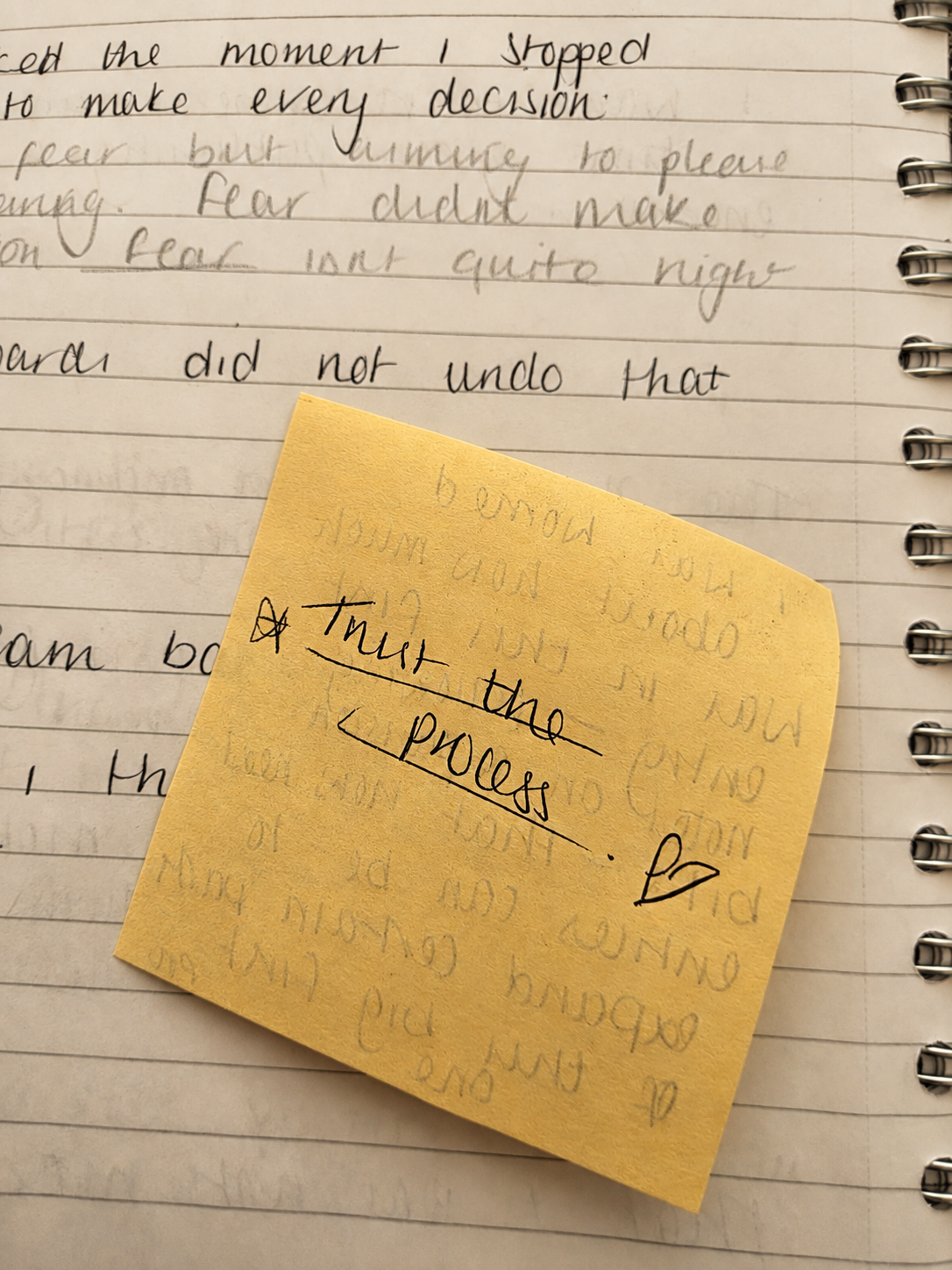
Perhaps it marked the moment I stopped allowing fear to make every decision.
The gap afterwards did not undo that beginning.
I came back.
The writing came back with me.
And this time I think we are learning how to stay.
Press below to keep up to date with this journal and more.
SubscribeIf you know someone this may help, please...
About the Creator
Enjoyed the story? Support the Creator.
Subscribe for free to receive all their stories in your feed. You could also become a paid subscriber, letting them know you appreciate their work.
Comments
There are no comments for this story
Be the first to respond and start the conversation.