
Vladimir Krull on Curved Furniture Taking Over Homes
Rounded sofas, arched mirrors and soft edges, and how to style them.
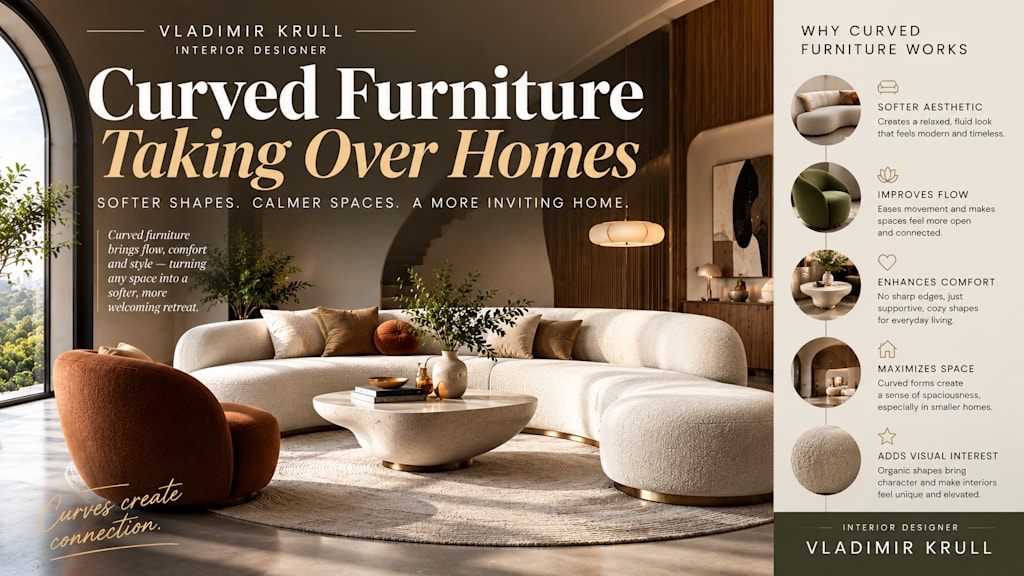
Why Everyone Is Suddenly Talking About Curves
Walk into almost any new furniture showroom today and you will notice the same thing: sharp corners are disappearing. Sofas look like soft clouds, coffee tables are round or pebble shaped, and mirrors arrive in arches. As an interior designer, I get asked about this shift constantly, so let me explain what I see and how I use curves in real homes.
Curves have appeared in design for centuries, so this is more of a return than an invention.
I do not think this is only a passing fashion. It reflects what people want from their living spaces right now: comfort, calm and a gentler feel after years of hard-edged, ultra-modern design.
The Feeling Behind the Shape
Straight lines suggest order and efficiency. Curves suggest ease. When your eye travels along a rounded arm or a circular table, it moves smoothly instead of stopping at every corner. That small difference changes the mood of a room more than people expect.
There is also a practical side. Rounded edges are friendlier in busy households, especially with children, and they help people move through tight spaces without bumping into things. A design that looks soft and also behaves softly is a rare combination.
Where Curves Work Best
You do not need to replace everything. I usually start with the pieces people interact with most.
Sofas and armchairs. A curved sofa can anchor a room beautifully, especially in an open plan where it can define the seating area without a wall. A barrel chair or rounded lounge chair adds a sculptural accent.
Tables. Round dining tables encourage conversation because everyone faces each other. A round coffee table is also easier to walk around than a rectangular one.
Mirrors and arches. An arched mirror or doorway softens a hallway immediately. Even a simple arched alcove for books or art makes a wall feel designed rather than flat.
How to Style Curves Without Overdoing It
The biggest mistake I see is filling a room with only curved pieces. The result can feel sleepy and shapeless. I prefer balance. If you bring in a rounded sofa, pair it with a table that has clean, straight legs or a bookshelf with crisp lines.
Contrast gives each shape a chance to be noticed. A good guideline is to let one or two curved pieces lead and let the rest of the room play a supporting role. That keeps the space lively and gives your eye somewhere to rest.
Think About Scale and Layout First
Curved furniture takes up space differently. A round table needs room on every side, and a large curved sofa can overwhelm a small living room. Before buying, I mark the footprint on the floor with painter's tape and walk around it for a day or two.
Pay attention to walking paths. You want at least a comfortable gap around each piece, particularly near doors and windows. Rounded shapes can actually help in small rooms, because they remove awkward corners, but only when the scale suits the room.
Materials and Textures That Suit Curves
Soft shapes pair very well with tactile fabrics. I often choose bouclé, wool, velvet or heavy linen, because their texture emphasizes the roundness. Smooth leather also looks wonderful on a curved sofa, though it needs more care.
For wood, look for warm, natural tones such as oak or walnut. Rounded edges in wood feel crafted and kind to the touch. Stone and marble also work well on curved tabletops, as long as you accept that they are heavy and need proper support.
Practical Points Before You Buy
Curves can cost more than straight pieces because they are harder to build well. Check the frame, the stitching and how the upholstery sits on the curve. Cheap versions often wrinkle or sag at the bends.
Think about delivery too. A large curved sofa may not fit through a narrow stairwell or door. Measure every access point in advance. It is a dull task, but I have seen lovely pieces returned because nobody checked the hallway.
Mistakes I Would Avoid
First, do not chase the look at the expense of comfort. Sit on a piece for at least a few minutes before you commit, because some sculptural designs look better than they feel.
Second, avoid mixing too many different curves. A round table, an oval rug, a kidney-shaped sofa and a wavy mirror all in one room can feel chaotic. Choose a consistent softness level, and repeat a shape or two on purpose.
Third, remember your lighting. Curved furniture looks best with soft, layered light, such as a floor lamp near the sofa or warm wall lights, rather than harsh overhead bulbs.
My Final Thoughts
Curved furniture is taking over homes because it answers a real need. People want rooms that feel welcoming, flowing and calm. When it is used with care and balanced by a few straight lines, a curve can make a home feel more human.
If you are curious, begin small. Try a round side table, an arched mirror or one rounded chair, and see how the room responds. You may find that a little softness goes a long way.
About the Creator
Enjoyed the story? Support the Creator.
Subscribe for free to receive all their stories in your feed.
Comments
There are no comments for this story
Be the first to respond and start the conversation.