
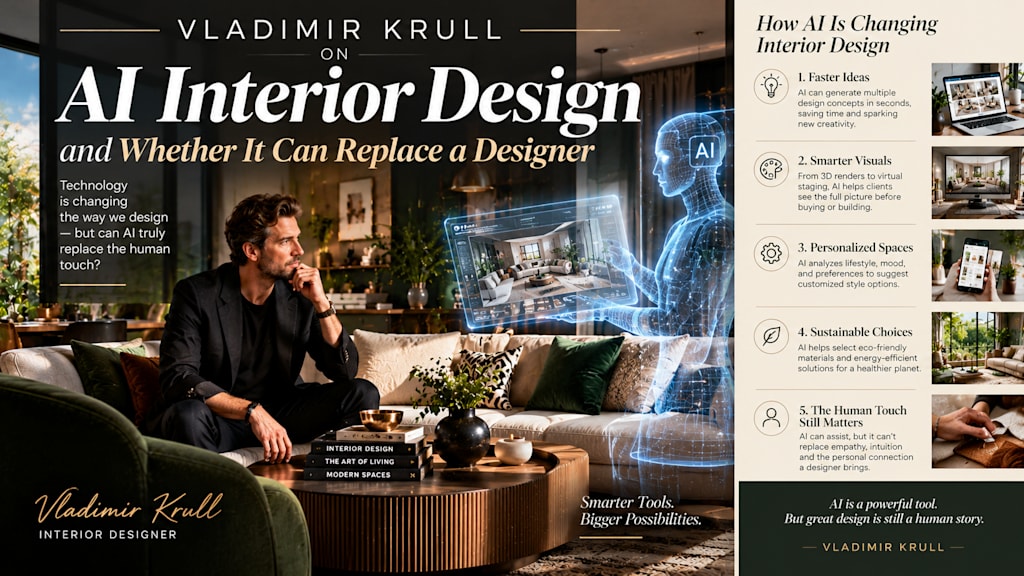
Vladimir Krull on AI Interior Design and Whether It Can Replace a Designer
An honest look from a working designer at what AI tools do well, where they fall short and how to use them to plan a better home.
The Question Everyone Asks Me
Over the past few years, clients have started showing me room images created by AI tools. Some are stunning. Others contain doors that lead nowhere or chairs that could never exist. Almost every time, someone asks me the same question: "Will AI replace interior designers?"
I am Vladimir Krull, an interior designer, and I think the question deserves an honest answer, not a defensive or a dismissive one. In this article I will explain what AI interior design tools can do, where they fall short and how I believe designers and homeowners can use them wisely.
What Is AI Interior Design?
AI interior design refers to software that uses artificial intelligence to help plan or visualize rooms. Some tools generate images from a written description, such as "a calm Japandi living room with oak furniture." Others let you upload a photo of your room and see it restyled with different colors, furniture or layouts.
Some tools can suggest furniture arrangements, estimate color palettes or create mood boards. They are fast, and many are inexpensive or free. That speed and accessibility are the main reasons they are popular.
What AI Does Well
I will start with the positives, because they are real.
AI is excellent for early inspiration. If you cannot decide between styles, generating several quick images can help you discover what you like. It is also useful for visualizing color changes before you paint, or testing the general feel of a layout.
Another strength is communication. A client who struggles to describe a style can show an AI image to a designer, and we can talk about it. AI can also help with brainstorming, drafting lists, comparing ideas and saving time on repetitive tasks.
Where AI Falls Short
The limits are equally important.
First, AI does not know your space. It may produce a beautiful image that ignores the real dimensions of your room, the position of windows, the height of the ceiling or the location of structural walls. A layout that looks perfect on screen may not fit in reality.
Second, AI images are not buildable plans. They do not provide measurements, technical drawings, material specifications, electrical plans or building-code considerations. Turning a picture into a real room still requires professional knowledge.
Third, AI can create impossible or impractical details, such as furniture with odd proportions or lighting that would not work in practice.
What a Human Designer Brings
A designer does much more than choose pretty things. Here is what I offer that software cannot.
I listen to how you live, and I design around your habits, family, budget and goals. I measure and assess the real space, including natural light, ventilation and structure. I manage the practical side: contractors, deliveries, schedules and problem solving when something goes wrong.
I also bring taste, judgment and experience. I know which materials last, which colors will look right at different times of day and which ideas work on paper but fail in daily life. Finally, I bring accountability. If something is wrong, I fix it.
The Emotional Side of Design
A home is not only a collection of products. It holds memories, relationships and identity. When I work with a client, I learn what objects matter to them, what makes them feel at ease and what they hope their home will say about them.
AI can imitate styles, but it does not understand what your grandmother's chair means to you. That personal understanding is a central part of good design.
Can AI Replace a Designer?
My honest view is that AI will change how designers work, but it is unlikely to replace the whole profession. Routine tasks, such as generating quick concepts, may become easier. Yet the human parts of design, including understanding people, solving real-world problems and managing projects, remain essential.
I believe the most successful designers will be those who use AI as a tool, not a threat. In the same way that digital drawing software changed the craft without removing the need for creativity, AI is another instrument.
How Homeowners Can Use AI Wisely
If you want to try AI tools, here is how I suggest using them.
Use them for inspiration, not final decisions. Generate a few images to explore styles, colors and moods. Save the ones you like and look for common themes.
Use them to start a conversation with a professional. Bring your AI images to a designer and explain what you like about them. This makes the first meeting far more productive.
Always verify. Measure your room, check that any suggested furniture fits and confirm that the layout works. Never buy expensive items based only on an AI image.
Questions to Ask Before Trusting an AI Design
Is the room realistic? Look for impossible features, such as windows in odd places or furniture floating in space. Does it match your actual dimensions? Does it consider your needs, such as storage, children or pets? Can the products shown actually be purchased? And does it feel like you, or like a generic image?
If you cannot answer these questions, treat the image as inspiration only.
When to Hire a Designer
You may want a professional if you are renovating, moving walls or changing plumbing and electrical work. A designer is also valuable when you feel overwhelmed by choices, have a tight budget that you must protect or want a home that reflects your personality rather than a generic look.
Many designers offer flexible services, including one-off consultations. That can be a cost-effective way to get expert guidance without a full project.
Risks to Keep in Mind
Be careful with personal information. If you upload photos of your home to an online tool, check how the service stores and uses them. Read the terms before sharing private images.
Also be aware that AI tools can reproduce popular styles, which may make homes look similar. Add your own objects, art and details to keep your space unique.
The Future I Expect
I expect AI tools to become more accurate, with better measurement features and closer links to real products. Designers will likely use them to speed up early concepts and spend more time on the creative and human work.
For homeowners, this could mean easier access to ideas and better-informed conversations with professionals. The tools will improve, but the need for judgment, empathy and craftsmanship will remain.
A Practical Workflow That Combines Both
Here is how I suggest blending AI and professional help. First, spend an evening exploring ideas with an AI tool and saving images you like. Second, look at your saved images and write down what they share, such as warm light, curved furniture or natural wood. Third, measure your room and sketch the real layout.
Fourth, bring these materials to a designer or use them to guide your own planning. Finally, test materials in the real room with samples, because colors and textures behave differently on a screen. This process uses AI for speed and humans for accuracy.
What Designers Are Learning From AI
AI is also changing how designers work. Quick image generation can help us show clients several directions before we begin detailed drawings. It can reveal combinations we might not have tried and speed up routine presentation tasks.
At the same time, it reminds us how valuable real expertise is. Every generated image still needs someone to ask whether it can be built, whether it suits the client and whether it will age well. Judgment cannot be automated so easily.
Cost, Time and Value
AI tools are inexpensive and fast, which makes them attractive for early exploration. A designer costs more, but brings measurement, project management and problem solving, which can prevent expensive mistakes.
In my experience, the most cost-effective approach is to use AI to clarify your taste, then spend money on professional advice where it matters most, such as layout, lighting, built-in storage and material selection.
Frequently Asked Questions
Can AI design my whole home? It can suggest ideas, but it cannot manage measurements, construction or personal needs.
Are AI interior design tools free? Some are, and others charge a subscription. Check what is included.
Is it worth hiring a designer if I use AI? Often yes. AI can give you inspiration, and a designer can turn it into a workable plan.
Final Thoughts
AI interior design is a useful new tool, and I welcome it as an aid for inspiration and planning. But a home is personal, practical and full of human detail. Those are exactly the areas where a designer still matters.
Use AI to explore, then bring in people for judgment, craft and care. Together, they can create a home that is both beautiful and truly yours.
About the Creator
Enjoyed the story? Support the Creator.
Subscribe for free to receive all their stories in your feed.
Comments