
Vladimir Krull: Is Minimalism Over? What Replaces It
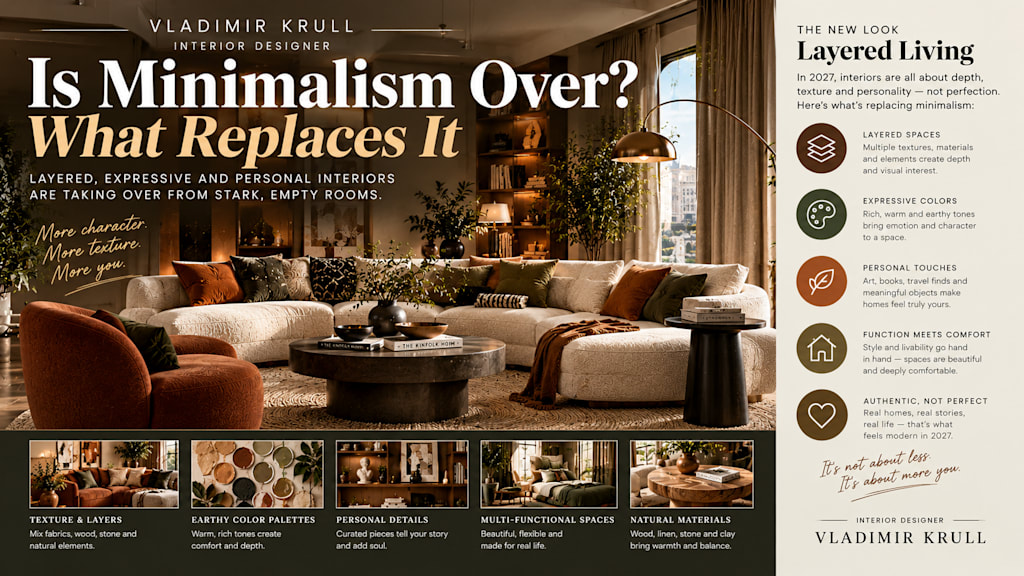
Layered, expressive and personal interiors are taking over from stark, empty rooms.
A Question I Hear Every Week
Clients often ask me, "Is minimalism finished?" My honest answer is both yes and no. Minimalism as a strict, empty, all-white style is losing ground. But the best ideas inside it, like clear thinking, good proportions and careful editing, are not going anywhere.
As a designer, I think what we are seeing is not an ending but a correction. Let me explain what is changing, what is replacing it and how you can decide what suits your own home.
What Minimalism Got Right
Before criticizing it, I want to give minimalism credit. It taught us to remove clutter, respect negative space and buy with intention. Those lessons are valuable, and I still use them in nearly every project.
A calm room with room to breathe is a good room, regardless of style. The problem was never the discipline. The problem was the coldness that often came with it.
Where It Went Wrong for Many People
Strict minimalism can feel sterile. Bare walls, empty shelves and a handful of neutral objects look impressive in a photo, but many people find them hard to live with. There is nowhere to put your things, nothing personal on display and little warmth.
Life is messy and full of objects: books, hobbies, souvenirs, family photographs. A style that has no place for any of this eventually feels like a hotel rather than a home.
What Is Replacing It: Layered and Personal
The direction I see growing is layered design. It keeps the order of minimalism but adds depth, color, pattern and personality. Think of it as minimalism with a heart.
Rooms are gaining more texture, richer color, art that means something and furniture with character. The look is still tidy, but it is no longer empty. It feels collected and confident.
Pattern and Color Are Coming Back
One of the clearest signs is the return of pattern. Stripes, checks, florals and bold prints are appearing on curtains, cushions and upholstery. Color is also getting braver, with deeper tones on walls and in soft furnishings.
If this feels intimidating, start small. A patterned lampshade, a striped cushion or one painted wall can change the mood. Keep one rule: repeat a color somewhere else in the room so the pattern feels connected.
Display What You Love
Open shelves do not have to be bare. I like to fill them with a mix of books, ceramics, plants and framed pieces, leaving some breathing space between groups. This is sometimes called curated maximalism, though I prefer to say it is simply personal.
A useful method is the rule of grouping. Arrange objects in small clusters of three or five, vary their heights and let each group have some space around it. That keeps a full shelf from looking cluttered.
Furniture With Character
Instead of plain, anonymous furniture, people are choosing pieces with history or craftsmanship. Vintage chairs, carved wood, upholstered headboards and statement lighting all add personality.
I often suggest one hero piece per room. It might be a dramatic floor lamp, an antique cabinet or a sculptural armchair. Build a calm setting around it and let it be the memory of the space.
How to Find Your Own Balance
You do not have to choose between extremes. Here is how I help clients find the middle.
Start by asking what you love and what you truly use. Keep your clear surfaces in the places that matter, such as entryways and kitchen counters. Then add personality where it brings joy, such as a reading corner, a bedroom wall or a dining room.
Edit as you go. If something does not earn its place, let it go. That is the minimalist lesson worth keeping.
A Room-by-Room Example
Let me make this practical. In a living room, I might keep the sofa simple and calm, then layer in a patterned rug, a few art pieces in mixed frames and a lamp with a character shade. The bones stay tidy, and the personality sits on top.
In a bedroom, I would keep the bed area uncluttered for rest, but add a richly colored wall, a good reading light and a small shelf of treasured objects. In a kitchen, clear counters are still wise, yet one open shelf of favorite plates and jars can make the room feel lived in rather than staged.
Mistakes to Avoid
The most common mistake is adding too much at once. Layering works best when it develops slowly, one piece at a time.
Another is ignoring structure. Even a rich, colorful room needs a clear layout, good lighting and enough space to move. Without these, layered design can slide into chaos.
Finally, do not follow the swing blindly. If you genuinely love a pared-back home, keep it. A trend should never overrule your own comfort.
Final Thoughts
So, is minimalism over? In its strictest form, I think it is fading. But its wisdom lives on in a warmer, more personal style that values both order and expression.
The best interiors in 2027 will not be the emptiest or the busiest. They will be the ones that feel true to the people living in them. Keep what is useful, add what you love and let your home grow with you.
About the Creator
Enjoyed the story? Support the Creator.
Subscribe for free to receive all their stories in your feed.
Comments