
They Said You Have to Be Mean to Pass a Big Tech Interview. Here's What the Interview Is Testing.
A new grad got called mean in the break room. The answer is not what the complaint suggests.
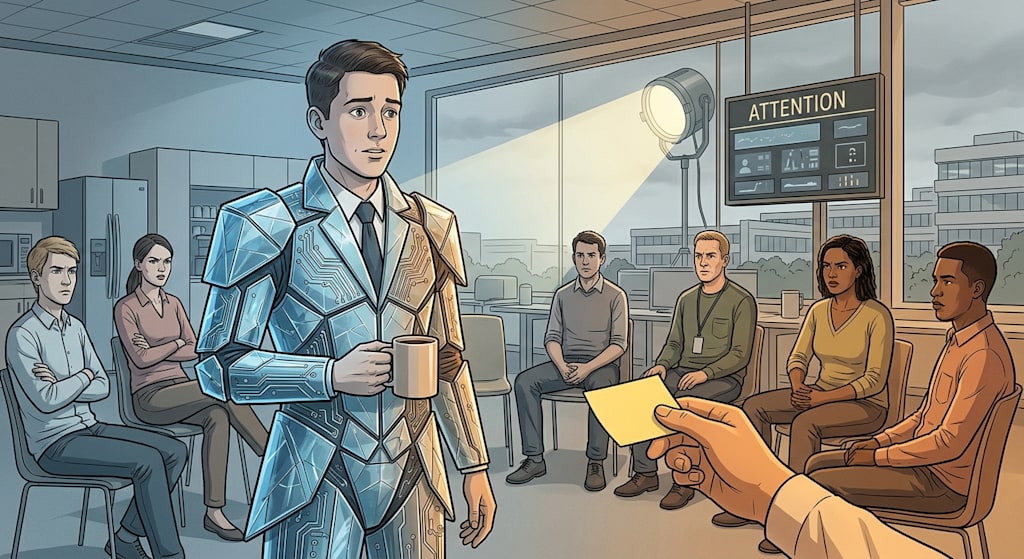
The weekly meeting had just ended when someone set a mug down in the break room. It wasn't loud, but it was enough to make a few people look up.
"What's wrong with the new grad? First sentence out of his mouth is 'This proposal doesn't hold up logically.' Then it's 'The metric definition is wrong.' He cuts people off before they're even finished. He's been here a few days. Why is he so mean?"
Someone next to them laughed, half joking, half serious: "You can't get through the interview unless you're mean."
That sentence is a needle. It pops a lot of default assumptions. It isn't accurate, but it pokes at a mismatch: the traits that get rewarded in an interview can become the traits people hate in the workplace.
The new grad may not be a bad person. He may just have worn his interview armor straight into the office. An interview is a forty-five-minute high-pressure game. Work is a long run measured in years. Armor keeps you alive on the battlefield. In the living room, it looks out of place.
So the question is: What is Big Tech selecting for? Is it selecting for "mean"? Or are we mistaking a filtered kind of sharpness for a defect of character?
Why interviews favor strong signals
An interview is not an exam. Exams have correct answers. Interviews do not. The interviewer usually doesn't have a scorecard that says right or wrong. They have a pile of fuzzy signals. They watch for whether someone can carry responsibility, make a judgment with incomplete information, stay calm under challenge, explain a complex problem clearly, and work with others to push something forward.
All of that has to be seen in a short time.
So interviews naturally favor strong signals.
Politeness, humility, gentleness, and taking care of the room are good qualities, but they are quiet. So quiet that in a forty-five-minute conversation, they are easy to miss. By contrast, a clear opinion, a well-supported argument, staying calm under pushback, asking about assumptions, and being willing to say "I disagree" are highlighter signals. They are like a fluorescent marker in the dark. The interviewer sees them immediately.
In organizational behavior, there is a much-discussed phenomenon: when assessing potential, evaluators tend to associate "willingness to challenge the status quo" with "innovation potential." That is because innovation often begins with a question: Why does it have to be this way? If someone nods along from beginning to end, the interviewer cannot tell whether they have no ideas or are simply afraid to speak.
So the interviewer is not looking for "mean." They are looking for the ability to think with high quality under pressure and to dare to say that thinking out loud. But in the short, concentrated setting of an interview, that ability easily presents as sharpness. And sharpness, once it leaves the interview room, can be experienced as offense.
Why Big Tech especially favors this kind of sharpness
The industry Big Tech lives in is a giant attention machine.
The core product of an internet company is not a high-speed train, not a power grid. It is attention, topic, growth story, valuation narrative. It needs new things constantly. It has to get ahead of others. And it must prove it is still relevant before the market decides it isn't. A few months without new work, or new work that isn't striking enough, and public opinion starts writing your obituary. The more successful you were before, the higher the expectation for the next thing.
In that environment, stability is the floor, not the selling point. Breakthrough is oxygen.
Breakthrough often comes from people who are not entirely settled. They are not satisfied with "this is how we've always done it." They say, "This logic has a problem." They ask, "Why can't we change the metric definition?" They keep insisting on their judgment even when everyone else thinks the plan is already settled. These people are not always liked on a team, but they are often the ones who drag a project out of mediocrity.
So Big Tech's tolerance for sharpness is higher than that of many traditional industries. It may even believe that people with breakthrough talent need a certain arrogance, a certain looking down on everything, a certain "I am the best and I am absolutely right" energy. As for the team's emotional cost and long-term mental health, the company is confident it can compensate with high pay. It believes no one will give up such generous treatment and such a highlight on their résumé over a few sharp words.
This logic has its reasons. It also has its price.
"Mean" is not the same as "selected"
"You can't get through the interview unless you're mean" is a serious misreading.
It equates "being selected" with "being mean," and "being mean" with "being able to pass the interview." Most people who pass at a high rate are not unpleasant. They are "sharp but measured."
Interview evaluators know the difference. Some will say plainly: "Some candidates are very argumentative, and then you know they won't be good collaborators." The negative case they describe is a candidate who repeatedly tells the interviewer, "That's not the right method," "My method is better," and then gets into an argument, determined to win.
That person is not being evaluated for ability. They are being evaluated for risk.
The expression that earns points is evidence-backed persistence. For example: "I have reservations about that conclusion because the data definitions are different." Not: "Your claim doesn't hold up." The former puts the problem in the center of the table. The latter puts the person in the crosshairs. The former is professional. The latter is offensive. When the interviewer pushes back, give your assumptions, your data sources, and your boundary conditions, and explain how you would adjust if the premise changed. That proves ability better than a hard tone.
The interview does not select for "mean." It selects for people who can stay logical under pressure and communicate judgment effectively. Sharpness is the surface. Professionalism is the core.
Interview persona and workplace persona are two systems
There is a subtler mismatch here: the interview persona and the workplace persona are two different systems.
An interview is a one-shot game. You and the interviewer may meet only once. In that hour, you have to build an impression quickly, be remembered, and prove in limited information that you are worth betting on. So many people unconsciously enter a state of high aggression and high defense: faster speech, harder opinions, more interruptions, fewer smiles.
Work is a repeated game. You will have many meetings with the same people, make many decisions, share blame, and carry deadlines. In a repeated game, cooperation, trust, emotional stability, and awareness of other people's situations become long-term assets. In a one-shot game, hardness may be optimal. In a repeated game, only hardness will go bankrupt.
The new grad being complained about may not have become bad. He just hasn't switched systems. He wore his interview armor into the office and mistook "proving myself" for "overpowering others." He doesn't know that what the interviewer admired as "challenging the status quo" can look to colleagues like "not leaving people any room," and what the interviewer liked as "insisting on your view" can look in cross-team collaboration like "not listening to anyone."
Sharp toward the problem, gentle toward the person. Those eight words are easy to say and take time to do.
High pay can compensate for emotional cost only up to a point
Big Tech uses high pay to compensate for emotional cost. There is a limit.
Money can buy endurance, but it cannot buy engagement. Someone who has been offended may not quit, but they will go silent. They stop telling the truth in meetings. They stop stepping in voluntarily. They stop treating the project as their own. They are still at their desk, but they have mentally checked out. This loss does not show up in the financial report, but it slowly eats away at the team's creativity.
More troublesome: if an organization rewards "the squeaky wheel" for a long time and punishes "the person who considers the greater good," the people who remain will increasingly resemble the squeaky wheels. Gentle people will either be assimilated or leave. The team atmosphere worsens, and projects become more mediocre. Because when a breakthrough is needed, no one dares to say "I don't know," no one dares to admit "this direction may be wrong," and no one dares to take risks in an environment with insufficient psychological safety.
Big Tech logic contains a contradiction: to achieve breakthroughs, it tolerates and even rewards sharpness. But excessive sharpness destroys the psychological safety that breakthroughs require. The attention economy needs edge. Long-term organizations need trust.
The AI race intensifies the tendency
In recent years, the AI race has intensified this tendency.
AI changes fast. Uncertainty is high. Talent density is high. A model released today may be surpassed next month. A team that is ahead today may have to prove itself again tomorrow. In that rhythm, "dare to speak," "dare to charge," and "dare to make a judgment" become hard currency. Companies do not want new people to suppress their ideas because they are polite and introverted, or to be unable to accept even a small delay.
But the more this is true, the more it is necessary to distinguish "fast" from "sloppy," "confidence" from "attack," and "persistence" from "stubbornness." The AI race is not a contest of who has the loudest voice. It is a contest of who can keep making correct judgments. And sustained correctness often requires listening, revising, collaborating, and admitting mistakes. Those abilities are the opposite of "mean."
If you are naturally gentle, you do not have to act aggressive
If you are naturally gentle, you do not have to force yourself to act aggressive.
Many roles need people who can explain things clearly, make collaboration work, and break down complex problems. Pretending to be aggressive will only make you more miserable after you join. You can practice "evidence-backed persistence" in interviews instead of imitating "mean."
For example, when an interviewer challenges your proposal, you can say: "I understand your concern. My assumption is... the data shows... if the premise changes, I would adjust it to..." That is not weakness. That is professionalism. It shows both your judgment and your openness.
At the same time, reallocate your preparation time. Do not put all your energy into grinding practice problems. Behavioral interviews matter just as much. Prepare a few stories and tell them clearly with the STAR structure: What complex problem did you encounter? What judgment did you make? What was the result? What did you learn? The interviewer does not want to hear how impressive you are. They want to hear how you push things forward under uncertainty.
Finally, look for cultural fit. Different companies and teams have very different cultures. Some worship "radical candor." Some put values first. Some emphasize "disagree and commit." You cannot change your underlying temperament, but you can choose an environment that suits it better.
Organizations need to look in the mirror too
Organizations need to look in the mirror too.
If interviews keep selecting for "mean," who pays the team cost? Interviewers need training. They need to learn to distinguish confidence from aggression, and challenging the status quo from belittling others. Do not reward interruptions. Do not reward contempt. Do not reward turning a meeting into a personal show. Reward the people who can make the problem clear and make others willing to speak as well.
The attention economy needs edge, but long-term organizations need trust. A healthy team is not one without conflict. It is one that can still get things done together after conflict. The best candidate is not the person who wins the most. It is the person who helps the whole team win.
Back to the break room
Back to that break room.
The new grad may still speak up in the next weekly meeting. He may still point out the logical hole in the proposal. He may still ask about the metric definition. But maybe he will wait for others to finish first. Maybe after pointing out the problem, he will add: "That's just my read. We can look at it together."
Sharp toward the problem, gentle toward the person. Firm in judgment, open to the unknown.
Big Tech interviews have never selected for "mean." They select for people who can still think with high quality under pressure and communicate that thinking effectively. Sharpness is a tool, not a personality. The armor you wear in the interview room has to come off in the workplace.
The mug is still on the counter. Next meeting, it will be picked up and put down again. So will people.
About the Creator
Jin
Writer of reamstories
https://reamstories.com/jin
Enjoyed the story? Support the Creator.
Subscribe for free to receive all their stories in your feed. You could also become a paid subscriber, letting them know you appreciate their work.
Comments
There are no comments for this story
Be the first to respond and start the conversation.