
They Cut Our Piece Rate and the Whole Shop Floor Started to Die
I've spent 35 years as a production supervisor in this Japanese-owned factory. The payroll sheet shows what the boss saved. It doesn't show what walked out the door.
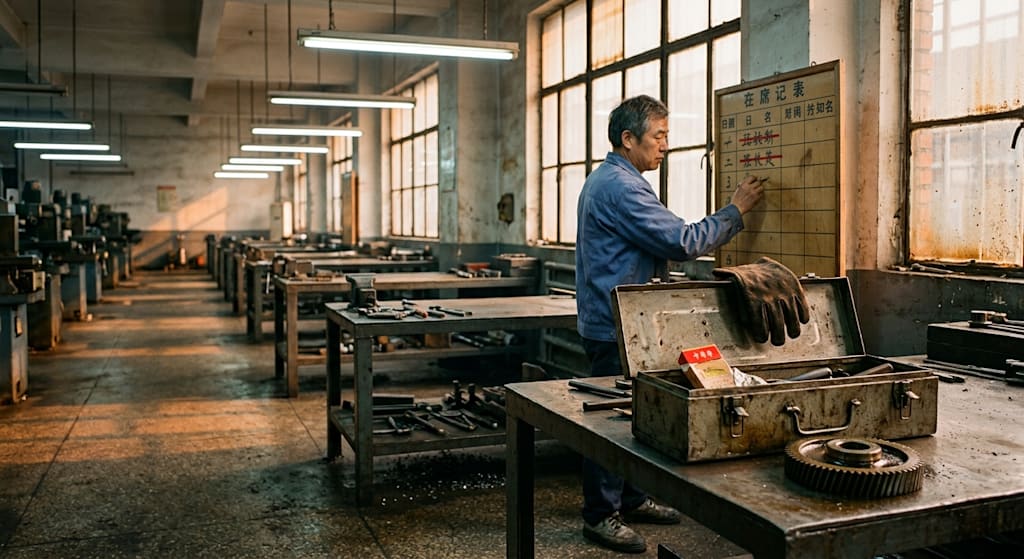
At 7:20 on the morning shift, the fluorescent lights in the workshop were already buzzing. The smell of cutting oil sat in the air. I stood by the notice board with the attendance sheet, and when I read the names, I paused at two empty spots.
Old Zhang's station was empty. The second spot, a younger man who had been here less than three months, was also empty. Nobody said anything. The men who were there kept their eyes on their benches. They knew what the empty spots meant. I knew too.
I have spent thirty-five years in this factory. I started as an apprentice and ended up as the production supervisor. I have seen good years and bad years. But lately I have been waking up in the middle of the night, reaching for my phone, checking the workshop group chat. Nobody says anything at that hour. But I know which station will be short in the morning, and I know I may have to cover it myself.
The Japanese side keeps the delivery dates tight. The boss keeps calling meetings and saying the same thing: cut costs, improve efficiency. In the end, the knife landed on the piece rate in the workshop.
The boss's logic is simple. If the piece rate is lower, the wage bill is lower. If the wage bill is lower, cost is lower. He looks at the payroll sheet and sees the number go down. He does not see what goes up.
The boss's arithmetic and the workshop's arithmetic
In hardware manufacturing, labor is usually only 15 to 25 percent of total cost. Material is 50 to 70 percent. Cutting the piece rate looks like a direct cut in wages, but it replaces a small and relatively controllable variable with several much harder ones: experienced workers leaving, defect rates rising, delivery penalties, recruitment and retraining costs.
Fixed piece-rate factories average defect rates of 3.5 to 5 percent. Manufacturing overall averages 1 to 2 percent. When the piece rate drops, the men who stay are not stupid. They do the math. If they cannot earn more by being careful, they earn more by being fast. Fast means skipping the caliper check. Fast means not waiting for the first-piece confirmation. Fast means tossing a part into the finished bin and hoping it passes.
Old Zhang used to measure every part with his calipers before putting it in the bin. After the rate cut, he stopped measuring. I asked him why.
He said, "Why measure it? It's not worth that money anymore."
That sentence was a calculation. And when a man like Old Zhang calculates that way, the scrap rate starts to climb.
The payroll sheet saves a few tenths of a yuan per piece. The scrap bin eats the material. The rework bench eats the hours. The delivery date eats the customer's patience. The money saved on the piece rate gets eaten back, and sometimes more than eaten back. This is the account I needed to put in front of the boss. As a number, not a complaint.
Why Old Zhang left
Old Zhang had been here for more than ten years. He was not afraid of hard work. He had been through slow months before. What he could not accept was that his skill had suddenly been repriced.
An old master's value is not in hand speed. His value is in setting the mold, judging the abnormal sound of the machine, holding the difficult process steady, teaching the young ones, and knowing which bearing is dry before it seizes. None of that shows up on the payroll sheet. None of it fits into a piece rate.
When the rate dropped, Old Zhang sat on his toolbox after the shift and punched numbers into his phone for a long time. He did not come to my office. He did not argue. The next morning, his badge was on the bench. His half-pack of cigarettes was still in the toolbox drawer. His worn glove was folded on top of it.
A gear can be replaced without the other gears noticing. A man leaves a hole that the next man has to stand in, and the men beside him watch how he was treated.
That is the part the payroll sheet does not show. The men who stayed saw Old Zhang leave. They saw the company do nothing. They drew their own conclusions.
And the new hires? Two young men came last week. They looked at the workload, asked how much they could make in a day if they worked fast, and I told them the truth. One of them nodded, went to the toilet, and did not come back. The other lasted half a day.
So now the workshop is losing one man at a time. The old workers will not stay. The young workers will not come. And when the delivery date slips, the production department gets the blame.
I understand the factory is under pressure. But this is not a sustainable way to relieve it. If we keep going, we will run out of people before we run out of orders.
Stop the bleeding first
The first thing is to keep the men who can still do the work. If there are a few old masters left, the delivery dates can still be held. If they all leave, no number of new hires will save the line.
There are three tools I can push within my authority, even if I cannot overturn the boss's decision on the piece rate.
1. Piece rate plus a floor
For a hardware factory with fluctuating orders, "piece rate plus a floor" is a mature practice in the industry. If the monthly piece-rate calculation falls below the floor, the worker is paid the floor. If it exceeds the floor, the worker is paid the actual amount.
The floor does not have to return to the old rate. But it has to be high enough that an old master does the math and concludes that the worst case is not far below what the nearby factories pay. The purpose is to cut off the expectation that "working is worse than not working." Once that expectation takes hold, no one stays.
Changing pay terms unilaterally is also legally risky in China. Pay is a key term of the labor contract. A change requires consultation. The boss may think adjusting the piece rate is a management prerogative. In law, it is not. I cannot say that in the meeting, but I can use it as a reason to restructure rather than simply cut.
2. A quality coefficient
The current problem is that the rate cut rewards speed and punishes care. The workers compensate by rushing, and the scrap rate eats the profit. The fix is to hang a quality coefficient on the piece-rate wage.
For example: first-pass yield at 99.5 percent or above, multiply by 1.05. From 98 to 99.5, multiply by 1.0. From 96 to 98, multiply by 0.95. Below 90, multiply by 0.7 and require mandatory quality training.
This redirects money that is already being wasted on scrap and rework back into doing it right the first time. Some hardware factories that connected quality metrics to piece-rate incentives moved their first-pass yield from the mid-70s to the mid-90s. The money is leaking through the scrap bin, and the coefficient plugs the leak.
Old Zhang's part that he stopped measuring? Under the new coefficient, if his first-pass yield falls below 96, his wage for that piece is multiplied by 0.95. He only has to calculate once to see that not measuring costs him more than measuring.
3. A skill allowance for old masters
An old master's value is in mold setting, abnormal judgment, holding the difficult process, and training the young ones. Give them a monthly skill allowance that does not fluctuate with output. For junior to senior technicians, the range can be roughly 100 to 1,500 yuan per month.
On the books, this is a "skill allowance." To the boss, it can be explained as a fixed small expense to retain the people who prevent large scrap losses and line stoppages. At the same time, put team turnover into the team leader's KPI. If the leader's team loses people, the leader carries the consequence. Retention responsibility should sit with the person who directly leads the men.
The lean lever that actually works
I have spent thirty-five years in a Japanese-owned factory. I know that Japanese lean manufacturing does not start by taking a few cents off the worker's piece rate. The core of lean is to have the people on the floor think about how to shorten work time and eliminate wasted steps. Management pressing the rate down and calling it efficiency is something else entirely.
The targets are the seven wastes. The tools are simple automation and work combination. The goal is to raise efficiency, not to lower the rate.
In a hardware workshop, the invisible black holes are easy to find: searching for material, moving material, waiting for material, mold change and adjustment, sorting rework, looking for tools. None of these hours are paid by the piece. None of them produce a part. But the workers spend real time on them. Why did the old masters leave? The rate was lower, yes. But at the same rate, they were also doing more useless work, and the effective output per hour was being eaten by a messy floor.
Pick the line with the worst turnover and the highest defect rate. Give it two weeks. Do material kitting, simplify the changeover flow, move the first-piece confirmation forward. The goal is to let the same man, at the same piece rate, produce 10 to 15 percent more effective output in a day. Not to make him work harder. To make his hours count.
Last year, Old Li on the press line proposed a change to the mold locating pin. He added a chamfer. The changeover time dropped from forty minutes to twenty-five. It did not cost a single cent in piece rate. On a line that changes molds twice a day, fifteen minutes saved each time is thirty minutes a day. Over thirty days, that is fifteen hours. At sixty parts an hour, that is nine hundred parts. You can do the rest of the math yourself.
That is the kind of cost reduction that does not leave an empty station at roll call.
How to talk to the boss
The boss cuts the piece rate because he is staring at the payroll sheet. My job is to put the hidden costs of that cut on the table in the language he understands. Not "the workers are unhappy." Not "morale is low." Money.
I would use three parts: current situation, key impact, two options.
"Boss, after the rate cut, we lost X experienced workers. The defect rate went from A to B. At our current monthly output of N pieces, the extra scrap material and rework hours come to about M yuan. On delivery, we already have Y batches at risk. By the customer's penalty clause, that is Z yuan. The money we saved on the piece rate has been eaten back by scrap and delivery risk, and then some."
Then give him two options. Do not wait for him to solve it.
The first is the stop-bleeding option. Restore a floor or add a skill allowance for the key processes, and put in the quality coefficient. Hold the defect rate and delivery dates first. The cost is limited, but it stops the bleeding immediately.
The second is the surgery option. Do not change the piece rate. I lead the floor in removing wasted labor. Use efficiency gains to absorb labor cost. In three months, report on output per person and unit labor cost.
The key is to shift the metric from "wage rate" to "unit labor cost" and "output per person." In hardware, labor cost is about 35 percent of revenue on average, and only 15 to 25 percent of total cost. Even if you cut the piece rate by 10 percent, the effect on total cost is far smaller than the boss imagines. But if the defect rate rises two points, or one delivery penalty hits, the profit lost can be several times that.
The boss understands that math. He just has not had it put in front of him.
If he still will not listen in the short term, I can at least push the quality coefficient and the floor for the key processes within my own authority. And I can build the comparison data from that one line. With data, I have something to put on the table in the next meeting. Without data, I am just another supervisor complaining about people leaving.
The empty station
Tomorrow at 7:20, I will stand by the notice board again with the attendance sheet. The fluorescent lights will buzz. The cutting oil will smell the same. I will read the names, and I will pause at the empty station.
If nobody has filled it, I will cover it myself. Thirty-five years in this factory, and I can still run that station.
But one man can only cover one station. The question is how many more mornings I will have to pause at the sheet before the boss sees what the payroll sheet does not show.
A gear can be replaced. A man leaves a hole. The men beside him are watching.
About the Creator
Jin
Writer of reamstories
https://reamstories.com/jin
Enjoyed the story? Support the Creator.
Subscribe for free to receive all their stories in your feed. You could also become a paid subscriber, letting them know you appreciate their work.
Comments
There are no comments for this story
Be the first to respond and start the conversation.